


A high-risk merchant account is a specialized payment processing account designed for businesses that card networks and banks consider to have elevated financial or regulatory risks. It could be due to industry type, chargeback history, or business model. This classification allows companies to accept credit card payments even when traditional processors decline them.
Getting labeled high-risk doesn’t mean your business is illegitimate. It means processors see factors that increase their potential exposure. This guide covers what triggers the designation, which industries qualify, and how to protect your account once you have one.
How a High-Risk Merchant Account Works
Every business that accepts cards works with an acquiring bank. That bank holds the merchant account and processes transactions on the business’s behalf. When the acquiring bank decides a business carries above-average risk of chargebacks, eCommerce fraud, or regulatory issues, it assigns the high-risk label.
The designation isn’t a judgment on whether your business is legitimate. Plenty of compliant companies operate in industries that processors view as riskier due to factors outside the merchant’s control.
One of the primary features of high-risk eCommerce merchant accounts is their ability to handle a wide range of payment methods securely. This diversity is essential for global eCommerce businesses that need to accept payments from different countries and currencies. It ensures a seamless shopping experience for their customers. Additionally, these accounts come equipped with advanced fraud detection tools, such as real-time transaction monitoring and automated alerts, to safeguard against fraudulent activities.
Furthermore, high-risk eCommerce merchant accounts often offer tailored customer support and risk management services. This support is crucial for merchants who need expert guidance to navigate the complexities of high-risk transactions.
How a High-Risk Merchant Account Differs From a Standard Account
High-risk accounts come with different terms than standard merchant accounts. The differences reflect the additional exposure processors take on. The elevated fees and reserve requirements exist because processors face greater potential losses. If a high-risk merchant suddenly closes or racks up excessive chargebacks, the processor may be left covering refunds and fines.
Unlike standard accounts, high-risk processors frequently enforce rolling, up-front, or capped cash reserves. This is to insulate themselves from sudden volume spikes or business closures. Furthermore, a single merchant account migration into a high-risk monitoring program can tack on an estimated $25 in long-term account risk penalties per dispute.
What Makes a Business High-Risk
Businesses are categorized as high-risk for various reasons, often based on factors such as industry type, transaction volume, or business model. Industries with a history of elevated chargeback rates, such as eCommerce, travel, and subscription services, are frequently labeled high-risk due to the increased likelihood of disputes between customers and merchants.
Another significant reason businesses might be considered high-risk is the nature of their customer base and transaction methods. If your business operates internationally or deals with high-value transactions, this can increase the complexity and risk of fraud. This may lead to the high-risk designation. Moreover, new businesses or those with poor credit histories may also be classified as high-risk due to perceived instability or lack of financial track record.
Industries Commonly Classified as High-Risk
Certain industries face increased fraud exposure due to transaction patterns, refund rates, or regulatory complexity. Without tailored fraud prevention strategies, businesses in these sectors risk significant financial losses, reputational damage, and potential regulatory penalties.
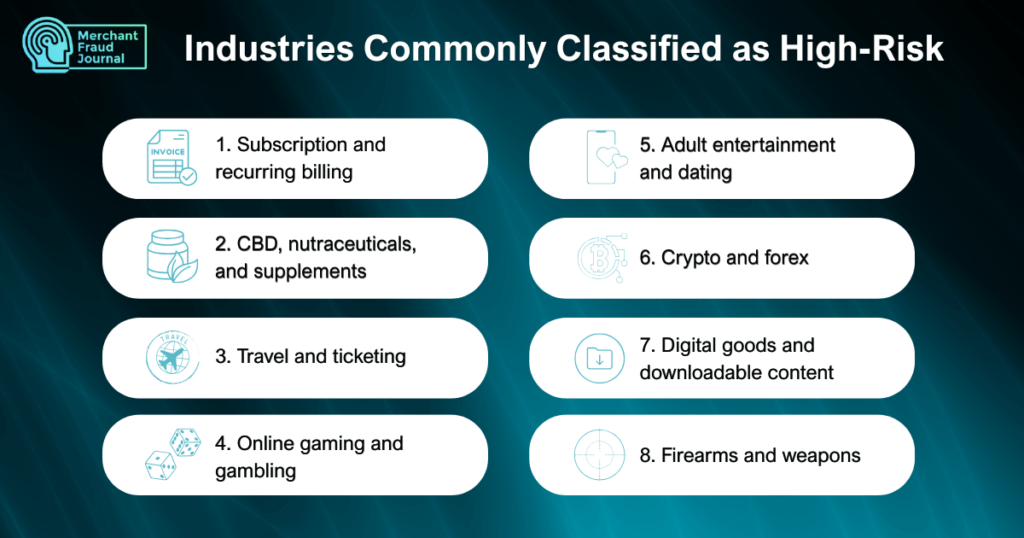
1. Subscription and recurring billing
Subscription businesses are particularly vulnerable to billing disputes and subscription trap claims. Cardholders who forget they signed up, or who experience buyer’s remorse after a free trial converts to paid, frequently file chargebacks rather than canceling through proper channels. Proactive communication strategies, such as sending automated renewal reminders a few days before charging the card, can significantly lower these accidental disputes.
2. CBD, nutraceuticals, and supplements
Regulatory gray areas and high return rates make this sector attractive for both legitimate disputes and outright fraud. Merchants operating in this space frequently face chargeback rates well above the industry-standard threshold, often driving processing fees up significantly. Securing a specialized payment processor that understands these strict compliance guidelines is essential for long-term business stability.
3. Travel and ticketing
Long fulfillment windows between purchase and service delivery create significant dispute opportunities. A customer who books a flight six months in advance has plenty of time to change their mind or claim they never authorized the transaction. Extended delays between payment and delivery naturally lower customer recall, often leading to accidental friendly fraud when the unfamiliar charge finally appears on a statement.
4. Online gaming and gambling
Age verification issues, impulse purchases, and buyer’s remorse drive high chargeback rates. Players frequently dispute legitimate charges after losing a wager or regretting an in-game microtransaction. Operators must establish crystal-clear refund policies and strict identity checks to effectively mitigate these revenue losses.
5. Adult entertainment and dating
Discreet billing requirements and high “I didn’t authorize this” claims from shared cardholders make this industry notoriously difficult to protect. Subscription-based models heavily used in these sectors routinely suffer from buyers forgetting their ongoing enrollments and initiating immediate disputes. High-risk merchant accounts in this space consequently require robust authentication protocols to verify user identities at the point of purchase.
6. Crypto and forex
Volatile markets, regulatory uncertainty, and irreversible transactions attract both sophisticated fraudsters and customers who regret their trades. Frequent price swings often trigger a surge in buyer’s remorse. This may result to users to falsely claim unauthorized activity to reclaim their funds. Payment processors routinely place these industries into ultra-high-risk categories to shield themselves from the massive volume of chargebacks and rolling legal battles.
7. Digital goods and downloadable content
Proving delivery of intangible products presents unique challenges. When a customer claims they never received a digital download, merchants often lack the physical proof that would win a dispute. Compiling detailed digital footprints, such as server download logs, IP addresses, and timestamps of user activity, serves as the critical evidence needed to validate fulfillment to payment processors.
8. Firearms and weapons
Legal restrictions vary by jurisdiction, and many banks avoid the reputational concerns associated with firearms sales. Strict compliance monitoring is required for every transaction to avoid immediate account termination. Merchant processors often impose rolling cash reserves on these businesses to insulate themselves from sudden regulatory shifts and shifting legal liabilities.
Benefits of Using a High-Risk Merchant Account
For businesses operating in challenging industries, a high-risk merchant account provides the infrastructure needed to process payments securely and efficiently. Even in sectors prone to elevated chargeback rates and fraud, the right account keeps operations running without costly payment disruptions.
- Secure payment processing: High-risk accounts are built to handle the unique demands of complex industries, ensuring transactions are processed reliably regardless of sector-specific risks.
- Advanced fraud prevention: Real-time transaction monitoring, fraud detection algorithms, and robust chargeback management tools work together to reduce financial losses from fraudulent activity.
- Chargeback protection: Built-in chargeback management protocols help merchants stay within acceptable dispute thresholds, protecting both revenue and processor relationships.
- Enhanced business credibility: Maintaining a dedicated high-risk account signals to customers and partners a commitment to secure, reliable payment processes, which builds confidence and encourages repeat business.
- Scalability and growth support: High-risk accounts accommodate growth, giving merchants the flexibility to expand into new markets or scale volume without outgrowing their payment infrastructure.
A high-risk merchant account is more than a compliance requirement for difficult industries; it is a strategic asset that protects revenue, strengthens customer trust, and supports long-term growth. Merchants who treat their account as a foundation for sound financial operations are better positioned to scale confidently and weather the challenges of high-risk commerce.
High-Risk Merchant Account Instant Approval: Is It Possible?
The concept of instant approval for high-risk merchant accounts is appealing to many businesses looking to streamline their setup process. However, it’s important to understand that instant approval is not always feasible due to the complex nature of high-risk industries and the thorough assessment required by providers to mitigate potential risks.
While some providers may advertise instant approval, it’s essential to approach such claims with caution. Genuine approval processes for high-risk merchant accounts involve a detailed evaluation of your business’s financial health, industry classification, and risk profile. This assessment ensures that the provider can offer appropriate fraud protection (e.g., credit card fraud prevention) measures tailored to your business’s specific needs.
To expedite the approval process, it’s advisable to prepare your application thoroughly and provide all necessary documentation upfront. Additionally, working with an experienced high-risk merchant account provider who understands the nuances of your industry can help facilitate a smoother approval process.
Navigating the High-Risk Merchant Landscape
Navigating the high-risk merchant landscape requires a strategic approach and a thorough understanding of the unique challenges and opportunities within your industry. Securing a high-risk merchant account tailored to your business’s needs enables you to enhance your fraud prevention efforts and ensure reliable payment processing capabilities.
Prioritize building strong relationships with reputable high-risk merchant account providers and leveraging their expertise to optimize your fraud prevention strategies. Stay informed about industry trends and regulatory changes, and continuously adapt your approach to maintain compliance and competitiveness.
Frequently Asked Questions
Can a high-risk merchant account become a standard merchant account?
Yes. If a business maintains low chargeback ratios and a clean processing history over time, some processors may reclassify the account or offer better terms. The timeline varies, but consistent performance over 12 to 24 months often opens renegotiation opportunities.
How long does high-risk merchant account approval take?
Approval typically takes longer than standard accounts due to extended underwriting. Expect anywhere from a few days to several weeks depending on documentation completeness and industry complexity.
Are PayPal and Stripe considered high-risk merchant accounts?
No. PayPal and Stripe are payment aggregators with strict acceptable use policies. They typically don't serve high-risk industries and may terminate accounts that exceed their risk tolerance. Businesses in high-risk categories usually require specialized processors.
What is the MATCH list and how does a merchant get removed from it?
The MATCH list is an industry database maintained by Mastercard that tracks terminated merchants. Removal typically requires waiting five years, though merchants can sometimes work with the original acquiring bank to request early deletion if the termination reason has been resolved.

Charity Amancio
Charity Amancio specializes in SaaS solutions for global eCommerce businesses, including payments and risk management applications. She bridges the gap between technology and merchant needs, offering practical perspectives on the tools shaping eCommerce. Her insights appear regularly in B2B publications covering the digital commerce space.
