


Credit card chargeback deadlines depend on the card network, the reason for the dispute, the transaction type, the country or region, and the stage of the dispute. Many card disputes use a 120-calendar-day filing window, but that is not a universal deadline. Certain disputes have shorter windows, while some circumstances allow a dispute to be processed later, subject to the applicable network rules.
Once a dispute is filed, you typically have 20 to 45 days to respond, depending on the card network, and your acquirer may give you even less. Visa, Mastercard, American Express, and Discover each set their own windows for filing, responding, and escalating a dispute, and some reason codes stretch the cardholder window to as long as 540 days.
Disclaimer: The timeframes in this guide are general orientation, not a substitute for the current network rules or the deadline displayed for an individual case. Network rules change, and regional rules may differ.
How the Credit Card Chargeback Time Limit Works
Every chargeback runs on two separate clocks. The first is the cardholder filing window, which controls how long a customer has to ask their issuing bank to reverse a charge. The second is the merchant response window, which controls how long you have to accept the chargeback or fight it with evidence. A third set of deadlines applies if the dispute escalates to pre-arbitration or arbitration.
The Cardholder Filing Window
Many common disputes have a 120-calendar-day time limit. For example, Visa’s rules provide a 120-day limit for many dispute conditions, and for certain merchandise- or service-not-received disputes the period can be measured from the expected delivery or service date. The precise trigger and any exceptions depend on the dispute condition.
Visa allows 75 days for certain authorization-related disputes, and Mastercard limits authorization-related chargebacks to 90 days and installment billing disputes to 60 days. Other cases, such as disputes over ongoing services, can extend the chargeback window to a maximum of 540 days from the transaction date.
Mastercard, American Express, and Discover also have their own dispute rules. Do not assume the same filing window applies to every reason code across all four networks.
The Merchant Response Window
Deadlines can differ by network, reason code, dispute stage, region, and processor. For example, American Express tells merchants to respond by the case’s displayed reply-by date; its U.S. merchant regulations set out the applicable inquiry and chargeback procedures.
Mastercard’s merchant guidance describes a 45-calendar-day period for certain second-presentment procedures, measured from the chargeback processing date, but that should not be treated as a deadline for every Mastercard action. Visa’s rules likewise set stage- and condition-specific periods.
Use the due date in your processor or acquirer’s notification as the operational deadline. If it appears inconsistent with the network rules, contact the acquirer promptly rather than assuming you have the longer period.
Official references:
Why your acquirer deadline is the one that counts
The network deadline is the outer limit, not your working deadline. Your acquirer or payment processor needs time to review and forward your response, so many set internal deadlines that are several days shorter than the network rules.
Notifications can also arrive days after the issuer filed the dispute, which means part of your window may already be gone when you first see the case. Check your processor agreement and dispute dashboard for the exact due date on each case.
Chargeback Time Limits by Card Network
The table below summarizes the standard chargeback time limit for each major U.S. card network. Treat these as general rules: specific reason codes, regions, and acquirer agreements can change the exact numbers.
| Card network | Cardholder filing window | Merchant response deadline | What to check |
|---|---|---|---|
| Visa | Often 120 calendar days for common dispute conditions; shorter or longer limits apply in specified circumstances | Varies by dispute condition and stage | The dispute condition, event that starts the clock, and current regional rules |
| Mastercard | Depends on the reason code and applicable rule; 120 days is common in many situations but not universal | Varies by stage; 45 calendar days applies to certain second-presentment procedures | The reason code, chargeback processing date, and current Chargeback Guide |
| American Express | Depends on the dispute type and applicable rules | Follow the case's displayed reply-by date; U.S. merchant regulations describe the applicable procedures | Whether the case is an inquiry or chargeback, the reason, and the case timeline |
| Discover | Depends on the applicable dispute rules and case circumstances | Follow the acquirer's or processor's case-specific due date | Current Discover rules and the notification for the dispute |
Visa Chargeback Time Limit
Visa’s rules contain different time limits for different dispute conditions. Many disputes use a 120-calendar-day window, but the clock may start from a specified event rather than the original transaction date. Certain conditions have shorter windows, and some qualifying disputes can be processed later, subject to the rule’s maximum limit.
Visa also has separate time limits for dispute responses and later stages. For example, a pre-arbitration attempt has its own procedural window. The deadline depends on the applicable dispute process, so avoid describing a single response or escalation period as universal.
Mastercard Chargeback Time Limit
Mastercard deadlines depend on the reason code and stage of the dispute. Mastercard’s Chargeback Guide describes a 45-calendar-day period for certain second presentments, counted from the chargeback processing date. It should not be described as a universal response window for every Mastercard dispute or every stage.
After a second presentment, further action may be available under the applicable rules. Check the current Mastercard rules and the case notice to identify the correct step, deadline, and trigger date.
Amex Chargeback Time Limit
American Express has its own inquiry and chargeback procedures. In the United States, merchants should consult the current U.S. Merchant Regulations and respond by the reply-by date displayed in the case-management tool. The required response period may depend on the type and stage of the case.
An inquiry may give a merchant an opportunity to provide information before a chargeback is issued, but responding does not guarantee that the dispute will end without a chargeback.
Discover Chargeback Time Limit
Discover deadlines should be confirmed using the applicable Discover rules and the case-specific notice from the acquirer or processor. A single 20-to-30-day response period should not be presented as universal without identifying the dispute type, stage, and region. If a case escalates, check the instructions and due date supplied for that specific stage rather than relying on a general arbitration deadline.
Debit Cards, PayPal, and Federal Billing Rules
Card network rules are not the only deadlines that affect disputes. Debit card disputes, wallet disputes, and federal consumer protection laws each add their own timelines.
Debit Card Chargeback Time Limit
The debit card chargeback time limit usually follows the same network rules as credit cards, so a Visa debit dispute generally gets 120 days. Consumers also have rights under Regulation E for unauthorized electronic transfers, which generally requires them to report errors within 60 days of the statement to keep their liability limits. For merchants, the practical result is the same: debit disputes arrive on the same timeline and require the same evidence.
PayPal Chargeback Time Limit
PayPal runs two separate processes. Buyers can open a dispute in the PayPal Resolution Center within 180 days of the payment, which is longer than most card windows. If the buyer paid with a card through PayPal and files a chargeback with their bank instead, the card network chargeback time limit applies, and PayPal handles the response on your behalf using the information you provide.
The Fair Credit Billing Act 60-Day Rule
Under the Fair Credit Billing Act, consumers have 60 days from the date of the first statement showing a billing error to send a written dispute to their card issuer. Regulation Z billing error rules then require the issuer to resolve the dispute within two complete billing cycles and no more than 90 days. In practice, card network rules give cardholders more time than the federal minimum, so the 120-day network window is the one merchants should plan around.
What Happens When a Chargeback Deadline Passes
If a merchant misses the response deadline, the chargeback is decided against the merchant by default. The funds stay with the cardholder, the merchant pays the chargeback fee, and the case counts toward the chargeback ratio that card network monitoring programs track. No network allows appeals for a missed response window, so a strong case lost on timing is lost for good.
The rule also works in the merchant’s favor. If a cardholder files after the credit card chargeback time limit for that reason code has expired, the dispute is invalid. Check the transaction date and reason code on every chargeback, and if the filing came too late, cite the expired time limit in your response. This is one of the fastest wins available when you learn how to fight chargebacks systematically.
How to Build a Dispute Workflow Around Chargeback Deadlines
Merchants that win more disputes tend to treat deadlines as an operations problem, not a legal one. These practices keep your team inside every chargeback window.
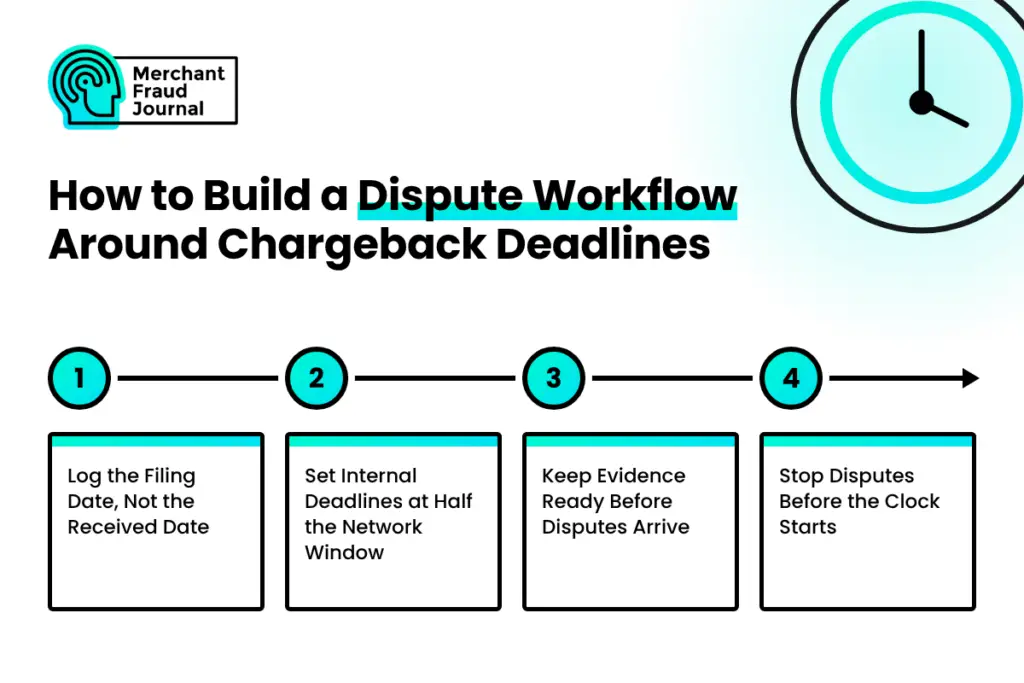
1. Log the Filing Date, Not the Received Date
Record the date the issuer filed each dispute and the due date your processor gives you. Calculate remaining days from those dates, not from when someone on your team opened the email.
2. Set Internal Deadlines at Half the Network Window
If Visa gives you 30 days, aim to submit by day 15. The buffer covers late notifications, acquirer review time, and cases that need extra evidence such as delivery photos or customer service transcripts.
3. Keep Evidence Ready Before Disputes Arrive
Store delivery confirmations, AVS and CVV results, IP and device data, customer communications, and signed terms with each order. A clear refund policy and a strong chargeback policy give you documents to attach instantly, which matters most for friendly fraud claims where the customer did make the purchase.
4. Stop Disputes Before the Clock Starts
Many chargebacks start because the customer does not recognize the charge. Following billing descriptor best practices, answering pre-dispute inquiries quickly, and enrolling in network alert programs such as Visa Order Insight or Rapid Dispute Resolution can resolve a complaint with a refund before it becomes a chargeback. Each prevented dispute is one less deadline to manage and one less mark on your ratio as you work to reduce chargeback risk.
Put Your Chargeback Deadlines on the Calendar Today
The credit card chargeback time limit gives cardholders about four months to file, but merchants get only a few weeks to respond, and that window is shorter in practice once acquirer processing time is counted. Map the Visa, Mastercard, Amex, and Discover response windows into your dispute calendar, set internal due dates at the halfway point, and keep evidence attached to every order so your team never forfeits a winnable case on timing alone. Merchants who control the clock control the outcome.
Frequently Asked Questions
How long does a cardholder have to file a chargeback?
Most cardholders have 120 days from the transaction date, or from the expected delivery date, to file a chargeback with Visa, Mastercard, American Express, or Discover. Some reason codes have shorter limits, such as 75 or 90 days for authorization disputes, and a few cases extend to 540 days.
How long does a merchant have to respond to a chargeback?
Merchants generally have 30 days for Visa, 45 days for Mastercard, 20 days for American Express, and 20 to 30 days for Discover. Acquirers often set shorter internal deadlines, so always follow the due date in your processor notification.
How long does a chargeback take to resolve?
Accepting a chargeback ends the case right away. A contested chargeback commonly takes about 75 to 180 days to reach a result after the merchant submits evidence, and cases that escalate to arbitration can take longer.
How long after a purchase can a customer do a chargeback?
In most cases, a customer can file a chargeback up to 120 days after the purchase or the expected delivery date. For services delivered over time or delayed deliveries, the window can extend further, up to a maximum of 540 days from the transaction.
What is the Mastercard chargeback time limit?
Mastercard cardholders generally have 120 days to file a chargeback, with shorter limits for authorization and installment billing disputes. Merchants have 45 days from the chargeback filing date to submit a second presentment.
How long can someone file a chargeback on PayPal?
PayPal buyers can open a dispute in the PayPal Resolution Center within 180 days of the payment. If the buyer files a chargeback through their card issuer instead, the card network time limit, usually 120 days, applies.

Charity Amancio
Charity Amancio specializes in SaaS solutions for global eCommerce businesses, including payments and risk management applications. She bridges the gap between technology and merchant needs, offering practical perspectives on the tools shaping eCommerce. Her insights appear regularly in B2B publications covering the digital commerce space.