


Friendly fraud rises sharply in the weeks after the holidays because shoppers who made genuine purchases in November and December start disputing them once January credit card statements, buy now, pay later installments, and buyer’s remorse arrives. Visa and Mastercard give cardholders up to 120 days to file most disputes, so holiday orders keep turning into chargebacks through April.
With the National Retail Federation forecasting 2026 holiday sales above $1 trillion, merchants that tighten refund policies, capture stronger transaction evidence before the rush, and answer pre-dispute alerts quickly can keep the post-holiday surge from erasing their seasonal margins.
Why Friendly Fraud Spikes After the Holiday Season
Friendly fraud happens when a cardholder disputes a legitimate purchase with their card issuer instead of contacting the merchant for a refund. The industry also calls it first-party fraud or first-party misuse, and it covers several different behaviors.
Some disputes are honest mistakes. A shopper forgets a purchase, does not recognize the billing descriptor, or finds a charge a family member made with their card. Others are deliberate, such as claiming a delivered package never arrived or disputing a charge after using the product. In every case the merchant loses the merchandise, the sale, and a chargeback fee, and each dispute counts toward the monitoring ratios card networks use to judge merchant risk.
The post-holiday chargeback surge comes from a mix of record spending, tighter household budgets, and the long dispute window card networks give consumers. Each factor peaks at a different point between January and April.
Record Holiday Spending Creates a Larger Pool of Disputes
Holiday sales volume sets the ceiling for post-holiday disputes. The National Retail Federation forecasts that 2026 holiday sales will reach $1.013 trillion, a 4.2% increase over the $972 billion consumers spent in 2025.
Online demand keeps climbing as well. Adobe reported that U.S. shoppers spent a record $257.8 billion online between November 1 and December 31, 2025, up 6.8% from the prior year, and that 56.4% of those transactions happened on mobile devices. More card-not-present orders mean more transactions that can be disputed later.
Credit Card Bills and BNPL Installments Arrive in January
January is when the bill for holiday shopping comes due. The Federal Reserve Bank of New York reported in August 2026 that U.S. credit card balances reached $1.26 trillion in the second quarter, up $21 billion from the first quarter. The annualized rate of card balances moving into serious delinquency stood at 6.97%. Shoppers who overspent are more likely to scrutinize statements and dispute charges they regret.
Buy now, pay later adds another layer. Adobe found that BNPL drove $20 billion in online holiday spending in 2025, up 9.8% year over year. Installment plans stretch payments into February and March, so a shopper may not feel buyer’s remorse until the second or third payment. That delay makes buy now pay later fraud and installment disputes harder to predict than standard card disputes.
Return Windows Close and Buyer’s Remorse Sets In
Return activity peaks right after the holidays. Adobe reported that online returns rose 4.7% between December 26 and December 31, 2025, and that this six-day stretch accounted for 1 in 7 returns for the season. Retailers surveyed by the NRF and Happy Returns expected 17% of 2025 holiday sales to be returned and estimated that 9% of all returns are fraudulent.
Shoppers who miss a return deadline sometimes file a chargeback instead, which turns a declined return into a dispute. Return fraud and refund abuse are also changing as new tools appear. Retailers have started catching shoppers who submit AI-generated damage photos to claim refunds on items that arrived intact.
Shipping Delays and Unrecognized Charges Cause Accidental Disputes
Peak-season fulfillment problems drive a large share of honest disputes. Late deliveries, packages left with neighbors, and gifts shipped to a different address all create “item not received” claims. Cardholders also dispute charges they do not recognize, especially when the billing descriptor does not match the store name they remember or when a family member placed the order.
The 120-Day Dispute Window Pushes the Surge Into Spring
Visa and Mastercard generally give cardholders 120 days from the transaction or expected delivery date to file a dispute. A Black Friday order can still turn into a chargeback in late March, and late-December orders stay open into April.
Most merchants feel the first wave in January, when statements arrive, and a second wave in February and March as BNPL payments and closed return windows catch up with shoppers. Planning only for January chargeback disputes leaves merchants exposed for the rest of the season.
Post-Holiday Friendly Fraud Triggers and When They Hit
The table below maps the most common post-holiday triggers to the months they usually peak, the claim the cardholder typically makes, and the response that works best.
| Trigger | Typical timing | Common dispute claim | Best merchant response |
|---|---|---|---|
| Credit card statements arrive | January | Unrecognized charge or unauthorized transaction | Clear billing descriptor, order confirmation emails, pre-dispute alerts |
| Shipping delays and porch theft | December to January | Item not received | Tracking, delivery confirmation, signature on high-value orders |
| Return windows close | January to February | Not as described or defective | Visible return policy, extended holiday return windows, fast refunds |
| BNPL installments come due | February to March | Merchandise not received or order canceled | Prompt order and delivery data to the BNPL provider |
| Subscription and free-trial renewals | January to March | Canceled recurring transaction | Renewal reminders and easy online cancellation |
| Family or gift purchases | January to April | Fraud in a card-not-present environment | Compelling Evidence 3.0 data, account login and device history |
Most of these triggers can be handled before a dispute is filed. Each response in the last column costs far less than a lost chargeback, which adds fees and counts toward network monitoring thresholds.
What the Latest Data Shows About Friendly Fraud
Recent industry research shows first-party misuse is still growing while overall fraud attacks are falling. The most useful figures for planning the 2026 post-holiday season are below.
- The Merchant Risk Council’s 2026 Global eCommerce Payments and Fraud Report, released March 18, 2026, found that 64% of merchants saw first-party misuse rise, and a quarter of those reported increases of 25% or more. Merchants reported fewer fraud attacks overall, an average of 3.7 in 2025 compared with 4.2 the year before.
- Mastercard research with Datos Insights, published in April 2025, found that 45% of chargebacks were tied to first-party or third-party fraud and that merchants saw chargebacks rise 10% in a year. The study projects global chargeback volume will grow from 261 million transactions in 2025 to 324 million in 2028.
- Mastercard forecasts that the global cost of chargebacks to merchants will reach $42 billion by 2028.
- The LexisNexis Risk Solutions True Cost of Fraud study, released April 2, 2025, found that U.S. eCommerce and retail merchants lose $4.61 for every $1 of fraud once fees, labor, and lost merchandise are counted.
Together these numbers explain why friendly fraud has become a top concern for fraud teams even as other attack types decline. Fraud tools have improved at stopping stolen-card attacks, while disputes from real customers still slip through. That gap is one of the latest eCommerce fraud trends changing how merchants budget for chargeback management.
Card Network Rules That Help Merchants Fight Friendly Fraud Chargebacks
Visa and Mastercard have both changed their rules to give merchants more ways to push back on illegitimate disputes. Visa has also tightened the monitoring program that penalizes merchants with high dispute rates.
Visa Compelling Evidence 3.0
Visa Compelling Evidence 3.0 (CE3.0) took effect in April 2023 and applies to disputes filed under fraud reason code 10.4 for card-absent transactions. Merchants can shift liability back to the issuer when they show at least two earlier undisputed transactions on the same card, made between 120 and 365 days before the disputed order.
Those earlier transactions must share at least two data elements with the disputed one, such as IP address, device ID, shipping address, or customer account login, and at least one must be the IP address or device ID. Returning holiday customers often meet this standard, which makes CE3.0 one of the strongest tools against post-holiday friendly fraud chargebacks.
Mastercard First-Party Trust Program
Mastercard’s First-Party Trust program lets merchants share purchase history, device details, delivery information, identity elements, and location data at authorization or during a dispute.
The data helps issuers tell third-party fraud apart from first-party fraud, and merchants that meet the program’s data-sharing requirements receive chargeback protection. Mastercard launched the program in the U.S. and expanded it to Canada, Latin America, the Caribbean, and Asia Pacific in June 2025.
Tighter Visa VAMP Thresholds in 2026
The Visa Acquirer Monitoring Program (VAMP) combines fraud reports and disputes into a single ratio measured against settled card-not-present transactions. Since April 1, 2026, merchants in the U.S., Canada, the EU, and Asia Pacific are flagged as excessive at a VAMP ratio of 1.5%, down from 2.2%. Merchants in the excessive tier face fees of $8 per flagged transaction, which acquirers can pass along.
A post-holiday spike in disputes can push a merchant that was safely under the threshold in December over it by February. Tracking the ratio weekly from January through April gives teams time to act before fees apply.
How to Prevent Friendly Fraud After the Holidays
Friendly fraud prevention and chargeback prevention work best when they start before the holiday rush and continue through the dispute window. The steps below cover both sides of the problem, stopping disputes before they are filed and winning the ones that still come in.
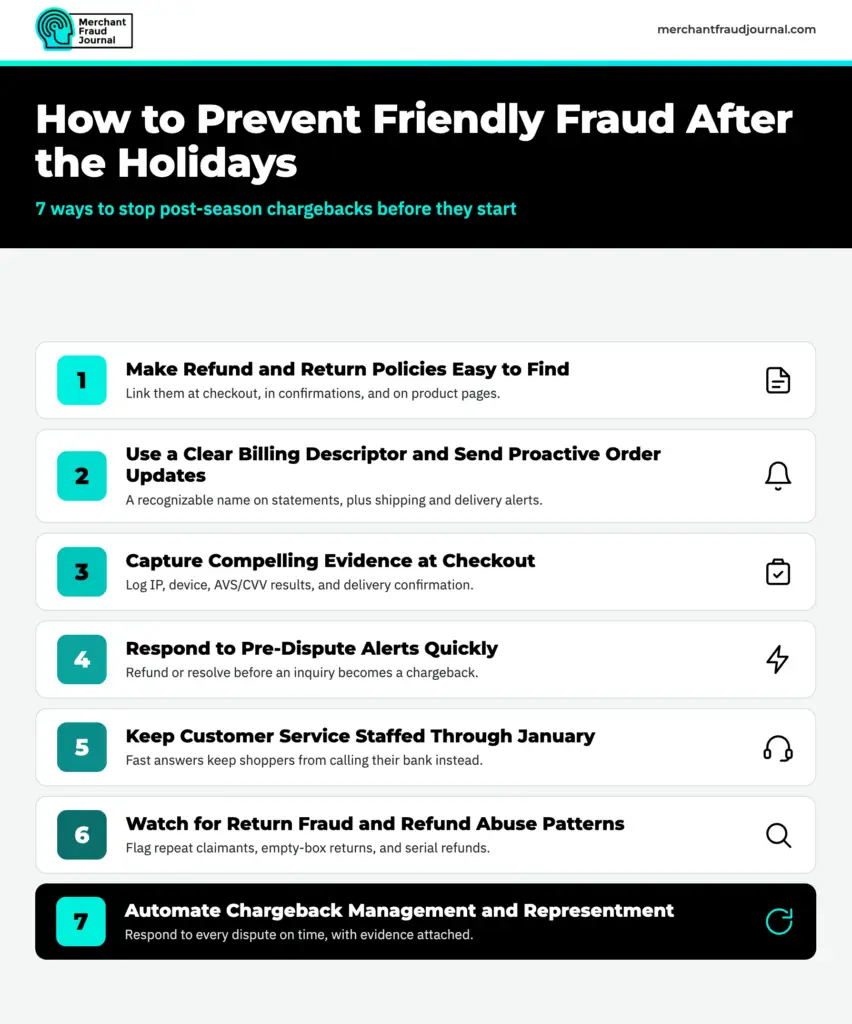
1. Make Refund and Return Policies Easy to Find
Many shoppers file a chargeback because they cannot figure out how to get a refund. Post the return policy on product pages, at checkout, and in order confirmation emails. Consider extending holiday return windows into late January so gift recipients have a clear path to a refund instead of a dispute. A refund costs less than a chargeback, which adds fees and labor on top of the lost sale.
2. Use a Clear Billing Descriptor and Send Proactive Order Updates
Make sure the billing descriptor matches the brand name customers know and includes a website or phone number. Send order confirmations, shipping notifications, and delivery confirmations, and keep copies of each. These messages reduce unrecognized-charge disputes and become evidence if a dispute is filed anyway.
3. Capture Compelling Evidence at Checkout
Collect the data elements card networks ask for before the holiday rush begins. Log IP addresses, device IDs, account logins, and shipping addresses for every order so you can qualify for Compelling Evidence 3.0 and the First-Party Trust program. Use 3D Secure authentication and address verification on higher-risk orders, and require signature confirmation for expensive items. The same records help merchants prevent credit card fraud from stolen cards during peak season.
4. Respond to Pre-Dispute Alerts Quickly
Visa Order Insight and Mastercard’s Ethoca Consumer Clarity let issuers show cardholders order details, such as merchant name, items purchased, and delivery status, when they ask about a charge. Shoppers who see a receipt they recognize often drop the dispute.
Pre-dispute alert services give merchants a short window to refund a transaction before it becomes a chargeback. Resolving the case at this stage keeps it out of network monitoring ratios such as VAMP.
5. Keep Customer Service Staffed Through January
NRF expects retailers to hire 325,000 to 375,000 seasonal workers for the 2026 holidays. Many of those roles end in late December, right as post-holiday questions about returns, delivery, and billing peak. Keep enough customer service capacity through January so shoppers can reach a person quickly, and give agents authority to resolve simple refund requests on the first contact.
6. Watch for Return Fraud and Refund Abuse Patterns
Track customers who repeatedly claim items never arrived, file damage claims, or return goods after the return window. Flag accounts with a history of disputes and require extra verification, such as video or photos with intact metadata, before issuing refunds on high-value claims. Sharing data between fraud, customer service, and returns teams makes repeat abusers easier to spot.
7. Automate Chargeback Management and Representment
Disputes that still reach the chargeback stage need fast, organized responses. A defined dispute management process helps teams meet response deadlines, match evidence to reason codes, and submit a clear chargeback rebuttal letter for each case.
Merchants handling high January volumes often work with chargeback protection companies that automate evidence collection and submission. Automation improves their chances to win a credit card dispute without adding staff during the busiest months.
Build Your Post-Holiday Friendly Fraud Plan Before January
Friendly fraud after the holidays follows a predictable pattern. Statements arrive in January, return windows close, BNPL installments come due, and the 120-day dispute window keeps holiday orders open until spring. Start now, while there is still time to adjust policies and data collection before holiday orders peak.
Frequently Asked Questions
Is chargeback fraud the same as friendly fraud?
The terms are often used interchangeably because both describe a cardholder disputing a valid transaction. Many fraud teams use chargeback fraud for deliberate false claims and friendly fraud for accidental or confused disputes.
Why do chargebacks increase after the holidays?
Chargebacks rise after the holidays because credit card statements, BNPL installments, and closed return windows all reach shoppers in January and February. Higher holiday sales volume and peak-season shipping problems add even more disputes.
How long do customers have to file a chargeback on holiday purchases?
Visa and Mastercard generally give cardholders 120 days from the transaction or expected delivery date to file most disputes. Holiday purchases can therefore turn into chargebacks as late as April.
How can merchants prevent friendly fraud chargebacks?
Merchants can prevent many friendly fraud chargebacks with clear refund policies, recognizable billing descriptors, and proactive order and delivery updates. Collecting device, IP, and account data at checkout also helps them qualify for Visa Compelling Evidence 3.0 and the Mastercard First-Party Trust program.
Is friendly fraud a crime?
Knowingly disputing a valid purchase to keep both the goods and the money can be treated as fraud, and penalties depend on local law and the amount involved. Accidental disputes are not criminal, which is why most merchants focus on prevention and strong evidence rather than prosecution.

Charity Amancio
Charity Amancio specializes in SaaS solutions for global eCommerce businesses, including payments and risk management applications. She bridges the gap between technology and merchant needs, offering practical perspectives on the tools shaping eCommerce. Her insights appear regularly in B2B publications covering the digital commerce space.
