

By MFJ Staff | Sources: Retail Insider, and Infobip
Key takeaway: Retailers leaning on SMS for one-time passcodes and order confirmations are absorbing a growing, often-overlooked cost. Most fraud programs focus on payment cards. They leave a real gap at the authentication layer.
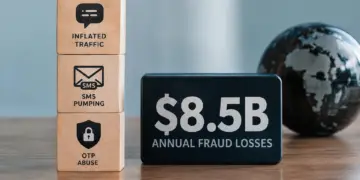
Infobip’s 2026 Fraud & Security Report tracks three fraud types: artificially inflated traffic, SMS pumping, and bot-driven one-time password exploitation. Together, they cost enterprises an estimated $8.5 billion a year. Adoption of AI-powered fraud detection grew 71 percent year over year. Retail Insider reported the figure on October 14, 2026, in an interview with Infobip’s chief information security officer, Andro Galinović.
Galinović told Retail Insider that fraud activity tracks the retail calendar closely. December 2025 produced the highest volume of harmful messages Infobip detected that year, with November close behind. Singles Day, Black Friday, and Cyber Monday all fall within that November-December window, driving the spike. Blocked messages grew twelvefold year over year in North America, Galinović said. AI-powered firewalls also blocked 27 percent more SMS threats than in prior years.
Phishing keeps working, Galinović said, because it targets human behavior rather than a technical flaw. AI now lets fraudsters personalize, automate, and scale their phishing attempts. Some fraudsters even hide malicious content inside images to slip past text-based filters, he said.
For retailers, Galinović named four fraud patterns Infobip is tracking. Bots generate fake accounts. Separately, account takeover attacks steal payment information, fraudsters intercept one-time passwords, and fake transaction confirmations enable chargebacks.
The 71 percent adoption figure also appears in Infobip’s own July 7, 2026 announcement of the report. In the Retail Insider interview, Galinović said enterprises are also adopting multi-channel authentication. They are using network APIs, such as SIM-swap detection and number verification, to move beyond SMS-only security.
Why it matters: SMS pumping and OTP interception do not show up on a balance sheet as fraud losses. Unlike a stolen card number, they do not register that way. Instead, they arrive as inflated messaging bills, locked-out customers, and chargebacks. Those chargebacks often trace back to confirmations a bot generated rather than a real buyer. AI is lowering the cost of running these schemes at scale. Merchants that treat authentication messaging as a commodity cost, not a fraud surface, will likely keep paying for it. Their share of that $8.5 billion will keep growing.
Sources: Retail Insider, and Infobip
