

Fraud losses have a way of sneaking up on you. One month, your chargeback ratio looks fine; the next, you’re staring down a processor warning and wondering how things escalated so fast. The tipping point usually arrives before most businesses recognize it. This is why it’s critical for businesses to understand when they must let in a fraud analyst to address issues related to potential fraudulent activities.
Below, you’ll learn about the warning signs that indicate you’ve outgrown ad-hoc fraud management, and how to decide between hiring in-house expertise or leveraging automation to protect your revenue.
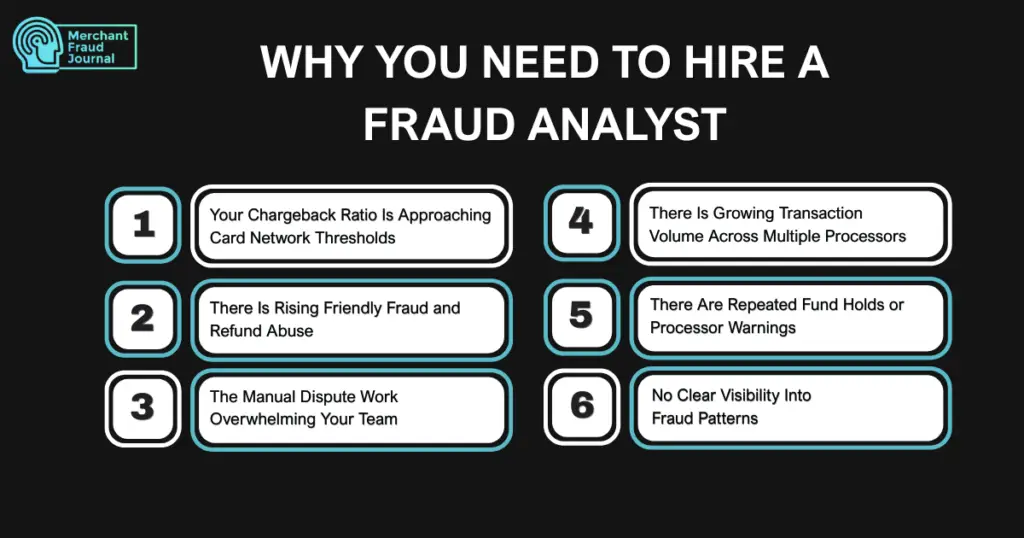
1. Chargeback Ratio Approaching Card Network Thresholds
Visa and Mastercard monitor your dispute ratio monthly. Once you exceed 0.9% with Visa or 1.0% with Mastercard, you enter monitoring programs that carry fines starting at $25,000 per month and escalating from there.
The consequences extend beyond fees. Processors may hold reserves, increase processing rates, or terminate your account entirely. If you’re watching your ratio climb toward card network thresholds, you’ve already waited too long to bring in specialized help.
2. Rising Friendly Fraud and Refund Abuse
Friendly fraud happens when customers dispute legitimate purchases. These aren’t stolen cards. They’re real customers claiming “item not received” on delivered orders or filing disputes instead of requesting refunds.
Watch for patterns like repeat abusers placing multiple orders, customers exploiting return policies, or sudden spikes in “unauthorized transaction” claims from verified purchasers. A fraud analyst can identify bad actors and block them before they cost you more.
3. Manual Dispute Work Overwhelming Your Team
When your operations, finance, or customer service teams spend hours daily managing disputes instead of their primary responsibilities, you’ve hit a tipping point. Chargeback responses require specific evidence, tight deadlines, and knowledge of card network rules that generalists rarely have time to master.
Only about 34% of merchants have a dedicated chargeback team or department head. These responsibilities fall to finance, operations, or customer service staff without specialized knowledge of card network rules and evidence requirements. If dispute management has become a second job for someone whose actual job is something else, the math favors hiring a specialist.
4. Growing Transaction Volume Across Multiple Processors
Scaling across processors and stores creates fragmented fraud data. What looks like isolated incidents on Stripe, PayPal, and your direct processor might actually be the same fraud ring hitting you from multiple angles.
A fraud analyst centralizes visibility across all channels, standardizes prevention rules, and spots patterns that siloed teams miss. This becomes especially critical during peak seasons when transaction volume spikes and eCommerce fraud attempts follow.
5. Repeated Fund Holds or Processor Warnings
Processor warnings and reserve holds are late-stage indicators. The moment your processor freezes funds or sends formal notices about your dispute rate, you’re already in trouble. Fund holds and processor warnings demand immediate action. A fraud analyst can triage the situation, identify root causes, and implement fixes fast enough to prevent account termination.
6. No Clear Visibility Into Fraud Patterns
Operating blind is expensive. If you can’t answer basic questions about which customers file the most disputes, which products get disputed most often, or which traffic sources drive fraud, you’re making decisions without data. Visibility is the foundation of fraud prevention. Platforms like Chargeflow Insights provide this visibility automatically, but someone still has to interpret the data and act on it.
When Is the Right Time To Hire a Fraud Analyst
Timing matters. Hiring too late means you’re already in a monitoring program or losing significant revenue. Hiring too early means paying for expertise you don’t yet need.
Consider hiring based on one of the following triggers:
- Pre-scale: Before rapid growth periods like BFCM, product launches, or expansion into new markets
- Post-incident: After a significant fraud event, processor warning, or unexpected chargeback spike
- Volume threshold: When manual review becomes unsustainable, typically when you’re spending 10+ hours weekly on disputes
The best time to hire is before you desperately need one. The second-best time is now. That sounded cliché, but the urgency of having a fraud analyst, especially as artificial intelligence and automation are taken advantage of for fraud, cannot be understated.
How Much Does a Fraud Analyst Cost
Salary ranges vary significantly by experience, location, and industry. Entry-level fraud analysts typically earn $50,000-$70,000 annually, while senior analysts with specialized eCommerce experience command $90,000-$130,000 or more.
The true cost extends beyond salary. Factor in recruiting fees, onboarding time, tools and software, and ongoing training. A fraud analyst also requires access to data platforms, alert services, and dispute management tools to be effective.
The total cost of employment from a business owner’s perspective, including benefits, tools, and management overhead, makes automation an attractive alternative or complement to hiring. However, fraud analysts offer another layer of behavioral and even psychological screening that outbounds automation, which is an important point of comparison, especially if you’re handling high-risk accounts or transactions.
In-House Fraud Analyst Vs. Fraud Automation Software
The choice isn’t always either/or. Many businesses use both approaches strategically. Software handles the high-volume, repetitive screening that would overwhelm a human reviewer, flagging suspicious transactions in real time before they are processed. A fraud analyst then steps in to review the edge cases, investigate flagged accounts, and make judgment calls that automated rules aren’t equipped to handle.
| Factor | In-House Fraud Analyst | Fraud Automation Software |
|---|---|---|
| Best for | Complex investigations, policy strategy | High-volume dispute handling, 24/7 monitoring |
| Time to value | Weeks to months (recruiting, onboarding) | Hours to days (integration) |
| Scalability | Limited by headcount | Scales with transaction volume |
| Cost structure | Fixed salary and benefits | Usage-based or success-based pricing |
| Expertise required | Hiring and managing specialist talent | Minimal, platform handles complexity |
The combination of a fraud analyst and automation lets businesses catch obvious fraud instantly while still benefiting from the nuanced, contextual thinking that only an experienced analyst can bring to complex or ambiguous cases. Over time, the analyst’s decisions on these edge cases can also help refine the automation’s rules, creating a feedback loop that makes the whole system smarter and reduces false declines.
How to Hire a Fraud Analyst
Follow this process to find and onboard the right candidate efficiently. Take note that getting each step right matters, since a rushed hiring process often results in a mismatch between the candidate’s background and the specific fraud challenges your business actually faces.
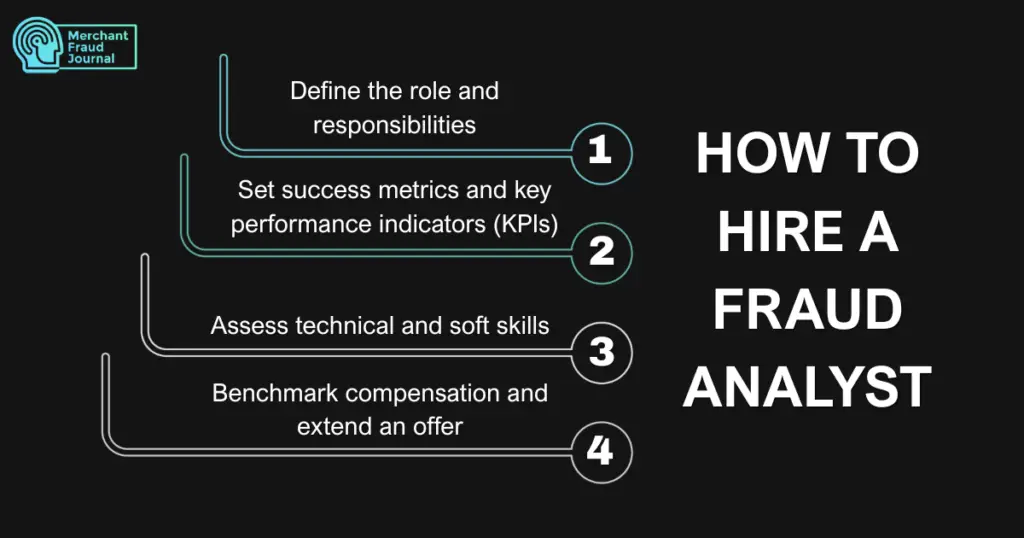
Step 1. Define the role and responsibilities
Write a clear job description specifying whether the role focuses on prevention, detection, disputes, or all three. Include required tools and systems experience. Familiarity with your specific processors and platforms accelerates onboarding. A well-scoped description also helps candidates self-select, so you spend less time interviewing people whose background doesn’t match what the role actually demands.
Step 2. Set success metrics and key performance indicators (KPIs)
Establish measurable goals before you start interviewing. Common metrics include chargeback ratio targets, dispute win rate improvements, fraud loss reduction percentages, and time-to-resolution benchmarks. Sharing these benchmarks with candidates during the interview process also gives them a clear sense of what success looks like on day one.
Step 3. Assess technical and soft skills
Use practical assessments during interviews. Case studies, data analysis exercises, and scenario-based questions reveal analytical ability and investigative thinking better than resume reviews alone. Pairing a technical exercise with a live discussion of the candidate’s reasoning also helps you gauge how they’ll communicate findings to non-technical stakeholders on your team.
Step 4. Benchmark compensation and extend an offer
Research market rates for your region and industry. Factor in the cost of unfilled positions, including ongoing fraud losses, while you search, when evaluating budget constraints. Moving quickly once you’ve identified a strong candidate also matters, since skilled fraud analysts are in high demand and rarely stay on the market long.
The Bottomline: Don't Wait for a Bigger Problem
If you recognized your business in even two or three of the signs above, that’s your cue to start the hiring conversation now rather than after a major loss forces your hand. A dedicated fraud analyst pays for themselves by catching what generalist staff and automated systems miss, freeing up your team to focus on growth instead of playing defense.
Frequently Asked Questions

Charity Amancio
Charity Amancio specializes in SaaS solutions for global eCommerce businesses, including payments and risk management applications. She bridges the gap between technology and merchant needs, offering practical perspectives on the tools shaping eCommerce. Her insights appear regularly in B2B publications covering the digital commerce space.
What is a red flag for a fraud analyst?
Red flags during hiring include gaps in employment without explanation, inability to describe specific fraud cases they've worked on, lack of familiarity with industry-standard tools, and poor attention to detail during the interview process. Also watch for candidates who can't explain their decision-making process or who rely entirely on automated systems without understanding why they work.
What questions to ask when interviewing a fraud analyst?
Ask candidates to walk through how they would investigate a suspicious transaction from start to finish. Have them describe a time they identified a fraud pattern others missed. Ask how they stay current on evolving fraud tactics and card network rule changes. Scenario-based questions reveal more than theoretical knowledge.
What is the difference between a fraud analyst and a forensic accountant?
A fraud analyst focuses on detecting and preventing fraud in real-time transactions, stopping bad orders before they ship and fighting chargebacks after they occur. A forensic accountant investigates financial records after fraud has happened, often for legal proceedings, audits, or insurance claims. The fraud analyst is proactive while the forensic accountant is retrospective.
Can a fraud analyst reduce chargeback ratios?
Yes. A skilled fraud analyst reduces chargeback ratios by identifying fraud patterns early, implementing prevention rules, improving dispute evidence quality, and blocking repeat abusers before they file disputes. The impact varies by business, but reductions of 30-50% in chargeback volume are common when dedicated expertise replaces ad-hoc management.