• Latest

Anti-money laundering: Frequently Asked Questions

January 3, 2023
Inside eCommerce Fraud Trends 2026: What Every Merchant Needs to See Coming

Inside eCommerce Fraud Trends 2026: What Every Merchant Needs to See Coming

July 23, 2026
Hand using a laptop trackpad with a fake phishing email displayed on screen, claiming a credit card is locked and prompting the user to click a 'Re-activate my card' button.

How to Spot a Phishing Scam: 5 Common Signs to Watch Out For

July 21, 2026
A gold envelope with a fishing hook piercing through it, pulling out a slip of paper labeled "password," alongside a phishing icon of an envelope with a hook and the word "Phishing."

Phishing Scams Explained: Types, Examples, and Prevention

July 17, 2026
Fraud analyst using a magnifying glass to review financial charts and transaction data on a desk with a laptop and stock reports.

What Is a Fraud Analyst? An Inside Look at the Role and Its Value

July 15, 2026
Close-up shot of multiple credit cards scattered over a black laptop keyboard. A prominent gold credit card sits in the foreground. Layered on top of the left side is a bright cyan line icon showing a rising bar graph with a percentage sign and an upward-pointing arrow, symbolizing an increase in rates or credit card fraud statistics.

10 Credit Card Fraud Statistics You Can’t Afford to Ignore

July 13, 2026
A Complete Guide to Credit Card Fraud

A Complete Guide to Credit Card Fraud

July 9, 2026
The Merchant’s Guide to eCommerce Fraud Detection

The Merchant’s Guide to eCommerce Fraud Detection

July 8, 2026
Common Dropshipping Supplier Red Flags Every Store Owner Must Know

Common Dropshipping Supplier Red Flags Every Store Owner Must Know

July 3, 2026
8 Dropshipping Scams Targeting Sellers and Buyers in 2026

8 Dropshipping Scams Targeting Sellers and Buyers in 2026

July 2, 2026
How Credit Card Fraud Happens: 10 Common Methods Explained

How Credit Card Fraud Happens: 10 Common Methods Explained

June 25, 2026
Master the basics of Fraud-as-a-Service (FaaS). Discover how this underground economy works and get actionable strategies to defend your business.

A Guide to Fraud-as-a-Service: The New Frontier in Cybercrime

June 23, 2026
What Is a High-Risk Transaction?

What Is a High-Risk Transaction?

June 22, 2026
  • Contribute
  • Contact Us
  • About
  • Join Us
  • Advertise
Tuesday, July 28, 2026
Merchant Fraud Journal
ADVERTISEMENT
  • Home
  • Articles
    • Chargebacks
    • Fraud Prevention
    • Influencer Insights
  • Resources
    • Recorded Webinars
    • Podcasts
    • Vendor Directory
    • eCommerce Fraud Reports
    • Training and Certifications
    • Jobs Board
    • Associations and Non-Profits
  • News
No Result
View All Result
  • Home
  • Articles
    • Chargebacks
    • Fraud Prevention
    • Influencer Insights
  • Resources
    • Recorded Webinars
    • Podcasts
    • Vendor Directory
    • eCommerce Fraud Reports
    • Training and Certifications
    • Jobs Board
    • Associations and Non-Profits
  • News
No Result
View All Result
Merchant Fraud Journal
No Result
View All Result

Anti-money laundering: Frequently Asked Questions

Anti-money laundering (AML) is the process of combating money laundering and terrorist financing. AML refers to a set of procedures, laws, and regulations designed to prevent the use of the financial system for illegal purposes.

AML is a critical part of the fight against terrorism and financial crime. By detecting and preventing the use of the financial system for illegal activities, AML helps protect the safety and security of the global financial system.

AML also helps to ensure that legitimate businesses can operate without being used to launder money or finance terrorism.

What are the goals of anti-money laundering?

There are three main goals of anti-money laundering: to prevent crime, to protect national security, and to protect the economy. AML efforts are designed to make it more difficult for criminals to use the financial system to commit crimes and to hide the proceeds of their crimes. By making it more difficult for criminals to use the financial system, anti-money laundering efforts help to protect national security and the economy.

What are the basic steps of anti-money laundering?

There are a number of basic steps required for anti-money laundering (AML) compliance in Europe and the United States. These include identifying and verifying the identity of customers, monitoring customer activity, and reporting suspicious activity.

To identify and verify the identity of customers, businesses must collect certain information, such as name, address, and date of birth. They must also verify this information through reliable means, such as checking government-issued IDs.

To monitor customer activity, businesses must track the types of products or services customers are buying, as well as the amount and frequency of transactions. This helps them identify any unusual or suspicious activity.

To report suspicious activity, businesses must have procedures in place for identifying, assessing, and reporting any suspicious transactions. This includes evaluating whether a transaction is consistent with the customer’s normal activity, the nature of the business, and the geographic location of the customer.
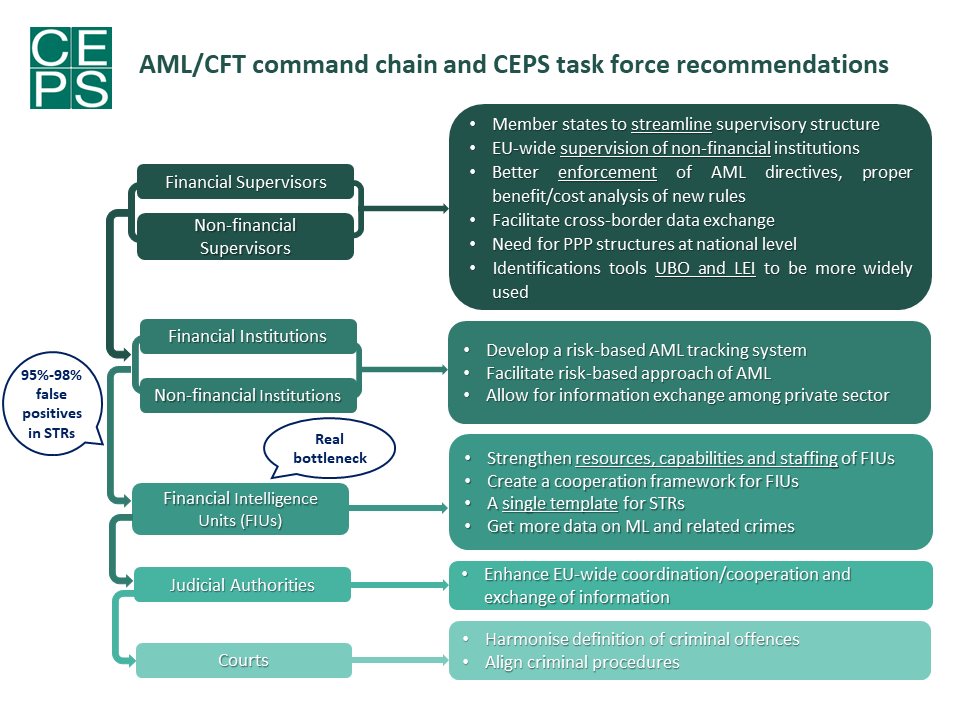
Chart showing AML/CFT command chain and CEPS task force recommendations
Source: European Credit Research Institute

What are the main challenges of AML?

The main challenges of anti-money laundering are the large volume of transactions, the use of new technologies, and the global nature of the problem. Financial institutions must have systems in place to identify and report suspicious activity, but it can be difficult to keep up with the ever-changing tactics of criminals. Additionally, different countries have different regulations, so banks must be compliant with multiple standards.

What are the benefits of anti-money laundering?

There are a number of benefits to anti-money laundering (AML) efforts. Perhaps the most obvious benefit is that it helps protect the financial system and economy from criminal activity. By preventing criminals from using the financial system to move money around, it makes it more difficult for them to conduct illicit activities.

AML also helps protect consumers. By identifying and stopping money laundering, financial institutions can help protect consumers from being scammed or defrauded.

Finally, AML helps protect the integrity of financial markets. By ensuring that financial institutions are not used to launder money, it helps to prevent market manipulation and other illegal activities.

What is the future of anti-money laundering?

The future of anti-money laundering is uncertain. With the rise of cryptocurrencies and other digital currencies, new methods of money laundering have been created. These new methods make it difficult to track and stop money laundering. Governments and financial institutions are working to create new methods to combat money laundering, but it is unclear if these methods will be successful.

Tags: AMLanti-money laundering
TweetShareSend
Previous Post

Chargeback Fraud: How to Prevent it and What to Do if it Happens

Next Post

How to Write a Strong Chargeback Policy: Tips to Help You Protect Your Business

Next Post
How to Write a Strong Chargeback Policy: Tips to Help You Protect Your Business

How to Write a Strong Chargeback Policy: Tips to Help You Protect Your Business

Download our latest report:

Our Latest Reports

2024 Fraud Trends Report

2023 Consumer Payments Survey Report

2023 Fraud Trends Report

2022 Chargeback Consumer Survey Report

Fraud Prevention Tactics that Enable Exceptional Customer Experience

Addressing Payment Fraud and The Customer Experience in 2022

2022 Fraud Trends Report

ATO Fraud In Retail Report

2022 Customer Experience Report

3 Ways a Unified Chargeback Management and Fraud Platform Increases Revenue

Digital Trust And Safety Report: Combating the Evolving Complexities of Payment Fraud

On-Demand Webinars

New Trends in The Payments Ecosystem

Balancing Customer Experience and Fraud Prevention: What’s the Secret?

Stopping Fraud Across the Customer Lifecycle

Addressing Payment Fraud and the Customer Experience in 2022


Get the 2024 Fraud Trends Report

Search Our Site

No Result
View All Result

Our Sponsors

Quick Navigation

  • Home
  • News
  • Join Us
  • About Us
  • Contact Us
  • Advertise
  • Contribute
  • Privacy Policy

The Payments Media Network

Merchant Fraud Journal
Payments Review

Privacy Policy

Our Privacy Policy
Our Terms of Use

Resources

  • Articles
  • eCommerce Fraud Reports
  • eCommerce Fraud Webinars
  • Training and Certifications
  • Jobs Board
  • Associations and Non-Profits
  • Podcasts
  • Vendor Directory

Download the 2023 Fraud Trends Report

No Result
View All Result
  • About Merchant Fraud Journal
    • Interested in Contributing or Guest Posting to Merchant Fraud Journal?
    • Merchant Fraud Journal Editorial Guidelines
  • Advertise on Merchant Fraud Journal
  • Articles
    • Chargebacks
    • Fraud Prevention
    • Influencer Insights
  • Contact Us
  • Download Addressing Payment Fraud and Customer Experience Report
  • Download Chargebacks Consumer Survey Report 2022
  • Download Evolving Complexities of Payment Fraud Report
  • Download Fraud Prevention Tactics that Enable Exceptional Customer Experiences Report
  • Download Merchant Fraud Journal 2023 Fraud Trends Report
  • Download Merchant Fraud Journal 2024 Fraud Trends Report
  • Download Merchant Fraud Journal Generative AI Fraud Prevention Checklist for SMBs
  • Download Quantifying the Challenge of Friendly Fraud: Your Post-purchase Strategy for the Future
  • Download the 2020 Chargeback and Representment Report
  • Download the 2020 Merchant Fraud Journal Vendor Guide
  • Download the 2021 Fraud Trends Report
  • Download the 2022 Fraud Trends Report
  • Download the 2023 Consumer Payment Trends Report
  • Download the 3 Ways a Unified Chargeback Management and Fraud Platform Increases Revenue Report
  • Download the MFJ 2022 Customer Experience Report
  • Download the MFJ ATO in Retail Report
  • Home
  • Home Elementor
  • Job Dashboard
  • Join The Merchant Fraud Journal Community
  • Merchant Fraud Journal Advertising Agreement
  • Merchant Fraud Journal Advertising Agreement – Signifyd
  • MFJ Fraud Trends Report Giveaway
  • News
  • Post a Job
  • Privacy Policy
  • Resources
    • #9978 (no title)
    • 2020 Chargeback Representment Guide for Merchants
    • 2020 Vendor Guide
    • 2023 Consumer Payments Survey Report
    • 3 Ways a Unified Chargeback Management and Fraud Platform Increases Revenue
    • 8 Fraud Prevention Training and Certifications: A 2026 Guide
    • Addressing Payment Fraud and the Customer Experience in 2022
    • Associations and Non-Profits
    • ATO Fraud In Retail Report
    • Balancing Customer Experience and Fraud Prevention: What’s the Secret?
    • Chargebacks Consumer Survey Report 2022
    • Digital Trust & Safety: Combating the Evolving Complexities of Payment Fraud
    • eCommerce Fraud Reports
    • eCommerce Fraud Webinars
    • Fraud Prevention Tactics that Enable Exceptional Customer Experiences
    • How to Build a Recession Proof Chargeback Prevention Strategy
    • How to Reduce Customer Friction During Holiday Sales Season
    • How to Stop Fraud During the 2022 Holiday Season
    • Jobs Board
    • Merchant Fraud Journal 2023 Fraud Trends Report
    • Merchant Fraud Journal’s Fraud Trends 2020 Report
    • Merchant Fraud Journal’s Generative AI Fraud Prevention Report: A Checklist for SMB Companies
    • Merchant Fraud Journal’s Fraud Trends 2021 Report
    • Merchant Fraud Journal’s Fraud Trends 2022 Report
    • MFJ’s 2022 Customer Experience Report
    • Podcasts
    • Prevent High-Velocity Fraud Attacks During the 2021 Holiday Season
    • Quantifying the Challenge of Friendly Fraud: Your Post-purchase Strategy for the Future
    • Stopping Fraud Across the Customer Lifecycle
    • The surprisingly easy way to secure your payment data, reduce your risk, and win the war on ecommerce fraud
    • Vendor Directory
    • Webinar – Addressing Payment Fraud and the Customer Experience in 2022
    • Webinar – Mitigating Fraud and Risk on the ACH Network
    • Win January Chargeback Disputes
  • Subscribed
  • Terms and Conditions

© 2021 Payments Media Solutions Canada Inc.

Not enough quota to unlock this post
Unlock left : 0
Are you sure want to cancel subscription?