

By MFJ Staff | Source: Check Point Research
Key takeaway: Retailers and payment teams should expect more Black Friday scams that use sale-themed and delivery-themed lookalike domains before the peak shopping weekend. Monitoring domains that imitate the brand and its carriers is a practical step. So is warning customers about fake order and delivery messages while the volume is rising.
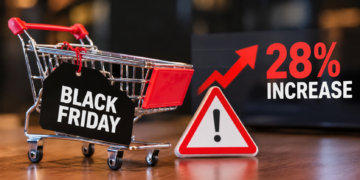
Check Point Research reported on November 16, 2026 that attacks on the Consumer Goods and Services sector rose 28% ahead of Black Friday. That compares with a 22% increase across all industries. Black Friday scams are also building through new infrastructure, as registrants created more than 4,000 new sale-themed domains.
The 28% compares September and October 2026 with earlier in the year. Organizations in the sector averaged 2,458 weekly cyber attacks each during those two months, according to Check Point.
Check Point counted more than 4,000 new domains using November sale terms. Registrants created them in October and the first eight days of November 2026. Check Point’s ThreatCloud AI already classified nearly one in five as risky. The domains used seasonal keywords such as “Black Friday,” “Cyber Monday” and “Singles’ Day.” They also named retail brands such as Amazon, AliExpress, Walmart and Best Buy. Other domains named delivery firms such as DHL, FedEx, USPS and Royal Mail.
Researchers also found 647 new .com domains matching the pattern “FedEx” plus two to four additional letters. Registrants created them between September and November 8, 2026. The count was 139 in September, 439 in October and 69 in the first eight days of November. Check Point noted that the pattern alone does not prove every one of these domains is malicious.
Check Point found one example. Scammers registered a fake Walmart site in October 2026. The site promised discounts of up to 80%, including an iPad for $49.99, and claimed only 48 units remained.
ReliaQuest recently reported that impersonating domains made up 43% of retail brand-impersonation alerts. That finding, from ReliaQuest’s own report, points to the same exposure.
Check Point advised shoppers to buy from official retailer sites or apps and to check web addresses for misspellings and extra words. It also advised tracking packages only through the courier’s official site or app. For businesses, Check Point recommended monitoring for suspicious domains and fraudulent sites that impersonate the brand. It also recommended training employees on seasonal phishing and brand impersonation scams.
Why it matters: Black Friday scams often rely on fake shopping websites and look-alike delivery domains. These give fraudsters a way to collect card details and credentials during the highest-volume period of the year. Holiday phishing scams like these can reach merchants later as disputes and account takeover attempts. That makes early domain monitoring a fraud control as well as a security task.
Source: Check Point Research