

By MFJ Staff | Sources: Sumsub and PR Newswire
Key takeaway: Merchants and platforms that let AI agents buy or move money should be able to show who authorized each agent. Sumsub found that 53% of businesses worldwide detected or suspected AI agent fraud. Separately, only 37% of businesses worldwide said they could verify who authorized an agent.
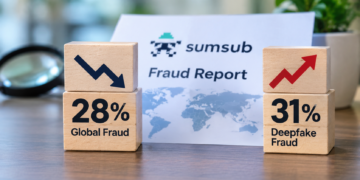
Sumsub reported in its Identity Fraud Report 2026-2027 that global fraud rates fell 28% in 2026. Deepfake fraud rose 31% over the same period. Sumsub released the report on November 17, 2026. The report also found that 53% of businesses detected or suspected AI agent fraud, a distinct piece of the AI agent fraud picture from the authorization numbers above.
Among businesses reporting AI agent fraud, malicious instructions manipulated a legitimate agent in 49% of incidents. In 30% of agentic AI fraud incidents, the agent made a purchase, payment or transfer, the kind of action AI agents that check out for shoppers are increasingly built to take on a buyer’s behalf. Fewer than one in four businesses log what their agents do, and only 37% can verify who authorized one in the first place.
Europe recorded the highest detected deepfake fraud rate in the world, up 41%. That was the sharpest rise of any region Sumsub tracked, consistent with the pattern behind cases like the deepfake CEO and attorney impersonation scheme US prosecutors charged earlier this year. Sumsub’s new Fraud Complexity Index rose globally from 2.1 to 2.2. In Europe, fraud fell 8% while complexity rose 13%. Jacob Thompson, VP of Sales at Sumsub, said regulation is becoming more harmonized across the region. “What gives me confidence about Europe is that the direction of travel is becoming much clearer,” he said.
The report draws on 5.8 million fraud samples from Sumsub’s verification data. It also draws on an August 2026 survey of more than 1,400 fraud and risk professionals. This is vendor research from an identity verification provider. Its identity fraud figures come from Sumsub’s own platform data.
Why it matters: Falling fraud rates can hide a harder problem, because deepfake fraud is rising even as total fraud declines. Attacks are fewer but more complex. AI fraud detection and other controls tuned to volume can miss the cases that cost the most. When an AI agent can complete a purchase or transfer, merchants need a record of who authorized it. Tools such as single-use cards for AI agent payments are one way to create that record. Without one, merchants struggle to attribute a disputed agent-initiated order, raising the same liability questions over a wrongful AI agent purchase that payment firms are already split on.
Sources: Sumsub and PR Newswire