

By MFJ Staff | Sources: U.S. Department of Justice and CFPB
Key takeaway: Federal agencies are going after the infrastructure behind online scams, from spoofed domains to business email compromise. The same tools drive phishing, account takeover and impersonation losses for merchants. Fraud teams can use these tallies to show leadership how organized and well-funded scam networks have become.
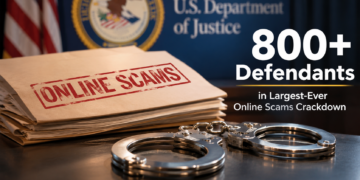
The U.S. Department of Justice said on November 24 that its anti-scam surge has targeted over 800 defendants. Prosecutors have brought more than 400 cases across 85 federal districts, according to the DOJ. The department called it the largest crackdown on scammers in its history.
The surge began under Executive Order 14390, signed March 6, 2026. Participants include the FBI, the Secret Service, Homeland Security Investigations and the Postal Inspection Service. The FTC, SEC, FCC and State Department also took part. Prosecutors have also extradited 30 defendants to face scam-related charges.
Several of the tallies map directly to online scams that hit businesses. The Secret Service said it investigated more than 1,540 business email compromise incidents. It also disrupted 1,780 domains and recovered more than $119 million. The State Department reported taking down over 1.4 million fraudulent websites and accounts.
The FBI said its Operation Blackout restrained nearly $17 billion in illicit funds. The same operation dismantled 29 scam compounds overseas, according to the release. Homeland Security Investigations reported more than 300 arrests. It also seized, froze or recovered more than $120 million in illicit proceeds.
The FTC filed 16 actions as part of the surge and took down 19 impersonating websites. The DOJ also cited Gallup data estimating that Americans lost $68 billion to scams in 2025.
The Consumer Financial Protection Bureau said separately that it has worked with the DOJ on the effort since March. The CFPB also launched a webpage to help consumers spot scammers who impersonate its staff. The surge follows recent DOJ action against a North Korean deepfake scheme tied to $400 million in crypto theft.
Why it matters: Scam networks use the same tools that drive merchant losses, such as spoofed domains, impersonation sites and mule accounts. Each takedown removes some of that infrastructure. The scale of these tallies also shows how industrialized online scams have become. Merchants should expect impersonation and business email compromise attempts to continue during the holiday peak.
Sources: U.S. Department of Justice and CFPB