


Agentic AI fraud prevention uses autonomous software agents to detect and stop fraud at machine speed. These agents reason across multiple steps, pull in external data, and take defensive action without waiting for a human analyst. Merchants need it because fraud rings now use their own AI agents to open fake accounts, bypass verification checks, and complete purchases faster than any manual review queue can respond. Those attacking agents also learn from every failed attempt.
The practical answer to combat Agentic AI fraud is a layered defense: behavioral signals, defensive agents, zero-trust input handling, cross-channel correlation, and human oversight for high-stakes decisions. Learn more about these tactics below.
What Is Agentic AI Fraud Prevention?
Stopping autonomous AI attacks means moving beyond static rule-based checks to machine-speed behavioral defense and zero-trust architecture. Traditional AI fraud detection relies on predefined rules or supervised machine learning models that score transactions one at a time and then wait for a human to act. Agentic AI fraud prevention works differently. It deploys autonomous agents that can investigate, decide, and respond on their own.
In this context, an agent is software that observes a situation, decides what to do, and acts on that decision independently. A traditional machine learning (ML) model might flag a suspicious login and send an alert. An agentic system can review the session history, check whether the device fingerprint matches previous visits, query an external database for known fraud signals, and then step up authentication or block the session. All of that happens within milliseconds.
This shift matters because attackers have already made it. Fraud rings now run agentic systems that fill out forms, solve CAPTCHAs, rotate identities, and learn from failed attempts at machine speed. When the defense runs at human speed and the attack runs at machine speed, the outcome is predictable.
How Autonomous AI Attacks Work
Agentic fraud is not just a faster version of old tactics. It changes how fraud gets executed. Criminal interest is growing quickly. Visa’s agentic commerce threat research found a more than 450% increase in dark web posts mentioning AI Agent over a six-month period compared with the six months before.
Machine-Speed Execution
Human fraudsters have natural limits: typing speed, attention span, and the need to sleep. AI agents have none of these limits. A single agent can complete account applications, bypass MFA challenges, and execute purchases in seconds. It can also run thousands of parallel sessions across different merchants at the same time. Palo Alto Networks’ Unit 42 research on agentic retail fraud warns that if an agent can trigger refunds on its own, organized crime groups could use bot farms to push through thousands of fraudulent returns in a single hour.
Self-Improving Attack Strategies
Modern agentic fraud systems learn from failure. When a transaction is declined or an account is flagged, the agent adjusts its approach. It might change device fingerprints, rotate IP addresses, or modify its behavior to avoid detection. Each blocked attempt makes the next one harder to catch. Static rules can’t keep up with that kind of adversarial feedback loop.
Synthetic Identities at Scale
AI can now generate complete fraudulent identities in minutes rather than days. That includes names, addresses, Social Security numbers, and even synthetic document images. This speeds up synthetic identity fraud considerably. These identities often pass initial verification because they are internally consistent and don’t match known fraud patterns in existing databases.
Long-Horizon Persistence
Opportunistic human fraudsters usually look for quick wins. Agentic systems can play a much longer game. They create accounts, build transaction history over weeks or months, and strike only once the account looks trustworthy. This sleeper approach defeats velocity rules designed to catch rapid suspicious activity.
5 Core Strategies for Agentic AI Fraud Prevention
An effective agentic AI fraud prevention program meets autonomous attacks at machine speed. It also keeps the judgment and oversight that stop false positives from damaging the customer experience. Five approaches do both.
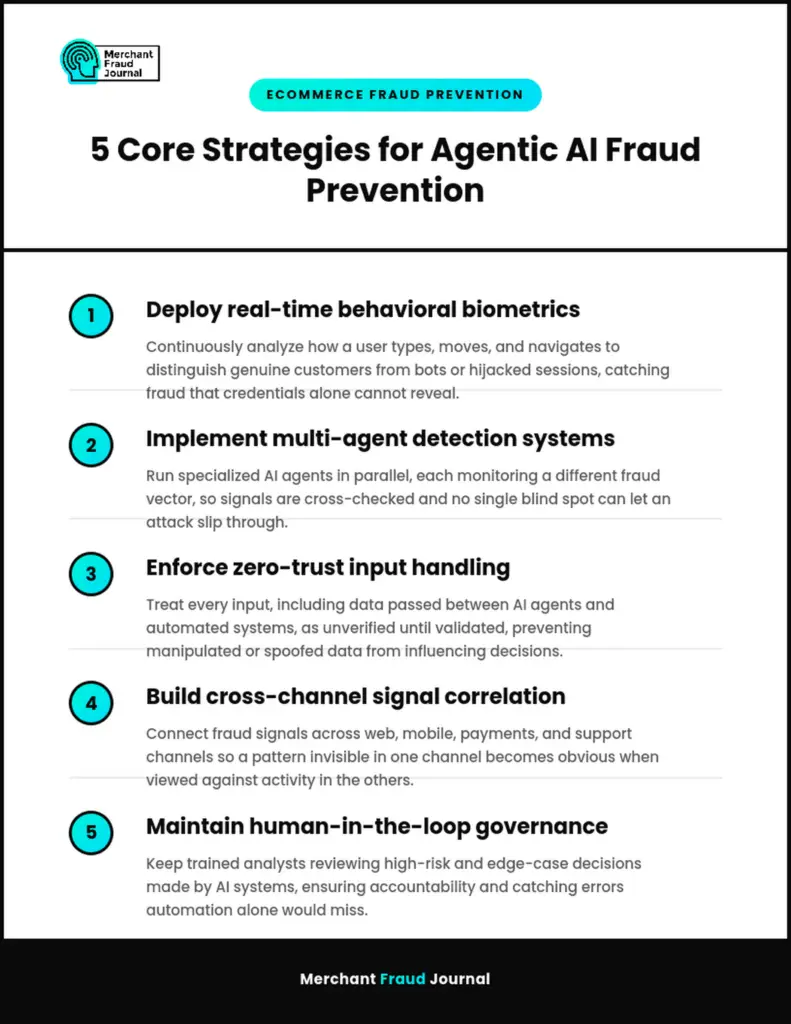
1. Deploy Real-Time Behavioral Biometrics
Device fingerprinting tells you what device is connecting, but device fingerprinting on its own leaves gaps. Behavioral biometrics tell you how that device is being used. AI agents behave differently from humans. They complete forms instantly, keep keystroke timing perfectly consistent, and skip the browsing that real customers do.
Effective behavioral monitoring looks for signals such as:
- Ghost touch patterns: programmatic interactions that lack the micro-variations of human input.
- Impossible velocity: form fields completed faster than any human could type.
- Session anomalies: missing scroll events, absent mouse movements, or perfectly linear navigation through a site.
These signals work best alongside the other payment fraud detection methods already in a merchant’s stack.
2. Implement Multi-Agent Detection Systems
The most effective defense against an agentic attack is often another agent. Defensive agents can monitor sessions continuously, correlate signals across the fraud stack, and respond in real time instead of waiting for batch processing or human review.
This creates an agents vs. agents dynamic in which agentic AI fraud detection matches the speed and adaptability of the attacking systems. Defensive agents need two things to work well: rich signal data, and clear escalation paths for cases where their confidence is low. They are also most effective when they target high-volume bot attacks, such as the credential stuffing and card testing described in these common types of eCommerce fraud.
3. Enforce Zero-Trust Input Handling
Merchants should treat every external input as potentially compromised, including data from their own tools and APIs. This helps prevent prompt injection, where malicious inputs manipulate an AI system into taking actions it shouldn’t. OWASP’s LLM01 prompt injection guidance ranks it as the top risk for LLM applications. It also notes that injected instructions don’t need to be visible to humans to affect a model.
Practical zero-trust measures include:
- Strict separation: keep system instructions isolated from user-provided data.
- Input filtering: block known malicious patterns before they reach reasoning systems.
- Least-privilege access: limit the actions any single agent or system can take on its own.
4. Build Cross-Channel Signal Correlation
Fraudsters count on organizational silos. An account takeover fraud attempt might look normal if you only look at login behavior. The same attempt becomes obvious when you see it next to a recent password reset, a shipping address change, and a high-value purchase, all within the same hour.
Agentic defense systems can maintain that cross-channel view continuously and connect signals that siloed detection tools miss. This is especially useful against AI agent fraud that spreads activity across several touchpoints to stay under single-channel velocity rules.
5. Maintain Human-in-the-Loop Governance
Autonomous doesn’t mean unsupervised. The most effective systems include clear escalation paths for high-stakes decisions. Account freezes, large transaction blocks, and identity verification failures usually warrant human review before final action.
The goal here isn’t to slow the system down. It is to make sure fast autonomous responses don’t produce unacceptable false positive rates or compliance risk. A well-designed system handles routine threats on its own and routes edge cases to human analysts.
| Defense Layer | What It Catches | Response Speed |
|---|---|---|
| Behavioral biometrics | Bot-like interaction patterns | Real-time |
| Multi-agent detection | Coordinated attack sequences | Real-time |
| Zero-trust input handling | Prompt injection, data poisoning | Pre-processing |
| Cross-channel correlation | Multi-vector attacks | Near real-time |
| Human-in-the-loop | Edge cases, high-stakes decisions | Minutes to hours |
Source: Merchant Fraud Journal
Building an Agentic AI Security Framework
Moving from concept to implementation depends on three things: infrastructure, governance, and integration with existing systems.
Data Pipeline Requirements
Agentic systems are only as good as the data they can access. Real-time fraud prevention needs streaming data pipelines that deliver transaction signals, device telemetry, and behavioral data with minimal latency. The batch processing that worked for traditional ML models can’t support the response times agentic defense requires.
Model Governance and Auditability
Autonomous decisions create compliance challenges. Regulators and card networks expect merchants to explain why a transaction was declined or an account was frozen. Agentic systems therefore need thorough logging that records both the decision and the reasoning chain behind it.
Integration With Existing Fraud Stacks
Most merchants won’t replace their entire fraud infrastructure overnight. The best agentic solutions work alongside existing rules engines, ML models, and manual review queues, adding to established processes rather than replacing them. When comparing fraud protection services, look for tools that can take in signals from your current stack and send decisions back into existing workflows.
Tip: Consider starting in shadow mode. In this setup, the agentic system makes recommendations but doesn’t act on its own. It lets you check its performance against existing processes before going live.
Challenges and Risks of Agentic AI Fraud Prevention
Agentic AI fraud prevention isn’t a silver bullet. Knowing its limits helps you deploy it well and avoid costly mistakes.
False Positives and Customer Friction
Aggressive fraud prevention always risks blocking legitimate customers. Agentic systems running at machine speed can generate false positives faster than human review teams can resolve them. The cost of wrongly declined transactions often exceeds the cost of the fraud being prevented, so any rollout should include a plan to reduce eCommerce false declines.
Adversarial Manipulation
Attackers will probe defenses to learn how they work. A system that learns from feedback can be manipulated with carefully crafted inputs that shift its decision boundaries over time. Regular model monitoring and adversarial testing help reveal when a system is being gamed.
Governance and Compliance Gaps
Autonomous decisions can create accountability gaps. When an AI agent declines a transaction, who is responsible? How do you show compliance with fair lending laws or anti-discrimination rules? Merchants need clear answers to these questions before deployment, not after.
4 Best Practices for Implementing Agentic AI Fraud Prevention Tactics
A phased rollout balances speed-to-value against risk. These steps build on core eCommerce fraud prevention best practices rather than replacing them.
1. Start With High-Risk, High-Volume Use Cases
Account creation and login authentication are often the best starting points. They see high attack volumes, have fairly clear success metrics, and deliver quick ROI when automated well. Payment authorization has higher stakes and more complex compliance requirements, so it usually comes later.
2. Establish Clear Escalation Protocols
Define exactly which decisions the agentic system can make on its own and which need human approval. Document these thresholds and review them regularly as you gain confidence in the system.
3. Monitor and Retrain Continuously
Fraud patterns shift constantly. A system trained on last quarter’s attacks will miss this quarter’s new techniques. Build continuous monitoring into daily operations, set regular retraining cycles, and keep up with emerging eCommerce fraud trends.
4. Align With Regulatory Requirements
Card network rules, PCI DSS, and regional regulations such as GDPR all limit how automated decisions can be made. Confirm that your agentic systems can meet documentation and explainability requirements before deployment.
The Future of Agentic AI in Fraud Prevention
The agent-vs-agent dynamic is still in its early stages. Over the next two to three years, expect defensive systems that predict attack patterns before they emerge, coordinate responses across merchant networks in real time, and adapt to new fraud vectors without manual retraining. Adoption is already spreading beyond detection into post-transaction work, including payment processors adding an AI agent to automate chargeback rebuttals.
Put Machine-Speed Fraud Defenses in Place Now
Autonomous attacks are becoming the norm, and merchants still relying on static rules and batch-processed models will fall further behind. Start with one high-volume touchpoint such as account creation or login. Run a defensive agent in shadow mode, and write down which decisions stay with human analysts. Then build the streaming data and audit logging that let you expand safely. The goal isn’t to remove human judgment from fraud prevention. It is to apply human expertise where it matters most and give machine-speed threats a machine-speed response.
Frequently Asked Questions
What is AI fraud prevention?
AI fraud prevention uses machine learning and autonomous agents to spot and stop fraudulent activity in real time, based on behavioral, device, and transaction data. Unlike static rules, it adapts as fraud patterns change.
How does agentic AI prevent fraud in payments?
Agentic AI deploys autonomous agents that investigate a session, check signals such as device fingerprints and behavior, and step up authentication or block the transaction within milliseconds. High-stakes decisions are escalated to human reviewers.
How do companies protect against AI agent fraud?
Companies layer behavioral biometrics, defensive AI agents, zero-trust input handling, and cross-channel signal correlation to catch automated attacks. They also keep humans in the loop for account freezes and large transaction blocks.
Who is liable for AI shopping agent fraud?
Liability for AI shopping agent fraud is still being worked out and currently depends on card network rules, authentication methods, and how the transaction was authorized. Merchants should keep detailed decision logs and review network guidance as agentic commerce rules evolve.
How is AI used in fraud detection and prevention?
AI scores transactions, flags bot-like behavior, links identities across accounts, and increasingly takes autonomous action, such as stepping up verification. It also automates post-transaction work like chargeback evidence collection.
How do you scale AI fraud prevention?
Start with high-volume use cases such as account creation and login, and run new systems in shadow mode before giving them authority to act. Expand autonomy step by step as false positive rates and audit trails prove reliable.

Charity Amancio
Charity Amancio specializes in SaaS solutions for global eCommerce businesses, including payments and risk management applications. She bridges the gap between technology and merchant needs, offering practical perspectives on the tools shaping eCommerce. Her insights appear regularly in B2B publications covering the digital commerce space.
