


Summary
The seven most common types of eCommerce fraud include card-not-present theft, account takeovers, chargeback abuse, return fraud, phishing, triangulation schemes, and promo abuse, all of which threaten online merchant revenue and security.
eCommerce fraud is escalating rapidly, with businesses facing over thousands of cyber attacks monthly and losing billions annually. Now more than ever, knowing the seven most common fraud types and their warning signs is essential for protecting your business and customers. This guide breaks down common types of ecommerce fraud, proven prevention strategies to protect your business, and general warning signs to look for.
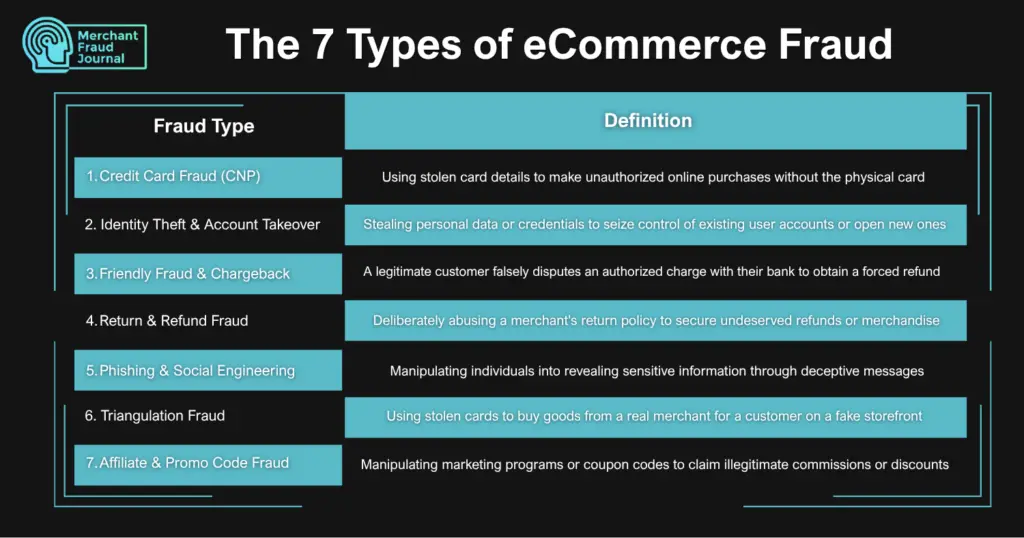
1. Credit Card Fraud (CNP Transactions)
CNP (card-not-present) fraud represents the most pervasive form among various types of eCommerce frauds. This crime occurs when criminals use stolen card information to make unauthorized purchases online, by mail, or over the phone without needing the physical card. They collect stolen credit or debit card information, including CVV (card verification value) numbers, to commit credit card fraud without needing a physical card to buy goods or services.
How credit card fraud works
Fraudsters obtain card information through data breaches, phishing, skimming devices, or stolen credentials from the dark web. They typically begin with small test purchases to verify the card is active. If these go unnoticed, they escalate to larger transactions targeting digital goods or services that can be shipped to untraceable addresses. Bot attacks amplify this threat, enabling hundreds of fraud attempts to occur more quickly with minimal effort.
The growing adoption of faster payment systems worldwide has worsened the problem, allowing fraudsters to move money more quickly than ever while bypassing common card-present restrictions. Instant payment schemes and emerging payment types across many regions give bad actors the speed and flexibility they need to cash out before detection occurs.
How to prevent credit card fraud
Implementing a robust verification system is your most effective safeguard against these deceptive tactics. Prevention requires multiple security layers working together, which include the following:
- Address verification service (AVS) compares the billing address customers enter to the address on file with card issuers. Mismatches don’t automatically mean fraud, but they warrant additional verification.
- Card verification value (CVV) requirements add security because these three or four-digit codes aren’t stored on magnetic strips. Fraudsters find CVVs harder to obtain than card numbers.
- 3D Secure 2.0 protocol adds authentication without excessive friction. New customers may verify identity through fingerprint scans or email codes. Returning customers on the same device often skip extra steps. Enrolling in 3DS shifts liability for authenticated purchases from your business to card issuers.
- Real-time transaction monitoring analyzes purchases as they happen. Machine learning algorithms identify unusual patterns deviating from normal customer behavior. Systems flag transactions based on amount, currency, frequency, or buyer IP (Internet Protocol) address.
- Customer segmentation ensures different monitoring methods for different risk profiles. Segment clients into high, medium, or low risk based on spending patterns, history, and profession. This approach avoids unnecessary friction for legitimate customers while maintaining security.
Every $1.00 lost to fraud costs U.S. merchants $3.75 overall when accounting for product costs, shipping, chargebacks, and additional fees. Preventing CNP fraud protects your bottom line and maintains customer trust.
2. Identity Theft and Account Takeover
Identity theft happens when someone uses your personal or financial information without permission. This stolen information can include names, addresses, credit card numbers, Social Security numbers, bank account numbers, and medical insurance account numbers. Identity thieves obtain personal details such as passwords, ID numbers, and credit card information to act fraudulently in your name.
Account takeover (ATO) fraud is a type of identity fraud in which criminals use your existing credentials to take control of financial, credit, email, or social media accounts. The FBI’s Internet Crime Complaint Center received 4,700 ATO complaints totaling $359.70 million in losses in 2025. Once fraudsters gain unauthorized access, they can withdraw money, make purchases, or extract information to sell or use for accessing additional accounts.
How identity theft and account takeover work
Credential stuffing is one of the many types of eCommerce fraud that businesses must guard against. This method involves using stolen username and password combinations from one data breach to attempt access across other platforms. Cybercriminals often use bots to automate this process, making multiple login attempts across various platforms in a short time.
Phishing remains remarkably effective despite its familiarity. Attackers send deceptive emails, texts, or messages to trick you into revealing login credentials. Some phishing links secretly release malware into your device, which can spread throughout an organization’s IT network. Criminals may also exploit vulnerabilities in software applications your organization uses.
Data breaches provide another avenue for fraudsters, who obtain your login credentials from past security incidents or purchase them from dark web marketplaces. They may also impersonate bank employees, customer support, or technical support personnel to deceive you into giving sensitive information. Scammers may install skimmers at ATMs to digitally capture bank card information, or check your social media accounts to find identifying details.
How to prevent identity theft and account takeover
Fraudsters employ multiple sophisticated techniques to compromise your accounts. You can reduce the risk of unauthorized access and costly financial fraud through these strategies:
- Multi-factor and biometric authentication: Requiring different types of identification beyond passwords, such as unique eye scans, facial recognition, or fingerprints, creates a highly secure login process.
- Risk-based authentication: Examining login locations and contexts alongside passwords helps detect anomalous access attempts.
- Device fingerprinting and IP geolocation: Monitoring unique device characteristics and geographic locations blocks unexpected access from unrecognized regions or devices.
- Credit freezes: Restricting access to your credit reports with all three bureaus makes it much harder for identity thieves to open fraudulent accounts.
- Personal data habits: Storing sensitive items like Social Security cards safely at home, collecting mail daily, and using unique, complex passwords prevent physical and digital theft.
- Account oversight: Regularly reviewing online banking, credit scores, and statements ensures unauthorized transactions are caught and reported immediately.
With account takeover fraud impacting millions of adults and causing billions of dollars in losses annually, taking these protective steps is more critical than ever to defend against this specific eCommerce fraud type. Consistent vigilance and robust security settings remain your best defense against evolving eCommerce threats.
3. Friendly Fraud and Chargeback Abuse
Friendly fraud or chargeback stands apart from other types of ecommerce fraud because the person initiating the dispute is your actual customer, not a criminal with stolen credentials. This form of chargeback abuse occurs when cardholders dispute legitimate purchases by claiming the transactions are fraudulent, even though they authorized and received the items or services themselves.
Around 20% of fraudulent disputes globally represent friendly fraud, with high-volume online merchants experiencing rates up to 30%. Transaction confusion happens when cardholders don’t recognize purchases on banking statements and believe they were victims of fraud. First-party fraud involves unauthorized household users making purchases without the cardholder’s knowledge, such as family members streaming movies using stored payment information.
How friendly fraud and chargeback abuse work
The process begins when cardholders contact their issuing bank rather than your customer service team. Instead of requesting refunds through proper channels, they initiate chargebacks by claiming transactions were unauthorized or that the goods never arrived. Subsequently, the bank files a chargeback on the cardholder’s behalf, forcing you to refund the customer while paying additional chargeback fees.
Intentional abuse proves more damaging. Buyer’s remorse drives customers to reverse transactions through chargebacks rather than following return policies. Liar-buyer fraud involves knowingly exploiting the chargeback process to obtain free goods. Criminal intent cases represent deliberate attempts to receive products without payment.
How to prevent friendly fraud and chargeback abuse
Friendly fraud manifests in multiple forms, often overlapping with various types of fraud in eCommerce. Accidental cases include forgetfulness, where customers genuinely don’t recall purchases, confusion from unclear billing descriptors, misunderstanding the difference between refunds and chargebacks, or family members using shared payment methods without informing account holders.
Implementing the right steps protects your revenue while maintaining a smooth experience for honest customers.
- Optimize billing descriptors: Clear business names on bank statements reduce transaction confusion and prevent customers from accidentally disputing legitimate purchases.
- Provide detailed receipts: Deliver comprehensive order receipts with item details, order numbers, and transaction descriptions to jog customers’ memories.
- Elevate customer service: Making support easily accessible via phone, email, or live chat lets customers resolve issues directly with you rather than escalate to their banks.
- Maintain transparent policies: Display your return and refund policies prominently on your website and in your emails, giving customers a clear, official channel for legitimate complaints.
- Offer real-time tracking: Providing automated shipping updates and tracking information eliminates delivery doubts and helps curb buyer’s remorse.
- Utilize fraud prevention technology: Deploying machine learning algorithms allows you to flag suspicious behavior and identify patterns of abuse before transactions are finalized.
- Prepare for chargeback representment: Gathering detailed transaction records, communication logs, and delivery confirmations ensures you can successfully dispute unjustified claims.
Establishing these defensive layers safeguards your bottom line from the financial drain of administrative fees and lost merchandise. Combining automated eCommerce anti-fraud screening tools with excellent customer support creates a secure ecosystem where fraudulent disputes are stopped.
4. Return and Refund Fraud
Return fraud is a type of eCommerce fraud that represents deliberate abuse of your return policy for financial gain through deceptive means. Customers manipulate the returns process by returning items under false pretenses, seeking undeserved refunds, exchanges, or store credits.
The financial damage extends beyond refund amounts. For every $100 in returned merchandise, retailers lose $13.70 to return fraud. Processing returns costs 66% of the item’s value, and 67% of retailers recover less than half the total value of returned items. Merchants face costs averaging $10 to $20 per return, chargeback fees when applicable, and inventory distortion when products never actually return.
How return and refund fraud works
Wardrobing remains one of the most prevalent return or refund schemes. Customers purchase items with zero intention of keeping them, using products temporarily for events or projects before returning them for full refunds.
Receipt fraud is another scheme that involves using stolen, forged, or digitally altered receipts to return items never purchased or bought at discount prices. Fraudsters present fake receipts showing full retail prices for items acquired through theft or sales. Both of these tactics represent highly destructive types of eCommerce fraud.
Empty box returns involve shipping back packages containing worthless items, bricks, or nothing at all, while claiming original contents remain intact. Component stripping targets electronics, where fraudsters remove valuable parts like processors or memory before returning products as intact. Cross-retailer return fraud exploits price differences by purchasing items at discount stores and returning them to premium retailers at full value.
How to prevent return and refund fraud
Clear policies and utilizing modern tracking technology allow merchants to significantly mitigate the financial risks associated with abusive return behavior. To put this protective approach against this type of eCommerce merchant fraud in action, consider the following tips:
- Establish prominent policies: Define precise expectations for acceptable item condition, original packaging, and receipt documentation, and shorten return windows for seasonal items to prevent switch fraud.
- Require evidence and verification: Demand photo or video proof for damage claims to deter fraudsters, and link every return to a verified order using digital tracking systems that flag serial returners.
- Implement tiered risk profiles: Offer generous terms to first-time buyers with clean histories, but apply shorter windows or mandatory inspections for accounts flagged with high return rates.
- Delay refunds until inspection: Issue refunds only upon physical receipt and inspection of the goods, rather than on delivery confirmation, to prevent tampered-label fraud.
- Deploy fraud detection technology: Use machine learning algorithms to analyze customer behavior alongside AVS to cross-reference IPs, emails, and shipping addresses.
- Train staff and charge fees: Educate your team to meticulously inspect returned items for wear or counterfeits, and enforce restocking fees on high-value merchandise to discourage opportunistic abuse.
Combining diligent staff training with automated detection software creates a formidable barrier against evolving fraud tactics. These safeguards protect your bottom line without compromising the experience of your honest, loyal customers.
5. Phishing and Social Engineering Attacks
Phishing attacks exploit human psychology rather than technical vulnerabilities, making them particularly dangerous for eCommerce businesses. These social engineering tactics manipulate people into revealing sensitive information through deceptive emails, messages, or websites that impersonate trusted sources. Over 90% of targeted attacks start with phishing emails crafted to appear legitimate to specific recipients.
The human element remains the weakest security link. Breaches centered on human factors account for 74% of all incidents, whereas technical defenses continue improving. Phishing serves as the leading malware infection vector, identified in 41% of all security incidents. Social engineering attacks cost retailers millions through disrupted operations, compromised customer data, and damaged brand reputations.
How phishing and social engineering attacks work
Fraudsters pose as reputable entities like banks, payment processors, suppliers, or even customers to steal login credentials and financial details. Attackers craft convincing emails with company logos, professional formatting, and urgent, immediate-response messaging. Subsequently, victims click on malicious links that direct them to fake websites that capture their usernames, passwords, and credit card information.
Various attack types target different vulnerabilities. Email phishing broadcasts generic messages about account problems or security updates to millions of recipients. Spear phishing researches specific individuals, personalizing messages with names and familiar situations. Vishing conducts attacks through phone calls, whereas smishing uses text messages. Whaling targets executives with sophisticated schemes requiring their attention.
How to prevent phishing and social engineering attacks
A comprehensive security strategy that addresses both human behavior and technological vulnerabilities remains an imperative step to combat phishing and social engineering attacks. Setting a multi-layered defense system ensures that even if one security control fails, secondary measures are in place to intercept the threat.
- Conduct security training: Security awareness programs teach staff to recognize warning signs and verify suspicious communications by contacting organizations directly rather than clicking email links.
- Deploy advanced email filters: Robust spam and phishing filters block malicious messages before they ever reach an employee’s inbox.
- Utilize browser protections: Anti-phishing features built into browsers and email clients provide additional, automated layers of protection against known malicious sites.
- Maintain security software: Organizations should regularly update their defensive software, implement strict spam configurations, and enforce routine password changes.
- Verify sender identities: Staff members should manually type official website URLs directly into their browsers rather than following links embedded in unexpected emails.
Combining diligent staff education with proactive technical safeguards creates a highly resilient barrier against cyber threats. Establish continuous security adjustments to protect sensitive corporate data without disrupting daily business operations.
6. Triangulation Fraud Schemes
Triangulation fraud is a sophisticated card-not-present scheme where criminals position themselves between legitimate customers and retailers. This three-party fraud involves genuine shoppers, fraudsters impersonating sellers, and unsuspecting merchants who bear the losses. Triangulation schemes cause over $30 billion in annual losses to legitimate online sellers, with over 40% of Merchant Risk Council members reporting victimization within the past year.
How triangulation fraud schemes work
Fraudsters establish fake storefronts or marketplace seller accounts offering popular items at prices that seem too good to be true. These sites feature high-demand products like electronics, coffee pods, and consumer electronics at steep discounts to attract customers.
When unsuspecting buyers purchase items, fraudsters pocket the payment while simultaneously using stolen credit card information to order identical products from legitimate retailers. The authentic merchant ships directly to the customer’s address, unaware of the fraudulent transaction.
Subsequently, the compromised cardholder discovers the unauthorized charge and requests a chargeback. The legitimate merchant loses both the product shipped and faces refund obligations, whereas the fraudster retains the customer’s payment.
How to prevent triangulation fraud schemes
Triangulation fraud poses a severe threat to e-commerce merchants because it cleverly involves an unsuspecting legitimate shopper as an unwitting accomplice. It is essential to intercept these complex, three-tiered scams before they impact your revenue and brand reputation through clear protocols.
- Deploy ML tools: Real-time fraud detection software analyzes behavioral patterns and instantly flags transaction abnormalities.
- Monitor for duplicate storefronts: Regular web sweeps detect fraudulent copycat sites using your intellectual property and product images to trick consumers.
- Utilize risk-based verification systems: Automated systems cross-reference order details and divert questionable transactions for manual review.
Proactive monitoring and advanced data verification remain your best defenses against sophisticated e-commerce schemes. Implementing these preventive strategies for your digital storefront ensures that both your business assets and your customer relationships remain secure.
7. Affiliate and Promo Code Fraud
Affiliate fraud exploits marketing programs where businesses pay commissions for promoting products. Scammers use illegal tactics to earn commissions without legitimate referrals or actions. Similarly, promo code abuse involves unauthorized use of promotional codes beyond their intended purpose, costing eCommerce businesses billions yearly.
How affiliate and promo code fraud works
Cookie stuffing places tracking cookies on devices without consent to claim commissions from future purchases. Fake leads involve submitting false customer information using bots or stolen data.
Meanwhile, brand bidding occurs when affiliates bid on your branded keywords, diverting organic traffic through their links to steal commissions. For promo codes, fraudsters share exclusive codes publicly on coupon websites, stack multiple discounts against terms, exploit system loopholes, or use automated tools to generate valid codes.
How to prevent affiliate and promo code fraud
Merchants who establish firm boundaries and utilize smart tracking tools can successfully prevent bad actors from exploiting their promotional campaigns. Protect your marketing budget from affiliate and promo code fraud through these strategies:
- Vet affiliates thoroughly: Require all applicants to submit verifiable details, such as active websites or valid tax information, before granting approval into your program.
- Issue single-use coupons: Generate unique, single-use codes that are tied directly to specific customer accounts to prevent unauthorized public sharing.
- Deploy detection software: Implement machine learning tools that automatically detect anomalies and suspicious spikes in coupon redemption patterns.
- Define clear program terms: Set explicit program guidelines that outline prohibited promotional activities and the immediate consequences for violations.
- Scan external channels: Monitor social media platforms and coupon aggregator websites regularly to identify and remove unauthorized code distribution.
Proactive surveillance of your digital footprint prevents online fraud in eCommerce and ensures that your promotional discounts reach the intended target audience. Maintaining this tight control over your marketing channels ultimately secures higher profit margins and preserves the integrity of your brand.
Stay One Step Ahead of Digital Fraudsters
Protecting your eCommerce business from fraud requires more than just recognizing these seven common attack types. Your next step is to install multiple security layers, such as authentication protocols, real-time monitoring, employee training, and clear policies. Start by implementing the prevention strategies most relevant to your business model. Address your highest-risk fraud types first, then expand your defenses progressively.
Stay vigilant, keep your security measures updated. Remember, fraud prevention represents an ongoing process rather than a one-time fix.
Frequently Asked Questions
Why do fraudsters target digital goods over physical products?
Digital goods like gift cards, software, and e-vouchers are targeted because they are delivered instantly and lack physical shipping barriers. This allows fraudsters to immediately resell the digital assets for cash before the stolen credit card is reported and blocked.
Why is identity theft considered the baseline for many eCommerce frauds?
Identity theft involves stealing a victim's personal data, like names, social security numbers, and IP addresses, to create entirely new, fraudulent credit lines or accounts. Once these fake identities are established, criminals use them as a foundation to execute various other shopping scams undetected.
Which type of eCommerce fraud is the hardest for merchants to detect?
Chargeback fraud is difficult to detect because the transaction initially looks completely legitimate, using the customer's real device, IP address, and card details. Merchants usually only discover the fraud weeks later when the bank issues a dispute notice.
What is the best baseline defense for merchants against these 7 types of fraud in eCommerce?
Merchants should implement a multi-layered security strategy that includes address verification services (AVS), card verification values (CVV), and AI-driven fraud detection software. Combining these tools helps analyze user behavior in real-time to flag suspicious patterns before a transaction goes through.
Why is eCommerce fraud increasing globally?
The rise is driven by automated attack bots, the widespread availability of stolen data on the dark web, and the relative anonymity of online shopping. Fraudsters can easily exploit lenient return policies and a lack of strict identity verification without the physical risks of traditional retail theft.

Charity Amancio
Charity Amancio specializes in SaaS solutions for global eCommerce businesses, including payments and risk management applications. She bridges the gap between technology and merchant needs, offering practical perspectives on the tools shaping eCommerce. Her insights appear regularly in B2B publications covering the digital commerce space.