


eCommerce fraud doesn’t just cost you the stolen transaction. It triggers chargebacks that drain revenue, rack up fees, and put your merchant account at risk if dispute ratios climb too high.
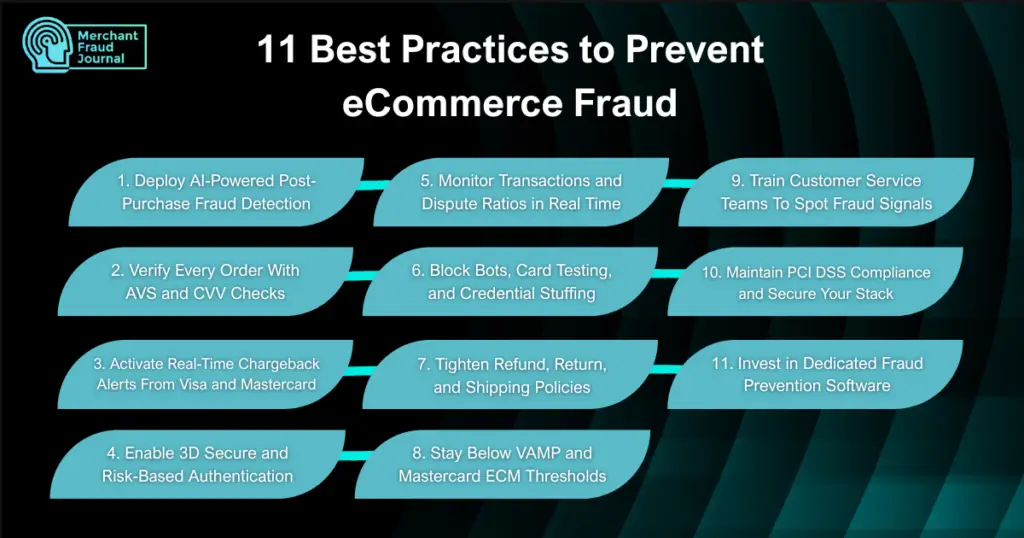
The most effective defense combines multiple layers: AI-driven detection, real-time alerts, strict authentication, and airtight policies working together. Below, you’ll find the 11 practices that actually move the needle to prevent eCommerce fraud and achieve meaningful chargeback reduction, from post-purchase screening to card network compliance.
1. Deploy AI-Powered Post-Purchase Fraud Detection
Pre-checkout fraud tools catch obvious stolen cards, but they miss friendly fraud entirely. Post-purchase AI analyzes device fingerprints, behavioral signals, and network data after checkout but before you ship. That gives you a chance to cancel risky orders.
The most effective solutions tap into data from thousands of merchants to identify digital shoplifters who abuse multiple stores. Chargeflow Prevent, for example, uses a global network of 15,000+ merchants to prevent eCommerce fraud by flagging known abusers before you ship.
The financial urgency here is undeniable. Global eCommerce fraud losses reached $44.3 billion in 2024, and machine learning fraud systems now achieve 95% detection accuracy while reducing false positives by 40%. Even more striking, merchants lose 13 times more to incorrectly declined legitimate orders than to actual fraud, making AI-driven post-purchase screening one of the few tools that protects both revenue and approval rates simultaneously.
2. Verify Every Order With AVS and CVV Checks
Address Verification System (AVS) confirms the billing address matches what the card issuer has on file. Card Verification Value (CVV) verification ensures the buyer has the physical card in hand. Both are baseline fraud checks, easy to implement and effective against amateur fraud. However, they won’t stop friendly fraud since the actual cardholder passes both checks.
The widespread merchant adoption of these tools reflects their proven value in preventing credit card fraud. AVS ranks as the second most implemented fraud detection measure with 82% merchant adoption, just behind card verification numbers at 88%.
3. Activate Real-Time Chargeback Alerts From Visa and Mastercard
Alert networks like Verifi and Ethoca notify you when a cardholder disputes a charge, before it becomes a formal chargeback. You typically have 24–72 hours to issue a refund and prevent the chargeback entirely. Issuing a refund during the alert window saves you the chargeback fee and protects your dispute ratio.
The data on these tools is compelling. A 2024 case study by Verifi showed that combining CDRN (Cardholder Dispute Resolution Network) and RDR (Rapid Dispute Resolution) resulted in a 55% reduction in disputes, allowing merchants to maintain a chargeback-to-sales ratio below 0.9%. Over the long run, since 2011, Ethoca Alerts has helped merchants avoid more than 110 million chargebacks, stopping more than $977 million in fraud in 2023 alone.
4. Enable 3D Secure and Risk-Based Authentication
3D Secure (branded as Verified by Visa or Mastercard SecureCode) adds an authentication step where the cardholder verifies their identity with their bank. The key benefit: liability shifts to the issuing bank for authenticated transactions. Risk-based authentication only triggers the extra step for suspicious transactions. That keeps checkout friction low for legitimate customers while adding merchant fraud protection where it matters.
For merchants, 3DS directly addresses the risk of exposure. When a transaction is authenticated through 3D Secure and later results in a fraud-related dispute, the financial responsibility for that chargeback shifts from the merchant to the card-issuing bank.
5. Monitor Transactions and Dispute Ratios in Real Time
You can’t fix what you can’t see. Real-time dashboards that consolidate data across all your processors help you understand how to prevent eCommerce fraud and spot problems before they escalate.
The cost of delayed visibility can be steep. Without real-time monitoring, surges can push a merchant into card network monitoring programs before they’re even aware of the trend. U.S. merchants are shouldering an excessive 10% of the total global chargeback volume, with U.S. chargeback volume estimated to reach 146 million at a value of $15.3 billion by 2026.
6. Block Bots, Card Testing, and Credential Stuffing
Automated attacks can generate hundreds of fraudulent transactions in minutes. Bot detection, rate limiting, and CAPTCHA at checkout and login pages form your first line of defense. Configure your systems to flag or block excessive transactions from the same IP address, device, or email address within short timeframes.
The scale of automated attacks makes this best practice to prevent eCommerce fraud a priority. For instance, DataDome’s 2025 Global Bot Security Report found that 61.2% of websites are fully unprotected against simple bot attacks, leaving their payment endpoints exposed to carding, credential stuffing, and the creation of fake accounts.
7. Tighten Refund, Return, and Shipping Policies
Clear, enforceable policies reduce opportunities for friendly fraud and serve as a fundamental strategy for how to prevent fraud in eCommerce. Consider requiring signatures for delivery on high-value orders, limiting return windows, and documenting all customer communications. That documentation becomes critical evidence if you fight a chargeback later.
Implementing stringent delivery protocols serves as a powerful deterrent against item not received claims. For instance, an electronics retailer might require a direct signature and photographic proof of delivery for any order exceeding $500. This concrete evidence leaves dishonest buyers with zero room to falsely claim their package never arrived, effectively cutting off a major avenue of opportunistic fraud.
8. Stay Below VAMP and Mastercard ECM Thresholds
Visa’s Acquirer Monitoring Program (VAMP) and Mastercard’s Excessive Chargeback Merchant program trigger when your dispute ratio exceeds their thresholds. Visa’s threshold sits at 0.9%, while Mastercard’s is 1.5%. Consequences include monthly fines starting at $25,000, increased processing fees, and potential account termination. Prevention isn’t just about individual chargebacks. It’s about protecting your ability to process payments at all.
Proactive monitoring of these ratios is vital for the long-term survival of any eCommerce venture. Consistently staying below these limits ensures uninterrupted cash flow and preserves your partnership with major credit card networks.
9. Train Customer Service Teams To Spot Fraud Signals
Your frontline teams often notice patterns before automated systems do. Train them to recognize suspicious behavior, escalate appropriately, and resolve complaints to help prevent eCommerce fraud before customers resort to chargebacks. Strong customer service can turn a potential dispute into a retained customer.
Equipping your staff with the right red flags can stop a fraudulent transaction before the product leaves the warehouse. Customer service representatives should look out for signs like a buyer calling to hurriedly change a shipping address right after order placement, or a customer ordering identical high-value items in different sizes. Spotting these anomalies early allows your team to freeze the order, verify the buyer’s identity, and prevent a costly chargeback.
10. Maintain PCI DSS Compliance and Secure Your Stack
Payment Card Industry Data Security Standard (PCI DSS) compliance is the baseline for payment security. It covers encryption, secure infrastructure, access controls, and regular security audits. Beyond compliance, keep all platforms, plugins, and software updated to patch known vulnerabilities.
Secure your digital infrastructure to prevent devastating data breaches that feed the global fraud ecosystem. Hackers constantly scan eCommerce sites for outdated plugins to inject malicious scripts, such as digital skimmers that steal credit card data in real time. Keeping your stack locked down blocks these vulnerabilities, protecting both your customers’ sensitive financial data and your brand from catastrophic reputational damage.
11. Invest in Dedicated Fraud Prevention Software
Relying solely on manual reviews and basic payment processor tools leaves significant gaps in your defense. Dedicated software solutions to prevent eCommerce fraud of any type bring together machine learning, real-time data, and automated workflows into a single system built specifically to protect eCommerce merchants.
The right software goes beyond flagging suspicious transactions. It automates chargeback dispute management, tracks patterns across your entire order history, and continuously learns from new fraud signals to stay ahead of evolving tactics. Some platforms also offer chargeback guarantees, where the provider absorbs the cost of fraud that slips through their system, turning an unpredictable loss into a manageable, fixed cost.
When evaluating fraud prevention solutions, look for tools that integrate directly with your payment stack, offer real-time reporting, and cover the full fraud lifecycle from pre-checkout screening through dispute resolution. The upfront investment typically pays for itself quickly when weighed against chargeback fees, lost merchandise, and the operational cost of handling disputes manually.
Prevent eCommerce Fraud Consistently and Intentionally
Securing your digital storefront requires a continuous, proactive commitment rather than a temporary fix, making it absolutely critical to adopt and follow the best practices proven by the industry. Online merchants must actively fight eCommerce fraud at every operational milestone. This means establishing a robust, multi-layered strategy that excels at early risk detection, robust pre-transaction prevention, and a seamless response when disputes inevitably occur.
Frequently Asked Questions
What is the difference between fraud prevention and chargeback management?
Fraud prevention focuses on the pre-transaction stage, using screening tools and firewalls to block bad actors before an order goes through. Chargeback management operates post-transaction, focusing on deflecting banking disputes via network alerts or automatically compiling evidence to fight friendly fraud after a chargeback occurs.
Should merchants manually review every single transaction?
No, manual reviews of every transaction slow down the checkout process and create friction for buyers. Merchants should utilize automated software to approve low-risk transactions instantly and route only highly ambiguous, borderline transactions to a human analyst for secondary review.
What are the benefits of using an AI-powered fraud platform?
Dedicated software solutions utilize machine learning models to analyze thousands of data points instantly, matching transactions against massive global merchant networks. These tools automate the approval process, drastically reduce manual review workloads, and maintain high accuracy at scale.

Charity Amancio
Charity Amancio specializes in SaaS solutions for global eCommerce businesses, including payments and risk management applications. She bridges the gap between technology and merchant needs, offering practical perspectives on the tools shaping eCommerce. Her insights appear regularly in B2B publications covering the digital commerce space.