


Fraud protection services are tools and solutions that help businesses reduce financial losses from fraudulent transactions, covering everything from real-time screening to chargeback recovery. In the eCommerce game, these services work across the entire transaction lifecycle: before, during, and after a purchase.
This guide breaks down ten fraud protection service categories that online sellers encounter most often, explains how each one works, and offers practical guidance on choosing the right combination for your business.
What Are Fraud Protection Services?
Fraud protection services are tools that reduce financial losses from fraudulent transactions. They work at different stages of a purchase (before, during, and after) to catch bad actors while letting legitimate customers through. eCommerce merchant fraud protection typically spans three areas:
- Transaction monitoring: Scanning purchases for suspicious patterns in real time
- Dispute management: Handling chargebacks when fraud slips through
- Identity verification: Confirming the customer is who they claim to be
The goal is straightforward: stop fraud before it costs you money, and recover what you can when it does. Done well, fraud protection should feel invisible to genuine shoppers while quietly closing the door on bad actors.
Fraud Detection vs. Fraud Protection vs. Fraud Prevention
Fraud detection, protection, and prevention are terms that are often used interchangeably, which creates confusion. They actually describe different things.
| Term | What it does | When it works |
|---|---|---|
| Fraud detection | Identifies suspicious activity as it happens | During the transaction |
| Fraud prevention | Stops fraud before it occurs | Before the transaction |
| Fraud protection | Umbrella term covering detection, prevention, and recovery | Entire lifecycle |
Imagine fraud protection as the full toolkit. Detection and prevention are specific tools within it. When evaluating vendors, knowing this distinction helps you spot gaps in your current setup.
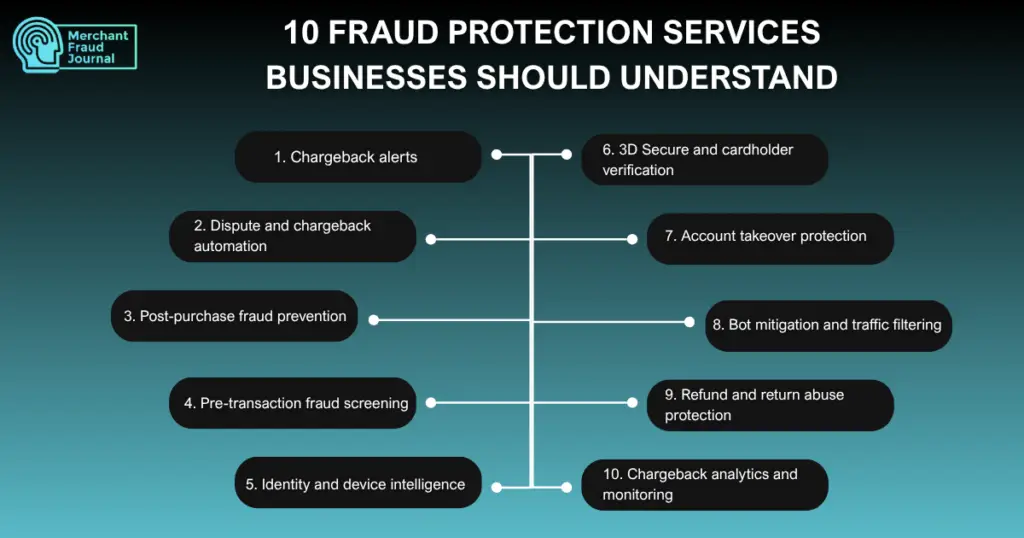
10 Fraud Protection Services Businesses Should Understand
Global ecommerce fraud losses hit $48 billion in 2025, a 16% jump from the year before, and are projected to climb to $107 billion by 2029. The financial toll compounds well beyond the fraud itself: US merchants now lose $4.61 for every $1 of actual fraud once chargebacks, fees, and operational costs are factored in, up 32% since 2022. Numbers like these are why understanding the tools available to fight fraud has become essential rather than optional.
That said, here are the core service categories that eCommerce merchants and payment professionals encounter most often. Each addresses a different piece of the fraud puzzle.
1. Chargeback alerts
Chargeback alerts are real-time notifications from card networks, Visa and Mastercard, delivered through services like Verifi and Ethoca, that warn you before a dispute is officially filed. Platforms like Chargeflow also provide a similar fraud protection service designed for merchants and businesses. When you receive an alert, you can issue a refund to avoid the chargeback entirely.
Why does this matter? Chargebacks carry fees, hurt your dispute ratio, and can eventually threaten your merchant account. Alerts give you a window to act before the damage is done.
How it works: Card network sends alert, merchant refunds, chargeback avoided
Best for: Merchants with dispute ratios approaching card network monitoring thresholds
2. Dispute and chargeback automation
Dispute automation handles the entire chargeback response process, evidence collection, formatting, and submission, without manual intervention. AI-driven systems pull data from your eCommerce platform, payment processor, and shipping provider to build compelling evidence packages.
The result is higher win rates and dramatically less time spent on each dispute. For merchants processing significant volume, automation often pays for itself through recovered revenue alone.
3. Post-purchase fraud prevention
Post-purchase fraud prevention screens orders after checkout but before fulfillment. This is where you catch friendly fraud and policy abuse that pre-transaction tools miss.
What is friendly fraud? It’s when a legitimate customer makes a purchase, receives the product, and then disputes the charge anyway, claiming they never received it or didn’t authorize the transaction.
Post-purchase tools analyze orders using network intelligence, which is data from thousands of other merchants, to identify repeat offenders. They can automatically cancel, verify, or approve orders based on risk scores and your business rules.
4. Pre-transaction fraud screening
Pre-transaction screening assesses risk at checkout, before authorization. These tools analyze signals like device fingerprint, IP address, email reputation, and behavioral patterns to approve or decline in real time.
The tradeoff here is balancing fraud prevention against false declines. Blocking too aggressively means losing legitimate sales. The best systems use machine learning to find that balance, learning from each transaction to improve accuracy over time.
5. Identity and device intelligence
Identity intelligence links device, IP, email, and payment behavior to detect repeat offenders, even when they use new accounts or different payment methods. Device fingerprinting identifies returning fraudsters across sessions by recognizing unique characteristics of their browser, operating system, and hardware.
This is particularly valuable for catching digital shoplifters who exploit return policies or file false chargebacks repeatedly. A single bad actor might hit dozens of merchants before getting caught without network-level intelligence sharing data across stores.
6. 3D Secure and cardholder verification
3D Secure (branded as Visa Secure and Mastercard Identity Check) adds an authentication step during checkout. The cardholder verifies their identity through their issuing bank, typically via a one-time code or biometric.
The key benefit is liability shift. If a chargeback occurs on a 3D Secure transaction, liability shifts to the card issuer rather than the merchant. You also have stronger evidence for your dispute response since the cardholder actively verified the purchase.
7. Account takeover protection
Account takeover (ATO) happens when fraudsters gain access to legitimate customer accounts, often through credential stuffing or phishing. Credential stuffing is when attackers use stolen username/password combinations from data breaches to try logging into other sites, betting that people reuse passwords.
ATO protection monitors login behavior, flags suspicious access patterns, and can require step-up authentication when something looks off. This matters because ATO fraud is harder to detect than new account fraud. The fraudster is using real customer credentials, so traditional fraud signals may not fire.
8. Bot mitigation and traffic filtering
Bots are used for credential stuffing, card testing, and inventory hoarding. Bot mitigation tools distinguish automated traffic from real customers and block malicious requests before they reach your checkout.
Card testing is especially costly. Fraudsters use bots to validate stolen card numbers with small purchases, then use the working cards for larger fraud elsewhere. You eat the chargebacks on those test transactions, plus the fees and ratio damage that come with them.
9. Refund and return abuse protection
Refund abuse, also called policy abuse, occurs when customers exploit return policies or falsely claim non-delivery. These services track abuse patterns across merchants and flag serial abusers.
The challenge is that individual merchants often can’t see the pattern. Someone might abuse your return policy once, but they’ve done it at fifty other stores. Network intelligence makes repeat offenders visible by pooling data across the merchant network.
10. Chargeback analytics and monitoring
Analytics dashboards consolidate dispute data across processors and stores into a single view. They track chargeback ratios, identify problem products or traffic sources, and alert you before hitting card network thresholds.
Staying below Visa and Mastercard monitoring thresholds is critical. Once you’re in a monitoring program, you face additional fees, required action plans, and potential account termination. Analytics help you spot problems early, before they become existential threats to your payment processing.
How to Choose the Right Fraud Protection Service
75% of eCommerce businesses plan to increase their fraud prevention budgets in 2026, with 20% boosting spending by at least 20%, so choosing tools that actually match your risk profile determines whether that investment pays off. Matching services to your specific fraud problems is more effective than buying a generic solution. Here’s how to think through the decision.
1. Match the service to your fraud type
Different fraud types call for different solutions. Stolen card fraud calls for pre-transaction screening. Friendly fraud requires post-purchase prevention and strong dispute evidence. Account takeover demands login monitoring.
Start by auditing your chargeback reason codes. They tell you what kind of fraud you’re actually experiencing, which points you toward the right category of solution.
2. Check platform and processor coverage
Verify native integrations with your eCommerce platform (Shopify, WooCommerce, BigCommerce) and payment processors (Stripe, PayPal, Braintree). Manual data exports and imports create delays and gaps that fraudsters can exploit. The best solutions pull data automatically from your existing stack, so evidence is ready when you need it.
3. Compare pricing models
Pricing models vary widely because the stakes are high: the average chargeback dispute is now valued at $84, and merchants filed over $37 billion worth of disputes in 2026 alone. Hence, understanding how a vendor charges for their service can meaningfully affect your bottom line.
Common pricing structures include:
- Per-transaction fees: Pay for each scanned order
- Success-based pricing: Pay only when disputes are won or chargebacks deflected
- Monthly subscription: Flat fee regardless of volume
Success-based pricing aligns vendor incentives with your outcomes. You only pay when the service delivers results, which reduces risk for merchants testing a new solution.
4. Look for AI and network intelligence
Services powered by machine learning and merchant network data outperform static rule-based systems. Rules can’t adapt to new fraud patterns. AI can, learning from each transaction to improve accuracy.
Network intelligence, defined as shared fraud signals across thousands of merchants, catches repeat offenders that single-merchant data would miss. A fraudster who’s new to your store might already be flagged across the network.
Best practices for layering fraud protection services
False declines cost retailers $443 billion per year globally, nine times more than losses from actual fraud, which is why no single fraud tool can carry the whole burden. Effective protection requires layering multiple solutions across the transaction lifecycle.
- Pre-checkout: Bot mitigation and traffic filtering
- At checkout: Pre-transaction screening and 3D Secure
- Post-checkout: Post-purchase prevention and identity intelligence
- Post-dispute: Chargeback alerts, automation, and analytics
The goal is defense in depth. If one layer misses something, the next layer catches it. And when fraud does slip through, you have the tools to recover revenue and learn from the incident.
Take Control of Fraud With the Right Tools
Knowing these ten fraud protection service categories puts you in a stronger position to evaluate vendors and build a protection strategy that fits your business. The fraud landscape keeps evolving, but the fundamentals (prevention, detection, and recovery) remain constant. Investing in the right combination of these services protects your revenue, your customer trust, and your ability to keep processing payments without interruption.
Frequently Asked Questions
Do small eCommerce businesses need fraud protection services?
Yes, small businesses are often targeted because they typically have weaker defenses. Even low-volume merchants can face account termination if their chargeback ratio exceeds card network thresholds, which sit around 0.9% for Visa and 1% for Mastercard.
How much do fraud protection services typically cost?
Pricing varies widely; some charge per transaction, others use success-based models where you only pay for results. Many services offer free tiers or trials for merchants to evaluate fit before committing to a paid plan.
Can fraud protection services completely stop chargebacks?
No service eliminates chargebacks entirely, but layered protection significantly reduces their frequency and financial impact. The goal is to keep dispute ratios below card network thresholds and recover revenue when chargebacks do occur.
Are fraud protection services worth the investment for low-volume merchants?
For most merchants, yes, the cost of a few chargebacks often exceeds the cost of protection. Success-based pricing models make fraud protection services accessible even for smaller operations since you only pay when the service delivers results.
How long does it take to set up a fraud protection service?
Most modern services offer one-click integrations and can be activated within hours. More complex enterprise deployments with custom configurations may take a few days, but the trend is toward faster, simpler onboarding.

Charity Amancio
Charity Amancio specializes in SaaS solutions for global eCommerce businesses, including payments and risk management applications. She bridges the gap between technology and merchant needs, offering practical perspectives on the tools shaping eCommerce. Her insights appear regularly in B2B publications covering the digital commerce space.
