• Latest
Amazon Fraud Against Sellers and How to Protect Your Business

Amazon Fraud Against Sellers and How to Protect Your Business

November 10, 2026
Handcuffs lie beside stacks of U.S. $100 bills in front of a Department of Justice emblem, symbolizing the DOJ's charges against three individuals in a $129 million deepfake CEO and attorney impersonation fraud scheme.

DOJ Charges Three in $129 Million Deepfake CEO and Attorney Impersonation Scheme

November 9, 2026
A miniature shopping cart holding black “Black Friday” shopping bags sits beside two boxes labeled “Non-Delivery Claims” (with a crossed-out delivery truck icon) and “Fraud Claims” (with a warning shield icon), with a cardboard shipping box and the Chargeflow logo in the background — illustrating chargeback claim types handled during the Black Friday shopping season.

Chargeflow Data Shows Non-Delivery Claims Overtake Fraud as Top Chargeback Category on Black Friday Weekend

November 9, 2026
A Crédit Mutuel Arkéa conference room at dusk, with a wall screen displaying a world map marked “Breached” and “Accès Compromis” at multiple locations alongside a “€100,000,000” figure and “transferring data” warning; the table is covered with stacked papers, a document titled “Incident Report: Third-Party Breach,” a notepad, coffee cups, and a cut network cable.

Hackers Steal About €100 Million From French Bank Crédit Mutuel Arkéa Through Third-Party Provider

November 9, 2026
Four wooden blocks labeled “Chargebacks,” “Manual Fraud Reviews,” “45%,” and “98%” with downward arrows, connected by a blue curved arrow pointing toward the Sardine logo in the background — illustrating reductions in chargebacks and manual fraud reviews achieved with Sardine’s fraud prevention platform.

Raise Cuts Chargebacks 45% and Manual Fraud Reviews 98% With Sardine

November 6, 2026
A clipboard with a “Fraud Prevention Checklist” listing checked items — monitor for suspicious orders, verify customer identity, use fraud detection tools, set transaction limits, and review high-risk orders — next to a miniature shopping cart holding a gift-wrapped box with a “Black Friday” price tag, and red and black shopping bags in the background.

Black Friday Fraud Prevention Checklist for eCommerce Merchants in 2026

November 6, 2026
A fishing hook pierces a stack of credit cards, with a black card reading “REVOLVE” on top, next to a laptop and a miniature shopping cart in the background — illustrating phishing fraud targeting payment card information in online shopping.

Revolve Says Attackers Stole Customer Payment Card Data Ahead of Holiday Shopping Season

November 4, 2026
A translucent glowing shield icon with a padlock, held up by a hand, stops a line of falling wooden dominoes while three wooden blocks beside it show icons of a masked thief, a credit card, and an envelope — symbolizing security protection against identity theft, payment fraud, and email scams.

PYMNTS Study Finds 59% of Firms Using Three or More AI Fraud Tools Stop 90% of Attempts Before Loss

November 4, 2026
A businessman in a suit holds a magnifying glass over a row of wooden blocks printed with robot-face icons, next to a final block reading “4,000 AI AGENTS,” symbolizing scrutiny or oversight of AI agent deployment.

RSA CEO Says a Midsize Bank Believed It Had No AI Agents, but RSA Found 4,000

November 4, 2026
Instagram Link Email to Receive Payment Scam Explained for Online Sellers

Instagram Link Email to Receive Payment Scam Explained for Online Sellers

November 4, 2026
What Is Smishing? How SMS Phishing Puts eCommerce Merchants at Risk

What Is Smishing? How SMS Phishing Puts eCommerce Merchants at Risk

November 3, 2026
Two wooden blocks on a desk, one showing a shield-and-padlock icon and the other reading “FRAUD DETECTION,” with a hand holding a magnifying glass over a digital screen displaying a red warning triangle and the word “FRAUD” against a binary-code background; a laptop, notebook, and pen are visible in the background.

PYMNTS Survey Finds Stark AI Fraud Detection Adoption Gap Among Finance Teams

November 3, 2026
A miniature shopping cart holding small paper shopping bags sits on a wooden desk beside a tabletop sign reading “REFUND” with a circular arrow icon, while a person in the background holds a paper shopping bag and reviews a printed receipt.

Ravelin Survey Finds 27% of Shoppers Admit to Refund Abuse, Calls Them “Refundjackers”

November 3, 2026
  • Contribute
  • Contact Us
  • About
  • Join Us
  • Advertise
Tuesday, November 10, 2026
Merchant Fraud Journal
ADVERTISEMENT
  • Home
  • Articles
    • Chargebacks
    • Fraud Prevention
    • Influencer Insights
  • Resources
    • Recorded Webinars
    • Podcasts
    • Vendor Directory
    • eCommerce Fraud Reports
    • Training and Certifications
    • Jobs Board
    • Associations and Non-Profits
  • News
No Result
View All Result
Merchant Fraud Journal
No Result
View All Result

Amazon Fraud Against Sellers and How to Protect Your Business

by Charity Amancio
November 10, 2026

Amazon fraud against sellers covers any scheme that uses Amazon’s marketplace rules, return policies, or payment protections to take money or inventory from a legitimate business. The most damaging forms come from buyers and rival sellers rather than outside hackers. They include refund and return fraud, false A-to-z Guarantee claims, chargebacks on delivered orders, counterfeit listings, and review manipulation. Each one costs sellers revenue, inventory, or account health, and most can be prevented or contested when sellers know how the schemes work and keep the right evidence.

How Amazon Fraud Affects Sellers

Amazon protects shoppers generously, and fraudsters exploit that generosity. When a refund, claim, or dispute goes against a seller, the cost often includes the product, the shipping, the fees, and a hit to performance metrics. Amazon expects sellers to keep their Order Defect Rate below 1% of orders over a 60-day period, and A-to-z claims and some chargebacks count toward that limit. A run of fraudulent claims can push an otherwise healthy account toward suspension.

Amazon fights fraud at scale. Its 2025 Trustworthy Shopping Experience report says the company seized and disposed of more than 15 million counterfeit products in 2025 and has pursued more than 32,000 bad actors through litigation and criminal referrals since 2020. Platform enforcement still leaves sellers responsible for defending their own orders and listings.

Common Types of Amazon Seller Fraud

Amazon seller fraud falls into a handful of patterns. The table below summarizes the most common ones and what each costs a business.

Fraud type How it works Main cost to sellers
Refund and return fraud Buyers return empty boxes, used items, or different products, or claim items never arrived Lost inventory and refunded revenue
A-to-z Guarantee claim abuse Buyers file false claims of non-delivery or items not as described Refunds and Order Defect Rate damage
Chargeback fraud Buyers dispute card charges for orders they received Lost revenue, fees, and possible ODR impact
Counterfeits and listing hijacking Unauthorized sellers attach to your listing and ship fakes Lost sales, negative reviews, and brand damage
Review manipulation Rivals post fake negative reviews or buy fake positive ones for their own products Lower conversion and possible policy flags

Phishing, fake support calls, and brushing round out the list of common Amazon scams that reach sellers through messages rather than orders. The sections below focus on fraud that targets orders, inventory, and listings.

Refund and Return Fraud on Amazon

Amazon return fraud is the most common seller-side problem because the return process favors the customer. Buyers can often start a return without contacting the seller, and refunds are sometimes issued before the item arrives back. The problem extends well beyond Amazon. Appriss Retail’s 2025 returns research found that about $100 billion of the $706 billion in merchandise returned in the U.S. in 2025 was lost to fraud and abuse.

Common Amazon Refund Scam Tactics

Sellers report the same handful of tactics again and again.These tactics include the following:

  • Empty box returns, where the buyer ships back a box with nothing inside or with filler that matches the item’s weight
  • Item swaps, where a buyer returns a cheaper, broken, or counterfeit version of the product
  • Wardrobing, where a customer uses an item once and returns it as unwanted
  • False non-receipt claims, where a buyer says a delivered package never arrived

The Amazon empty box scam and item swaps are hard to prove without photos or weight records from both ends of the shipment. Sellers who document outgoing orders are in a much stronger position when they request reimbursement.

The Rise of Refund Fraud as a Service

Many fraudulent refunds come from organized groups that sell refund fraud as a service. Customers pay these groups a fee to manipulate the return process on their behalf. Amazon’s update on dismantling fraud-as-a-service groups describes how its lawsuit against a group called REKK became the model for later cases, including five civil lawsuits against refund fraud groups filed in September 2025. Related tactics such as refund abuse and refundjacking now appear across eCommerce.

A-to-z Guarantee Claims and Chargebacks

A-to-z claims and chargebacks are the two formal ways buyers dispute Amazon orders. Both are legitimate protections, and both are open to abuse.

1. A-to-z Guarantee Claim Abuse

An A-to-z Guarantee claim asks Amazon to step in when a buyer says a seller failed to deliver an item or resolve a problem. Buyers can sometimes file one without contacting the seller first. Fraudsters use these claims to get refunds on items they received, especially when tracking is weak or a delivery scan is missing. Respond to every claim with tracking, delivery confirmation, and message history, because claims decided against the seller can count as order defects.

2. Amazon Chargebacks

An Amazon chargeback happens when a buyer disputes a charge with their card issuer instead of going through Amazon. According to Amazon’s seller guidance on chargebacks, Amazon handles fraud-related chargebacks such as stolen card cases, while sellers are responsible for service-related ones such as claims of non-receipt. Sellers should respond to a chargeback alert within seven calendar days with the shipping date, shipping method, and tracking details. The issuing bank’s decision is usually final, so the first response matters. Many of these disputes follow the same pattern as friendly fraud in other sales channels.

Counterfeits and Listing Hijacking

Counterfeit sellers do more than copy products. They attach themselves to legitimate listings and take sales and reputation from the brand owner.

How Amazon Hijackers Operate

An Amazon hijacker adds itself as another seller on your product page, often at a lower price, and ships counterfeit or inferior goods. Buyers blame the brand for poor quality, leave negative reviews, and file claims. The damage lands on your listing even though you never shipped the item.

Tools That Protect Brand Owners

Enroll in Amazon Brand Registry to gain more control over listing content and access the Report a Violation tool. Transparency adds unique codes to each unit so Amazon can verify authenticity before an order ships, and Project Zero lets approved brands remove counterfeit listings directly. Make test buys from suspicious sellers and keep the records, because documented Amazon counterfeit evidence strengthens every takedown request.

How to Protect Your Business From Amazon Fraud

Amazon fraud prevention depends on documentation, fast responses, and steady monitoring. These steps cover the risks sellers face most often.
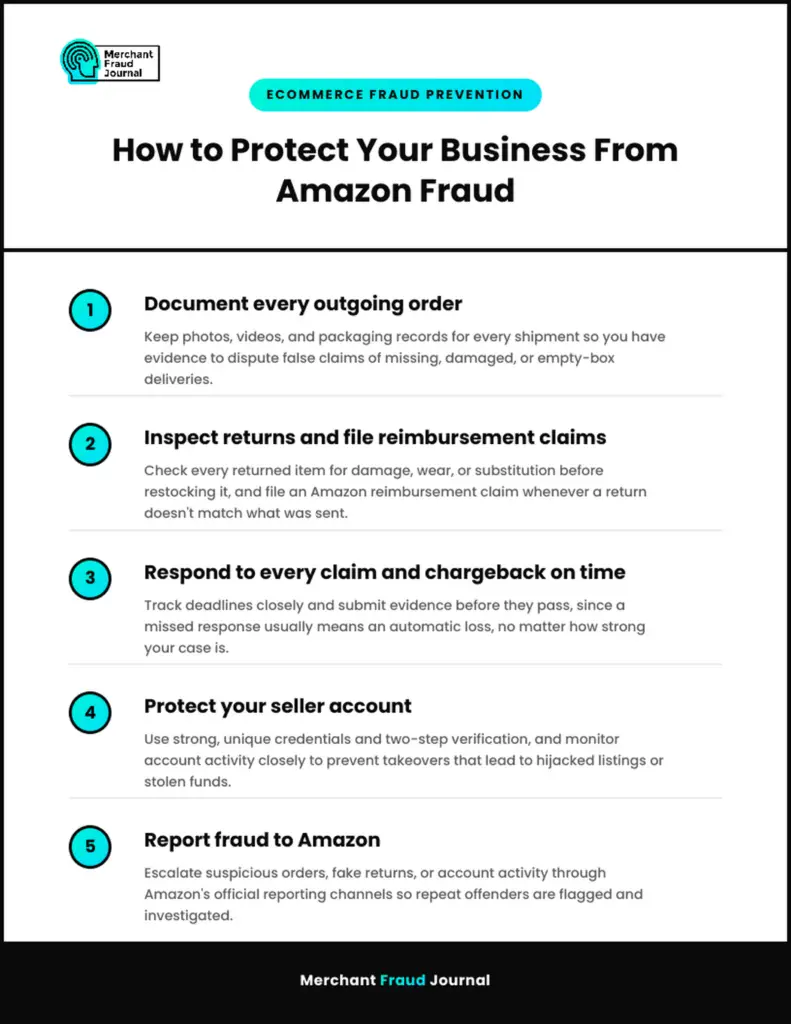
Merchant Fraud Journal infographic titled “How to Protect Your Business From Amazon Fraud,” tagged “Ecommerce Fraud Prevention,” with five numbered tips: 1) Document every outgoing order — keep photos, videos, and packaging records for every shipment so you have evidence to dispute false claims of missing, damaged, or empty-box deliveries; 2) Inspect returns and file reimbursement claims — check every returned item for damage, wear, or substitution before restocking it, and file an Amazon reimbursement claim whenever a return doesn’t match what was sent; 3) Respond to every claim and chargeback on time — track deadlines closely and submit evidence before they pass, since a missed response usually means an automatic loss, no matter how strong your case is; 4) Protect your seller account — use strong, unique credentials and two-step verification, and monitor account activity closely to prevent takeovers that lead to hijacked listings or stolen funds; 5) Report fraud to Amazon — escalate suspicious orders, fake returns, or account activity through Amazon’s official reporting channels so repeat offenders are flagged and investigated.

1. Document Every Outgoing Order

Photograph or record high-value items as they are packed, log package weights, and use tracking with delivery confirmation and signature for expensive orders. Serial numbers and tamper-evident packaging make item swaps much easier to prove.

2. Inspect Returns and File Reimbursement Claims

Check returns as soon as they arrive and compare them against your packing records. For seller-fulfilled orders, a SAFE-T claim lets you request reimbursement when a buyer returns an item that is damaged, used, or different from what you shipped. FBA sellers can request reimbursement when Amazon loses or damages inventory or when a refunded item never makes it back to the warehouse.

3. Respond to Every Claim and Chargeback on Time

Set up alerts for A-to-z claims and chargeback notices, respond within the deadline, and attach tracking, photos, and buyer messages. Check your Order Defect Rate weekly so you can spot a fraud pattern before it threatens your account.

4. Protect Your Seller Account

Turn on two-step verification, limit user permissions in Seller Central, and watch for changes to bank details or login settings. Learning the signs your Amazon seller account has been hacked helps you act before payouts are redirected.

5. Report Fraud to Amazon

Amazon fraud reporting works best with clear evidence. Report abusive buyers and suspicious claims through Seller Support, use the Report a Violation tool in Brand Registry for counterfeits and hijackers, and flag fake reviews through Amazon’s review reporting options. Keep a log of every case so repeat offenders are easier to show.

Keep Amazon Fraud From Eating Into Your Margins

Amazon fraud costs sellers more than the value of a single order. Each fraudulent refund, false claim, or hijacked listing chips away at inventory, margins, and account health. The sellers who lose the least treat documentation as routine, respond to every claim on time, protect their brand with Amazon’s own tools, and report repeat offenders. Put those habits in place now, and the next fraudulent return or claim becomes a recoverable cost instead of a permanent loss.

Frequently Asked Questions

How does Amazon detect fraud?

Amazon uses automated systems and investigators to screen sellers, listings, reviews, and transactions for suspicious patterns. It also pursues bad actors through lawsuits and criminal referrals, and reports more than 32,000 pursued since 2020.

How do I report fraud to Amazon as a seller?

Sellers can report abusive buyers and suspicious claims through Seller Support in Seller Central. Brand owners can report counterfeits and listing hijackers with the Report a Violation tool in Amazon Brand Registry.

What is an A-to-z claim on Amazon?

An A-to-z Guarantee claim is a buyer's request for Amazon to investigate an order when they believe the seller failed to deliver or resolve a problem. Claims decided against the seller can count toward the seller's Order Defect Rate.

Who pays for chargebacks on Amazon?

Amazon covers fraud-related chargebacks, such as those involving stolen cards. Sellers are responsible for service-related chargebacks, such as claims that an item never arrived, unless they win the dispute.

What is the Amazon refund scam?

For sellers, the Amazon refund scam usually means buyers who get refunds by returning empty boxes, swapped items, or nothing at all, often with help from organized refund fraud groups. A separate version targets shoppers with fake refund messages designed to steal account or payment details.

Can Amazon sellers get reimbursed for fraudulent returns?

Yes, sellers can file a SAFE-T claim on seller-fulfilled orders, and FBA sellers can request reimbursement for lost, damaged, or unreturned inventory. Strong evidence, such as packing photos and weights, improves the chance of approval.

 

Picture of Charity Amancio

Charity Amancio

Charity Amancio specializes in SaaS solutions for global eCommerce businesses, including payments and risk management applications. She bridges the gap between technology and merchant needs, offering practical perspectives on the tools shaping eCommerce. Her insights appear regularly in B2B publications covering the digital commerce space.

TweetShareSend
Previous Post

DOJ Charges Three in $129 Million Deepfake CEO and Attorney Impersonation Scheme

Search:

No Result
View All Result

Our Latest Reports

Fraud Trends Report

Consumer Payments Survey Report

Fraud Prevention Tactics that Enable Exceptional Customer Experience

ATO Fraud In Retail Report

3 Ways a Unified Chargeback Management and Fraud Platform Increases Revenue

Digital Trust And Safety Report: Combating the Evolving Complexities of Payment Fraud

On-Demand Webinars

New Trends in The Payments Ecosystem

Balancing Customer Experience and Fraud Prevention: What’s the Secret?

Stopping Fraud Across the Customer Lifecycle

Addressing Payment Fraud and the Customer Experience in 2022


Quick Navigation

  • Home
  • News
  • Join Us
  • About Us
  • Contact Us
  • Advertise
  • Contribute
  • Privacy Policy

Privacy Policy

Our Privacy Policy
Our Terms of Use

Resources

  • Articles
  • eCommerce Fraud Reports
  • eCommerce Fraud Webinars
  • Associations and Non-Profits
  • Podcasts
  • Vendor Directory
  • Chargeflow – AI Chargeback Management

Featured Vendors

  • Signifyd
  • TransUnion
  • PayRetailers
  • Spotrisk
  • CB-ALERT
  • Chargeflow
  • Corepay
  • AtData
No Result
View All Result
  • About Merchant Fraud Journal
    • Interested in Contributing or Guest Posting to Merchant Fraud Journal?
    • Merchant Fraud Journal Editorial Guidelines
  • Advertise on Merchant Fraud Journal
  • Articles
    • Chargebacks
    • Fraud Prevention
    • Influencer Insights
  • Contact Us
  • Download Addressing Payment Fraud and Customer Experience Report
  • Download Chargebacks Consumer Survey Report 2022
  • Download Evolving Complexities of Payment Fraud Report
  • Download Fraud Prevention Tactics that Enable Exceptional Customer Experiences Report
  • Download Merchant Fraud Journal 2023 Fraud Trends Report
  • Download Merchant Fraud Journal 2024 Fraud Trends Report
  • Download Merchant Fraud Journal Generative AI Fraud Prevention Checklist for SMBs
  • Download Quantifying the Challenge of Friendly Fraud: Your Post-purchase Strategy for the Future
  • Download the 2020 Chargeback and Representment Report
  • Download the 2020 Merchant Fraud Journal Vendor Guide
  • Download the 2021 Fraud Trends Report
  • Download the 2022 Fraud Trends Report
  • Download the 2023 Consumer Payment Trends Report
  • Download the 3 Ways a Unified Chargeback Management and Fraud Platform Increases Revenue Report
  • Download the MFJ 2022 Customer Experience Report
  • Download the MFJ ATO in Retail Report
  • Home
  • Home Elementor
  • Job Dashboard
  • Join The Merchant Fraud Journal Community
  • Merchant Fraud Journal Advertising Agreement
  • Merchant Fraud Journal Advertising Agreement – Signifyd
  • MFJ Fraud Trends Report Giveaway
  • News
  • Post a Job
  • Privacy Policy
  • Resources
    • #9978 (no title)
    • 2020 Chargeback Representment Guide for Merchants
    • 2020 Vendor Guide
    • 2023 Consumer Payments Survey Report
    • 3 Ways a Unified Chargeback Management and Fraud Platform Increases Revenue
    • 8 Fraud Prevention Training and Certifications: A 2026 Guide
    • Addressing Payment Fraud and the Customer Experience in 2022
    • Associations and Non-Profits
    • ATO Fraud In Retail Report
    • Balancing Customer Experience and Fraud Prevention: What’s the Secret?
    • Chargebacks Consumer Survey Report 2022
    • Digital Trust & Safety: Combating the Evolving Complexities of Payment Fraud
    • eCommerce Fraud Reports
    • eCommerce Fraud Webinars
    • Fraud Prevention Tactics that Enable Exceptional Customer Experiences
    • How to Build a Recession Proof Chargeback Prevention Strategy
    • How to Reduce Customer Friction During Holiday Sales Season
    • How to Stop Fraud During the 2022 Holiday Season
    • Jobs Board
    • Merchant Fraud Journal 2023 Fraud Trends Report
    • Merchant Fraud Journal’s Fraud Trends 2020 Report
    • Merchant Fraud Journal’s Generative AI Fraud Prevention Report: A Checklist for SMB Companies
    • Merchant Fraud Journal’s Fraud Trends 2021 Report
    • Merchant Fraud Journal’s Fraud Trends 2022 Report
    • MFJ’s 2022 Customer Experience Report
    • Podcasts
    • Prevent High-Velocity Fraud Attacks During the 2021 Holiday Season
    • Quantifying the Challenge of Friendly Fraud: Your Post-purchase Strategy for the Future
    • Stopping Fraud Across the Customer Lifecycle
    • The surprisingly easy way to secure your payment data, reduce your risk, and win the war on ecommerce fraud
    • Vendor Directory
    • Webinar – Addressing Payment Fraud and the Customer Experience in 2022
    • Webinar – Mitigating Fraud and Risk on the ACH Network
    • Win January Chargeback Disputes
  • Subscribed
  • Terms and Conditions

© 2026 Merchant Fraud Journal

Not enough quota to unlock this post
Unlock left : 0
Are you sure want to cancel subscription?