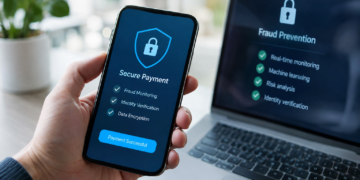


Fintech fraud prevention protects digital-first financial products from attacks that exploit remote onboarding, instant transactions, and API-driven architectures, threats that traditional bank fraud controls were never built to handle.
The speed that makes neobanks and digital lenders attractive to customers also makes them attractive to fraudsters: when an account opens in minutes and money moves in seconds, the window for catching fraud shrinks to nearly nothing. The answer is a layered defense that verifies identity at onboarding, authenticates behavior on every session, and monitors accounts for as long as they stay open.
What Makes Digital-First Financial Products Different
The core difference comes down to verification. Traditional banks have always relied on physical touchpoints: a branch visit, a face-to-face ID check, a teller watching someone sign a document. Digital-first fintech products have none of that. Every interaction happens through a screen, so every defense depends on data signals rather than human observation.
That creates the central tension in fintech fraud prevention. The frictionless experience that attracts legitimate customers also attracts fraudsters who can open accounts, move money, and vanish without ever revealing their true identity.
No Physical Branch Means No Face-to-Face Verification
In a branch, a teller can ask for a driver’s license, compare a face to a photo, and flag something that feels off. That human judgment layer disappears entirely in digital-first products.
Identity verification instead happens through document uploads, selfie matching, and database checks. These controls stop casual fraud attempts, but sophisticated attackers now defeat document verification with synthetic documents and deepfake images, and deepfake-driven identity fraud is growing fast. Without in-person verification, automated systems carry the entire burden of confirming who a customer really is.
Instant Account Opening and Real-Time Money Movement
Speed is the product for most digital-first financial services. Neobanks and fintech apps compete on how quickly a customer can go from download to funded account, and many advertise account opening in a matter of minutes.
That same speed compresses the detection window to nearly zero. Traditional banks had days or weeks to catch problems before funds cleared.
Digital-first products often have seconds, and money can leave through instant payment rails with no clawback window before a suspicious pattern even emerges. That is why instant payment fraud ranks among the top concerns for digital-first products, and why many firms are still catching up on fraud controls for real-time payments.
Unique Fraud Challenges in Digital-First Fintech
Digital banking fraud differs from traditional eCommerce or banking fraud in three important ways: attack vectors are more sophisticated, detection windows are shorter, and mistakes cut both directions. Blocking legitimate customers hurts just as much as letting fraud through.
Synthetic Identity Fraud at Onboarding
Synthetic identity fraud creates a fake person from a mix of real and fabricated information. A fraudster might pair a legitimate Social Security number (often belonging to a child, an elderly person, or a recent immigrant who isn’t actively using credit) with a fake name and address. Understanding how synthetic identity fraud works makes it clear why these profiles are so hard to spot.
- Long-con approach: Fraudsters often spend months building credit history before cashing out, which makes early detection extremely difficult.
- Detection difficulty: No single data point looks fraudulent in isolation, because each piece of information is technically real.
- Scale potential: Fraud rings use automated tools to create hundreds of synthetic identities at once.
The danger for digital-first products is that synthetic identities can pass standard KYC verification. Each data element is technically valid when checked against databases, so the fraud only surfaces months later when the customer defaults on a credit line or drains an account.
The Federal Reserve’s Synthetic Identity Fraud Mitigation Toolkit puts the scale in perspective: synthetic identity fraud cost US financial institutions an estimated $20 billion in 2020.
Account Takeover Through Credential Stuffing
Account takeover fraud (ATO) happens when a fraudster gains access to a legitimate customer’s account. In digital-first products, ATO often starts with credential stuffing attacks: automated scripts that test stolen username and password combinations from data breaches against login pages.
The challenge is that credential stuffing uses real credentials. The login looks legitimate because it technically is, just performed by the wrong person. Device fingerprinting and behavioral biometrics help flag when a known device or behavior pattern changes, but sophisticated attackers mimic the account holder’s device type, location, and interaction style.
The OWASP Credential Stuffing Prevention Cheat Sheet recommends layering multi-factor authentication, breached-password screening, and rate limiting to raise the cost of these attacks.
API and Open Banking Attack Surfaces
Digital-first products rely heavily on APIs (application programming interfaces) to connect with banking partners, payment processors, and third-party services. Each API endpoint is a potential attack vector that traditional banks rarely had to consider.
Open banking rules in many markets require financial institutions to share customer data through APIs when customers consent. That enables innovation and competition, but it also creates new openings for fraud: one compromised API key or poorly secured endpoint can expose thousands of accounts.
The Banking-as-a-Service (BaaS) model adds another layer of exposure, which is why regulators have raised BaaS compliance expectations for sponsor banks. Fraudsters also trade pre-verified accounts and identities, which lets them skip onboarding controls entirely.
Balancing Friction and Conversion
Every fraud control adds friction, and every friction point reduces conversion. Digital-first products live and die by conversion metrics, which puts constant pressure on fintech fraud prevention teams to strip out security steps.
The result is an optimization problem with no perfect answer. Block too aggressively and legitimate customers leave after false declines, often for good. Block too loosely and losses mount while banking partnerships come under strain. Finding the balance takes continuous testing, adjustment, and a clear plan for reducing false declines without opening the door to fraud.
The table below compares how each challenge lands at a traditional bank versus a digital-first fintech.
Fintech fraud impact comparison
| Challenge | Traditional Bank Impact | Digital-First Fintech Impact |
|---|---|---|
| Synthetic identity fraud | Moderate (caught at branch) | Very High (passes automated KYC) |
| Credential stuffing | Moderate (slower systems) | High (instant access, instant transfers) |
| API exploitation | Low (limited API exposure) | High (API-first architecture) |
| Conversion pressure | Low (captive customers) | Very High (competitive market) |
Source: Merchant Fraud Journal
Building a Fintech Fraud Prevention Stack
Effective fraud detection in fintech requires multiple layers working together. No single tool catches everything, and the strongest defenses combine real-time signals with historical pattern analysis across the entire customer lifecycle.
Real-Time Identity Verification and KYC
KYC verification is the first line of defense at onboarding and the main tool for stopping onboarding fraud. Modern KYC combines document verification, biometric matching, and database checks to confirm that a new customer is who they claim to be. It also sits inside the broader KYC and AML requirements that regulators and sponsor banks expect fintechs to meet.
The standards are changing as well: NIST’s Digital Identity Guidelines (SP 800-63-4), finalized in July 2025, added controls for injection attacks and forged media such as deepfakes.
The most effective approaches use several signals at once rather than relying on any single check:
- Document authenticity: Checking uploaded IDs for signs of tampering, forgery, or digital manipulation.
- Liveness detection: Confirming that a selfie comes from a live person rather than a photo, video, or deepfake.
- Database cross-referencing: Matching submitted information against credit bureaus, government records, and fraud consortium databases.
- Device intelligence: Analyzing the onboarding device for fraud signals such as emulators, VPNs, or links to known bad actors.
Device and Behavioral Biometrics
Device fingerprinting creates a unique identifier for each device based on hardware characteristics, browser settings, installed fonts, and other technical signals. When a known fraudster’s device appears on a new account, the system can flag it immediately.
Behavioral biometrics go further and analyze how a user interacts with an app. Typing patterns, swipe gestures, scroll speed, and navigation habits form a behavioral signature that is hard for fraudsters to replicate.
A sudden change (faster typing, unfamiliar navigation, new gestures) can signal account takeover even when the login credentials are correct. The same signals expose automation. That matters more as fraud rings shift to bots and AI agents that complete applications at machine speed, warranting practices for agentic AI fraud prevention.
Continuous Monitoring Beyond Onboarding
Fintech fraud prevention cannot stop at account opening. Many schemes involve clean-looking onboarding followed by suspicious activity weeks or months later, particularly synthetic identities that need time to build credibility.
Continuous monitoring tracks transaction patterns, login behavior, and account changes over time. Machine learning fraud prevention models flag anomalies such as sudden changes in transaction velocity, unusual transfer destinations, or logins from new locations.
Signals gathered at onboarding feed ongoing risk scoring, and unexpected shifts in behavior can trigger identity re-verification. This layer carries much of the fintech fraud detection workload, because the riskiest activity often comes after a successful login rather than during it.
Tip: The strongest fraud programs treat onboarding and ongoing monitoring as one continuous process rather than separate functions. Connecting data across the customer lifecycle catches fraud that point-in-time checks miss.
Build Fraud Defenses Designed for Digital-First Finance
Digital-first financial products face fraud challenges that traditional controls were never designed to handle. Remote onboarding, instant transactions, and API-driven architecture create attack surfaces that demand purpose-built defenses.
Start with robust identity verification at onboarding. Add device and behavioral biometrics for ongoing authentication, and run continuous monitoring to catch what slips through. Each layer compensates for the weaknesses of the others, and none provides complete protection alone.
For fraud and payments teams, the priority is clear: treat digital-first fraud as its own discipline, build defenses that match the speed and scale of the attacks, and keep adjusting as fraudsters change tactics.
Frequently Asked Questions
How do you prevent fraud in fintech?
Layer identity verification at onboarding, device and behavioral biometrics on every session, and continuous transaction monitoring for the life of the account. No single control catches everything, so each layer covers gaps the others leave.
How can fintech companies prevent onboarding fraud?
Combine document authenticity checks, liveness detection, database cross-referencing, and device intelligence during sign-up. Using these signals together catches synthetic and stolen identities that could pass any single check.
How do fintechs detect fraud in real time?
Real-time detection relies on machine learning models that score each login and transaction against device, behavioral, and historical signals within milliseconds. Suspicious events can then trigger step-up authentication, holds, or blocks before funds leave through instant payment rails.
How do you prevent account takeover fraud in fintech?
Pair multi-factor authentication and breached-password screening with device fingerprinting and behavioral biometrics. Together, these controls flag logins that use valid credentials but come from an unfamiliar device or behavior pattern.
How is AI impacting fraud detection in fintech?
AI helps fraud teams spot subtle anomalies across huge transaction volumes and adapt to new attack patterns faster than static rules can. Fraudsters use the same technology to produce deepfakes, synthetic identities, and automated attacks, so detection models need regular retraining.
Who regulates fraud prevention requirements for fintech companies in the US?
Oversight depends on a fintech's activities: FinCEN enforces anti-money laundering rules, state regulators license money transmitters, and the CFPB handles consumer protection. Many fintechs also inherit regulatory obligations from their sponsor banks under the bank partnership model.

Charity Amancio
Charity Amancio specializes in SaaS solutions for global eCommerce businesses, including payments and risk management applications. She bridges the gap between technology and merchant needs, offering practical perspectives on the tools shaping eCommerce. Her insights appear regularly in B2B publications covering the digital commerce space.
