


With the rise of cyber threats, relying solely on passwords is no longer sufficient. This is where Multi-factor authentication (MFA) comes into play. MFA is a security mechanism that requires users to provide two or more verification factors to gain access to an account, application, or system. Below, we delve into the intricacies of MFA, its importance, how it works, and the various types of authentication methods available.
Multi-Factor Authentication Defined
Multi-factor authentication is a security protocol that enhances the protection of user accounts by requiring multiple forms of verification. Unlike traditional authentication methods that rely solely on a username and password, MFA adds an additional layer of security by necessitating at least one more factor. This could be something the user knows (like a password), something they have (like a smartphone), or something they are (like a fingerprint).
The increasing frequency of data breaches and cyberattacks has highlighted the vulnerabilities associated with single-factor authentication. Passwords can be easily compromised through phishing attacks, brute force methods, or data leaks.
Why Multi-Factor Authentication Matters
The increasing frequency of data breaches and cyberattacks has highlighted the vulnerabilities associated with single-factor authentication. Passwords can be easily compromised through phishing attacks, brute force methods, or data leaks. Organizations can significantly reduce the risk of unauthorized access by implementing MFA, as even if a password is stolen, the additional verification factor acts as a barrier against intruders.
Benefits of Multi-Factor Authentication
MFA adoption has accelerated as account takeover threats have grown more sophisticated. Today, 87% of large enterprises with 10,000 or more employees enforce MFA, and roughly 70% of U.S. financial institutions have layered biometric technologies into their payment systems. These figures underscore why MFA has shifted from an optional safeguard to a baseline expectation for any organization handling sensitive payment or merchant data.
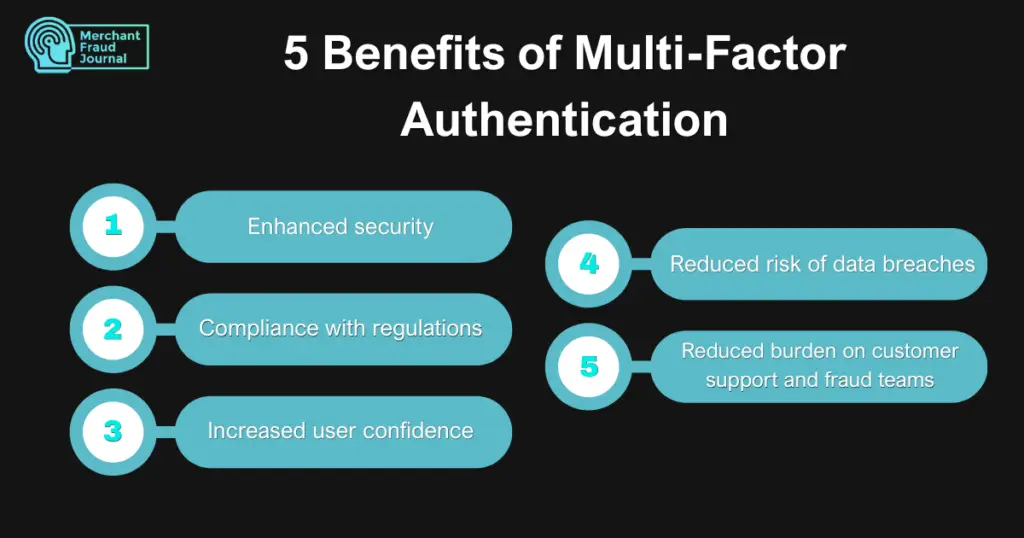
Implementing MFA offers numerous advantages for both individuals and organizations, which include the following:
1. Enhanced security
Requiring multiple forms of verification significantly reduces the likelihood of unauthorized access, since a stolen password alone is no longer enough to breach an account. For example, a fraudster who obtains a merchant employee’s login credentials through a phishing email would still be blocked at the second verification step. This is whether that’s a one-time code sent to a registered device or a biometric scan. This layered defense is precisely why MFA is credited with stopping the vast majority of automated and credential-based attacks before they succeed.
2. Compliance with regulations
Many industries are subject to regulations that mandate the use of MFA to protect sensitive data. These datasets include Payment Card Industry Data Security Standard (PCI DSS) requirements for payment card environments and standards like System and Organization Controls 2 (SOC 2) for service providers.
Merchants that process card transactions, for instance, are required to implement MFA for any personnel with access to cardholder data environments. Failing to do so can result in fines or loss of processing privileges. Implementing MFA proactively helps organizations meet these compliance requirements and avoid the costly penalties and audits that follow a violation.
3. Increased user confidence
Users are more likely to trust platforms that visibly prioritize security, and adopting MFA signals that an organization takes account protection seriously. A merchant that prompts customers to enable MFA on their accounts, for example, often sees this framed as a value-add rather than friction. This is because shoppers increasingly expect extra verification on platforms storing payment information. Demonstrating this commitment to safety helps organizations foster long-term trust and customer loyalty.
4. Reduced risk of data breaches
With MFA in place, the chances of falling victim to data breaches decrease significantly, since attackers need more than just a leaked password to gain entry. Google has found that two-factor authentication alone can cut account hijacking incidents in half, illustrating how a single added verification layer meaningfully lowers breach exposure. This protects sensitive information and helps maintain the organization’s reputation. Remember that breaches tied to weak authentication practices often draw public scrutiny and regulatory attention.
5. Reduced burden on customer support and fraud teams
When MFA prevents unauthorized logins outright, fewer compromised accounts ever reach customer support or fraud investigation queues. This means support teams spend less time resolving account recovery disputes, reversing fraudulent orders, or fielding complaints from customers whose accounts were hijacked. For merchants operating with lean fraud teams, this reduction in incident volume frees up resources to focus on more sophisticated threats rather than routine account compromises.
How Multi-Factor Authentication Works
Multi-factor authentication blocks 99.9% of modern automated cyberattacks and prevents 96% of bulk phishing attempts. Despite this proven effectiveness, adoption still varies widely across organizations, leaving significant gaps for fraudsters to exploit. Understanding exactly how MFA functions is the first step toward closing those gaps and protecting merchant accounts from takeover.
The process of multi-factor authentication typically involves three steps:
- Initial login: The user enters their username and password on a secure login page. This is the first line of defense against unauthorized access.
- Second verification: After successfully entering their credentials, the user is prompted to provide a second form of verification. This could be a one-time password (OTP) sent via SMS, an email, or generated by an authenticator app.
- Final authentication: The last step may involve biometric verification, such as a fingerprint scan or facial recognition, or the use of a hardware token. This ensures that the individual attempting to access the account is indeed the authorized user.
Each layer in this sequence closes a different gap that fraudsters might otherwise exploit. Merchants that enforce all three steps make it substantially harder for attackers to complete a takeover, even when one factor has already been compromised. As fraud tactics grow more sophisticated, this layered approach remains one of the most reliable safeguards available for protecting customer accounts and transaction data.
3 Types of Authentication Factors
Workforce MFA adoption climbed to 70% of users in January 2025. This momentum has pushed organizations to rely on a layered mix of authentication factors rather than passwords alone, and MFA utilizes various types of authentication factors, which can be categorized into three main groups.
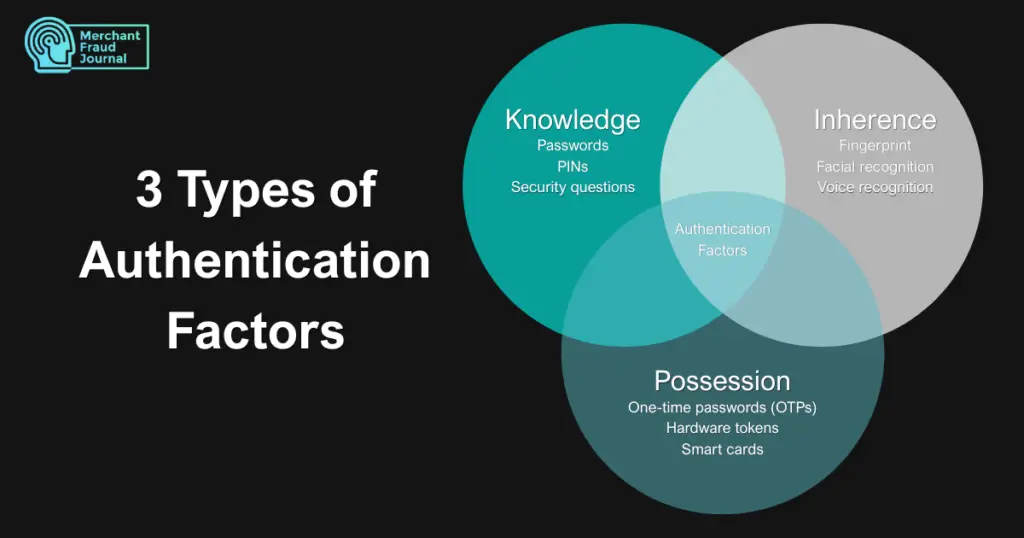
1. Knowledge Factors
Knowledge factors rely on something only the user is supposed to know, making them the most familiar but also the most exploitable category. They form the foundation of most login systems, even as security teams push toward stronger alternatives. These are pieces of information that the user knows, such as:
- Passwords: The most common form of authentication, but also the most vulnerable.
- PINs: Personal Identification Numbers that add an extra layer of security.
- Security questions: Answers to predefined questions that only the user should know.
Knowledge factors remain widely used because they’re cheap to implement and familiar to users, but their reliance on memory makes them easy to guess, phish, or steal. Pairing them with a second factor type closes much of that gap.
2. Possession Factors
Possession factors confirm identity through something the user physically holds, adding a layer that’s harder for remote attackers to bypass. This category has grown more common as organizations move away from password-only logins. These factors require the user to have a physical item to verify their identity, including:
- One-time passwords (OTPs): Temporary codes sent to the user’s mobile device or email.
- Hardware tokens: Physical devices that generate OTPs or provide access codes.
- Smart cards: Cards that store authentication data and can be swiped for access.
Organizations increasingly favor these methods for high-risk accounts where stronger access control is essential. This is because possession factors raise the bar for attackers since stealing a physical device or intercepting a one-time code is considerably harder than guessing a password.
3. Inherence Factors
Inherence factors authenticate users through unique physical traits, offering a layer of security that’s difficult to replicate or steal. Adoption of biometric methods has accelerated as device manufacturers build the necessary hardware directly into everyday devices. These are biometric characteristics unique to the user, such as:
- Fingerprints: Scans of the user’s fingerprint for verification.
- Facial recognition: Using the user’s facial features to authenticate.
- Voice recognition: Verifying identity through voice patterns.
Inherence factors offer strong eCommerce fraud protection since biometric traits are far harder to fake or transfer than a password or device. As biometric hardware becomes standard across phones and laptops, this category is poised to play a growing role in everyday authentication.
Combining factors from these three categories gives organizations a layered defense that’s significantly harder to defeat than any single method alone. Knowledge, possession, and inherence factors each address different weaknesses, so pairing them closes gaps that attackers would otherwise exploit. As authentication threats keep evolving, selecting the right mix of factors remains one of the most effective steps a business can take to protect its systems and data.
Common MFA Methods
Multi-factor authentication relies on several distinct verification methods, each offering a different balance of security and convenience. Merchants and businesses often combine more than one method to strengthen their overall fraud defenses. There are several methods of implementing MFA, each with its own strengths and weaknesses:
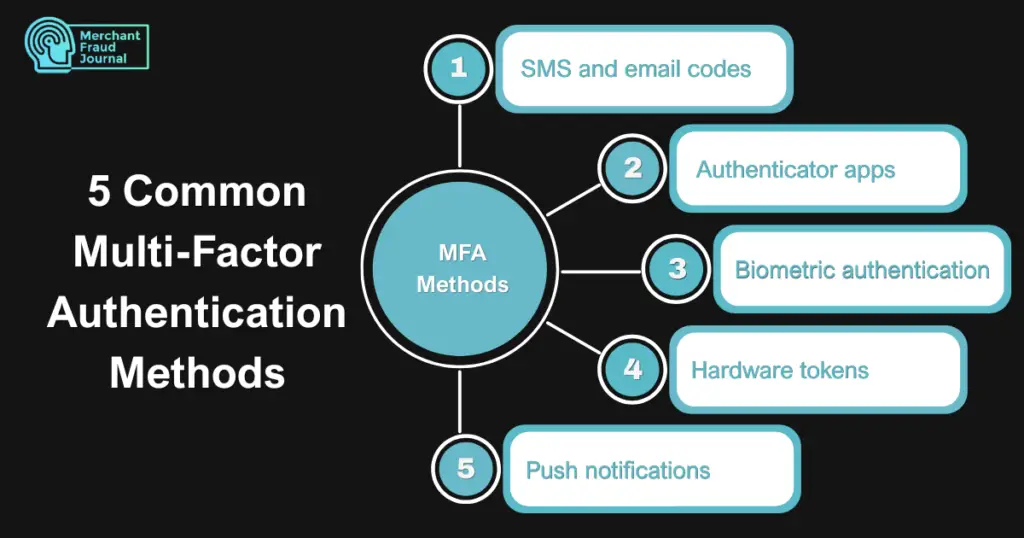
1. SMS and email codes
One of the most common methods, where users receive a code via SMS or email. This approach requires no additional hardware or app downloads, making it accessible to nearly any user. While convenient, this method is vulnerable to SIM swapping and phishing attacks.
2. Authenticator apps
Applications like Google Authenticator or Microsoft Authenticator generate time-based codes that users must enter during login. These apps provide a more secure alternative to SMS codes. Codes refresh every thirty seconds and remain accessible offline, reducing exposure to network-based interception.
3. Biometric authentication
Using physical traits such as fingerprints or facial recognition, biometric authentication offers a high level of security. However, it requires compatible hardware and may raise privacy concerns. Adoption continues to grow as smartphones and laptops increasingly ship with built-in biometric sensors.
4. Hardware tokens
Physical devices that generate OTPs or provide access codes. While highly secure, they can be lost or stolen, posing a potential risk. Many organizations issue backup tokens or recovery protocols to minimize downtime when a device goes missing.
5. Push notifications
Some systems send push notifications to the user’s device, prompting them to approve or deny a login attempt. This method is user-friendly but can be susceptible to MFA fatigue attacks. Limiting the number of approval requests sent within a short timeframe can help reduce this risk.
Choosing the right MFA method depends on a merchant’s risk tolerance, customer base, and operational resources. No single approach eliminates fraud entirely, so layering multiple methods often delivers stronger protection than relying on one alone. The goal is to balance robust security with a login experience that doesn’t frustrate legitimate users.
Strengthening Security with MFA
Multi-Factor Authentication is a vital component of modern cybersecurity strategies. Requiring multiple forms of verification allows organizations to significantly reduce the risk of unauthorized access and protect sensitive data. As cyber threats continue to evolve, adopting MFA not only enhances security but also fosters user confidence and compliance with regulations.
Frequently Asked Questions
Is MFA the same as Two-Factor Authentication (2FA)?
Not exactly. 2FA is a subset of MFA that uses exactly two verification factors, while MFA can involve two or more factors depending on the security requirements of the system.
What industries are required to use MFA for compliance?
Industries such as finance, healthcare, and e-commerce often face regulatory requirements mandating MFA to protect sensitive data. Standards like PCI DSS and HIPAA frequently include MFA as part of their compliance frameworks.
How does MFA protect against phishing attacks?
Even if a phishing attack successfully captures a user's password, MFA prevents access because the attacker still needs the additional verification factor. This added barrier makes stolen credentials far less valuable to cybercriminals.

Charity Amancio
Charity Amancio specializes in SaaS solutions for global eCommerce businesses, including payments and risk management applications. She bridges the gap between technology and merchant needs, offering practical perspectives on the tools shaping eCommerce. Her insights appear regularly in B2B publications covering the digital commerce space.
