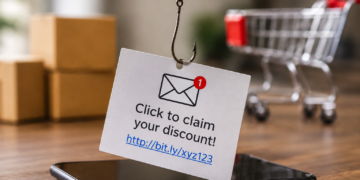


Smishing is phishing delivered by text message. A fraudster poses as a trusted brand, bank, carrier, or delivery service and pushes the recipient to tap a malicious link, share a login, or hand over card details or a one-time passcode.
The answer to what is smishing has two sides. Fraudsters send fake texts to your customers that impersonate your store, and they send fake texts to your team that impersonate your payment processor, platform, or bank. Both paths end in the same place, with stolen accounts, fraudulent orders, chargebacks, and customers who stop trusting your messages.
What Is Smishing and How Does It Work?
The word combines SMS and phishing. A smishing attack uses a text message that appears to come from a source the recipient already trusts, adds a sense of urgency, and includes a link or a phone number. The link usually opens a cloned login or checkout page built to capture credentials, card numbers, or one-time passcodes. Discussions of smishing in cyber security classify it as social engineering because it targets people instead of systems.
The Anatomy of a Smishing Attack
Most smishing scams follow the same short sequence, which makes them easier to recognize once you know it.
- The fraudster collects phone numbers and registers a lookalike domain that mimics a real brand.
- A text arrives with an urgent hook, such as a failed delivery, a locked account, an unpaid toll, or a suspicious charge.
- The recipient taps a shortened or lookalike link and lands on a page that copies the brand’s design.
- The page captures a password, card number, or one-time passcode, and the fraudster uses it within minutes.
Speed is the reason this works. A text feels personal and gets read almost immediately, so the recipient often acts before checking who actually sent it.
Why Smishing Attacks Are So Effective
Text messages carry fewer built-in defenses than email. Phones show limited sender details, shortened links hide the real destination, and mobile browsers make it hard to inspect a URL before it loads. Attackers also lean on brands people deal with every day, including retailers, carriers, and banks. The FTC’s 2024 text scam data shows consumers reported losing $470 million to scams that started with a text message, about five times the amount reported in 2020.
Smishing vs. Phishing vs. Vishing
The three attacks share the same goal and differ mainly in the delivery channel. The real difference in smishing vs phishing is that one arrives by text and the other by email, while vishing uses a voice call. Merchants often see vishing and smishing combined in a single campaign.
| Attack type | Channel | Merchant-facing example |
|---|---|---|
| Phishing | A fake payment processor notice asking you to verify your merchant account | |
| Smishing | SMS and messaging apps | A text impersonating your store that sends customers to a fake order-tracking page |
| Vishing | Voice call | A caller posing as your bank's fraud team who asks for a one-time passcode |
Many campaigns chain these channels together. A smishing text may ask the recipient to call a number, which turns it into a vishing call. The same playbook drives email phishing scams, so training that covers one channel should cover all three.
How Smishing Affects eCommerce Merchants
Merchants rarely send or receive the fraudulent text themselves, yet they absorb much of the cost. Smishing creates risk for a store in three main areas.
1. Brand Impersonation Targeting Your Customers
Fraudsters copy a store’s name, logo, and order-update language to send fake shipping notices, refund offers, and loyalty-point alerts. This kind of brand impersonation leaves customers confused and angry. They contact your support team, blame your brand for the scam, and start ignoring your legitimate texts, which also weakens your SMS marketing results.
2. Account Takeover and Fraudulent Orders
Credentials and one-time passcodes stolen through smishing feed directly into account takeover fraud. Fraudsters log in to customer accounts, change shipping addresses, drain gift card balances and loyalty points, and place orders with saved cards. When the real cardholder spots the charge, the merchant receives the chargeback and loses the merchandise.
3. Attacks Aimed at Your Own Team
Staff are targets too. A text that looks like it came from your eCommerce platform, payment processor, bank, or IT team can capture an admin login or a multifactor code. One compromised admin account can expose customer data, payout settings, and store configuration. The FTC has published guidance on common text scams for business staff that works well as onboarding material.
Smishing is one part of a wider SMS fraud problem
Text-based fraud costs merchants in other ways as well. Recent research on SMS pumping and OTP abuse shows how fraudsters exploit the same messaging channels to inflate costs for businesses that send verification codes.
Smishing Examples Merchants Should Recognize
The most common smishing scams follow seasonal and operational patterns. These smishing examples reflect the formats the FTC ranked highest in its top text scams of 2024, adapted to how they appear in eCommerce.
- Fake delivery alerts claim an order from your store is on hold until the customer confirms an address or pays a small fee.
- Fake fraud alerts appear to come from a bank or card issuer and ask the recipient to reply or tap a link to stop a suspicious purchase.
- Fake refund or giveaway texts use your brand name to collect card details for a refund that does not exist.
- Fake platform or processor alerts tell merchants that a payout is on hold or an account will be suspended.
- Fake passcode requests come after the fraudster triggers a real login code and then texts the victim asking them to confirm it.
Each of these relies on urgency and a familiar name. Teaching customers and staff to slow down when they see those two signals stops most attempts before any damage is done.
How to Prevent Smishing Attacks on Your Store and Customers
Merchants cannot stop fraudsters from sending texts. They can make impersonation harder to pull off and less profitable. The steps below cover your customers, your staff, and your own messaging program.
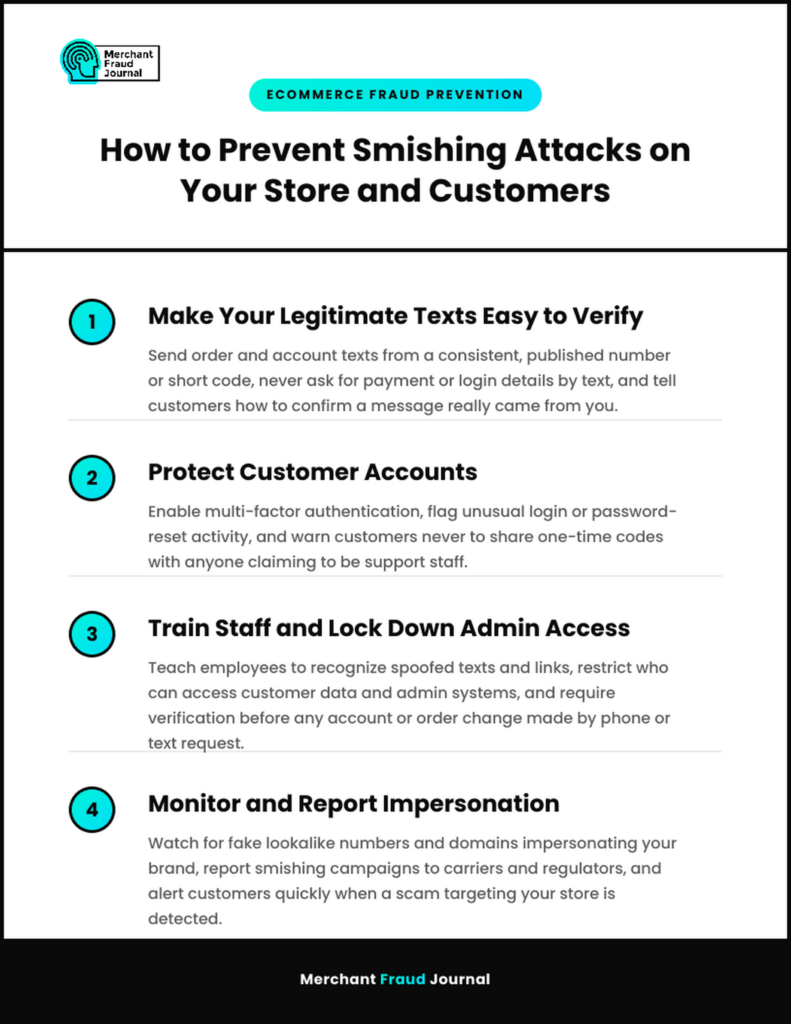
1. Make Your Legitimate Texts Easy to Verify
Customers spot fakes faster when your real messages are predictable. Send texts from one registered short code or number, avoid third-party link shorteners, and never ask for passwords, card numbers, or one-time passcodes by text. Publish a short page on your site explaining how your store communicates, and link to it in order confirmation emails.
2. Protect Customer Accounts
Stolen credentials are the main payoff of a smishing attack, so account-level controls limit the damage when a customer is fooled.
- Offer passkeys or app-based authentication in place of SMS codes where possible.
- Flag logins from new devices that are quickly followed by address, email, or password changes.
- Require re-authentication before customers redeem gift cards, loyalty points, or saved payment methods.
- Notify customers by email whenever account details change so they can react quickly.
Together, these controls blunt the rising account takeover rates merchants are seeing across eCommerce.
3. Train Staff and Lock Down Admin Access
Require multifactor authentication on every store, payment, and email admin account, ideally through authenticator apps or hardware security keys. Teach staff that real vendors will never ask for a code by text, and that any message about payouts or account suspension should be checked by logging in directly. These habits also reduce exposure to wider cyber fraud threats against merchants.
4. Monitor and Report Impersonation
Watch social media, support tickets, and reviews for reports of texts using your name. Ask customers to forward suspicious texts to 7726 (SPAM), which shares the report with their mobile carrier, and report active campaigns to the FTC at ReportFraud.ftc.gov. Lookalike domains used in smishing can often be taken down through the domain registrar once they are reported.
Close the Smishing Gaps Before Fraudsters Use Them
Answering what is smishing is the easy part. The harder work is making sure fraudsters cannot borrow your brand to reach customers or slip past your team with a convincing text. Set clear rules for how your store communicates, move account security away from SMS codes where you can, train staff to verify every payout or account alert directly, and watch for impersonation so you can act quickly. Merchants who take these steps now lose fewer accounts, fight fewer chargebacks, and keep their real messages trusted.
Frequently Asked Questions
What is smishing in cybersecurity?
Smishing is a social engineering attack that uses text messages to trick people into clicking malicious links or sharing sensitive information. It targets human trust in a familiar brand or contact instead of a technical weakness in a system.
What is the difference between smishing and phishing?
Phishing is the broad category of scams that impersonate trusted sources to steal information, and it usually arrives by email. Smishing is the same attack sent by SMS or a messaging app.
What do vishing and smishing refer to?
Vishing refers to voice phishing carried out over phone calls, and smishing refers to phishing carried out over text messages. Both impersonate trusted organizations to collect credentials, payment details, or one-time passcodes.
Why are smishing attacks particularly effective?
People tend to read texts quickly and trust them more than email, and phones show little information about the sender or the link destination. Attackers add urgency, such as a failed delivery or a locked account, so victims act before they stop to verify.
How do you prevent smishing attacks?
Never tap links or share codes from unexpected texts, and verify any alert by opening the official app or website directly. Businesses can also cut risk with multifactor authentication that does not rely on SMS and with clear rules about how they contact customers.
What should you do if you click a smishing link?
Close the page without entering anything, and if you already shared a password or card number, change the password and contact your bank right away. Report the text by forwarding it to 7726 and filing a report at ReportFraud.ftc.gov.

Charity Amancio
Charity Amancio specializes in SaaS solutions for global eCommerce businesses, including payments and risk management applications. She bridges the gap between technology and merchant needs, offering practical perspectives on the tools shaping eCommerce. Her insights appear regularly in B2B publications covering the digital commerce space.