

Fraud-as-a-Service (FaaS) has emerged as a significant threat in the digital landscape, transforming the way cybercriminals operate. Individuals with minimal technical skills engage in fraudulent activities by purchasing tools and services from organized crime syndicates.
As the accessibility of these services increases. Thus, the complexity and scale of fraud pose serious challenges for businesses and financial institutions. In this article, we will explore the intricacies of FaaS, its implications, and strategies for effective defense against this growing menace.
What Is Fraud-as-a-Service?
Fraud-as-a-Service refers to a business model where cybercriminals offer their expertise, tools, and infrastructure to facilitate fraudulent activities for paying clients. This model mirrors legitimate businesses in its structure and operations, providing a range of services that make it easier for individuals to commit fraud without needing extensive technical knowledge.
FaaS platforms fueled a 28% rise in the availability of sophisticated fraud tools in 2025 alone. Even unsophisticated criminals now have access to highly effective fraud techniques. For merchants, that evolution means the threat environment is no longer defined by opportunistic bad actors, but by well-resourced criminal enterprises operating with the efficiency of a subscription business.
The Structure of FaaS
FaaS operates similarly to traditional service-oriented businesses. It comprises various roles, including developers who create fraud tools, resellers who market them, and end users who execute fraudulent schemes. This organized approach allows for efficient operations, customer support, and even training for those new to cybercrime.
Accessibility and Appeal
One of the most alarming aspects of FaaS is its accessibility. In the past, committing fraud often required advanced technical skills. However, with the rise of FaaS, even individuals with basic computer skills can engage in fraudulent activities. This democratization of fraud has led to an increase in the number of perpetrators, making it a widespread issue.
The Mechanics of Fraud-as-a-Service
Understanding how FaaS operates is crucial for developing effective countermeasures. The services offered by FaaS providers vary widely, encompassing everything from phishing kits to account takeover services.
- Phishing kits: These pre-packaged tools allow criminals to impersonate legitimate businesses, such as banks, to steal sensitive information from unsuspecting victims.
- Account takeover (ATO) services: FaaS providers offer tools that enable fraudsters to gain unauthorized access to user accounts, often leading to identity theft and financial loss.
- Botnets: Cybercriminals can rent botnets to automate attacks, such as credential stuffing, where stolen usernames and passwords are used to access multiple accounts.
- Money mule services: FaaS platforms often provide access to networks of individuals who unwittingly facilitate money laundering by transferring stolen funds.
What makes these offerings particularly dangerous is how easily they can be combined. A fraudster might use a phishing kit to harvest credentials and run them through a botnet-powered stuffing attack. Then route the stolen funds through money-mule networks, all without possessing any technical expertise.
The Role of the Dark Web
Many FaaS offerings are found on dark web marketplaces, where anonymity is preserved, and transactions are conducted using cryptocurrencies. This environment fosters a thriving ecosystem for fraudsters, making it challenging for law enforcement to intervene.
Despite aggressive law enforcement operations, dark web marketplaces grew by 28% in 2025. Every time authorities shut down one marketplace, successors emerge, often with better operational security. When major platforms are seized or shut down, their vendor networks and stolen data inventories migrate to successor markets within days.
What makes dark web FaaS markets particularly resilient is their rapid adaptability. The average marketplace lifespan is now just 7.5 months, meaning the ecosystem has adapted to enforcement pressure by becoming more resilient through faster turnover.
The Impact of Fraud-as-a-Service on Businesses
The rise of FaaS has profound implications for businesses, particularly in the financial sector. As fraud becomes more sophisticated and widespread, organizations must adapt their strategies to mitigate risks.
a. Financial Losses
The financial impact of FaaS is staggering. According to industry reports, global eCommerce fraud continues to increase. In fact, it is expected to rise rapidly as FaaS continues to evolve and expand its reach.
b. Reputational Damage
Beyond financial losses, businesses face reputational risks associated with fraud. Customers expect their data to be secure, and any breach can lead to a loss of trust and loyalty. Organizations must prioritize fraud prevention to maintain their reputation in the market.
The upward trajectory in global eCommerce is driven in no small part by the accessibility FaaS platforms provide to even low-skill actors. For every dollar lost to chargebacks and fraud, U.S. merchants now incur $4.61 in total costs. This means the true toll extends well beyond the transaction itself into operational overhead, dispute management, and staff resources.
Organizations that treat fraud prevention as a core business function are best positioned to withstand the expanding FaaS threat landscape rather than absorb its escalating costs after the fact.
5 Strategies for Defending Against Fraud-as-a-Service
To combat the growing threat of FaaS, businesses must implement comprehensive fraud prevention strategies. Here are some effective measures:
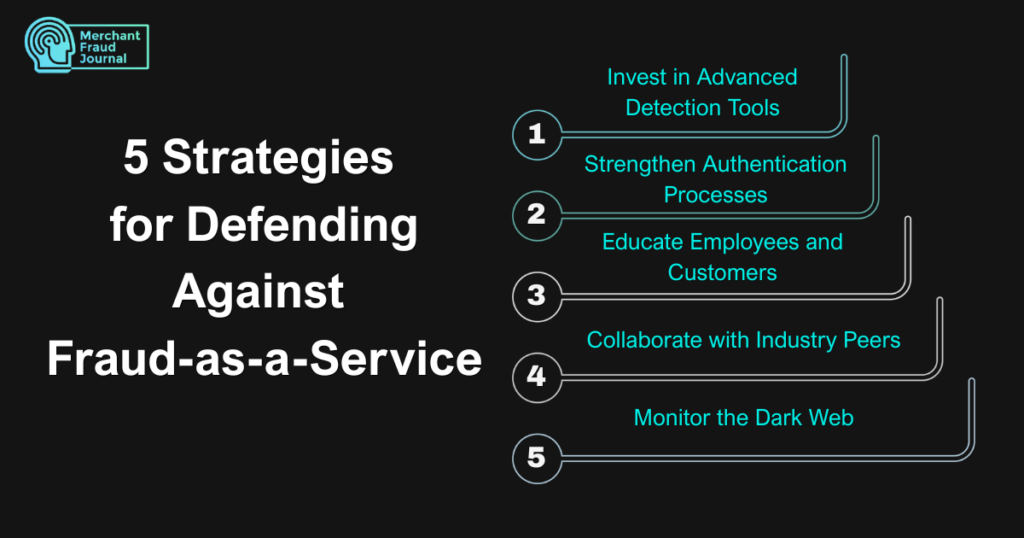
1. Invest in Advanced Detection Tools
Organizations should leverage machine learning (ML) and artificial intelligence (AI) to enhance their fraud detection capabilities. These technologies can analyze transaction patterns and identify anomalies in real-time, allowing for swift intervention.
Modern ML models can also adapt continuously as fraudsters evolve their tactics, reducing the lag time between new attack patterns and detection. Vendors offering AI-powered fraud scoring have become essential infrastructure for merchants processing high transaction volumes across multiple channels.
2. Strengthen Authentication Processes
Implementing multi-factor authentication (MFA) is essential for protecting user accounts. Requiring additional verification steps allows businesses to significantly reduce the risk of account takeovers.
Passwordless authentication methods, such as passkeys and biometric verification, are gaining ground as more resilient alternatives to traditional credential-based login flows. Organizations should also enforce adaptive authentication, which escalates verification requirements based on risk signals like unfamiliar devices or unusual login locations.
3. Educate Employees and Customers
Raising awareness about fraud tactics is crucial. Regular training sessions for employees and informative campaigns for customers can help them recognize potential threats and avoid falling victim to scams.
Employees with access to payment systems or customer data represent a particularly high-value target for social engineering attacks, making role-specific training a priority rather than an afterthought. Customer-facing communication should address common FaaS-enabled threats like phishing kits and account takeover attempts in plain, accessible language.
4. Collaborate with Industry Peers
Cross-industry collaboration is vital in the fight against FaaS. Sharing intelligence about emerging threats and best practices can help organizations stay ahead of fraudsters.
Industry consortiums and information-sharing networks, such as those facilitated through fraud prevention forums and financial sector ISACs, give participants early visibility into attack campaigns before they reach full scale. Merchants operating in high-risk verticals stand to benefit especially from pooled threat intelligence, as they are disproportionately targeted when FaaS operators test new toolkits.
5. Monitor the Dark Web
Regularly monitoring dark web forums for mentions of the organization or its customers can provide valuable insights into potential threats. Early detection of compromised credentials allows for prompt action to mitigate risks.
Automated dark web monitoring tools can surface stolen credentials, leaked customer data, and references to specific merchant brands before that information is weaponized in an active attack. Security teams should treat dark web monitoring as an ongoing intelligence function rather than a reactive measure triggered only after a confirmed breach.
The Future of Fraud-as-a-Service: Emerging Trends
As technology continues to advance, so too will the tactics employed by cybercriminals. The future of FaaS is likely to involve even more sophisticated tools and methods, making it imperative for businesses to remain vigilant.
- AI-driven fraud: As artificial intelligence becomes more prevalent, fraudsters will likely leverage AI to enhance their schemes, making detection increasingly challenging.
- Social media exploitation: Fraudsters are already using social media platforms to recruit individuals for money mule operations and promote their services. This trend is expected to grow, necessitating increased vigilance from businesses.
- Regulatory changes: As the threat of FaaS escalates, regulatory bodies may implement stricter guidelines for businesses to follow, emphasizing the importance of robust fraud prevention measures.
Businesses can no longer rely solely on traditional security measures to combat highly adaptable, outsourced cyber threats. Organizations must instead build resilient defenses through advanced behavioral analytics, cross-industry collaboration, and strict regulatory compliance to neutralize these emerging schemes before they impact the bottom line.
Secure Your Business Against FaaS
The accessibility and sophistication of Fraud-as-a-Service have transformed the cybercrime landscape, making it imperative for organizations to shift from reactive defenses to proactive safeguarding. Businesses must invest in advanced detection tools, strengthen authentication processes, and foster industry collaboration to effectively neutralize these evolving threats, protect financial integrity, and maintain customer trust.
Frequently Asked Questions
Why is FaaS considered a rapidly growing threat to businesses?
The democratization of fraud means the sheer volume and sophistication of cyberattacks hitting organizations have scaled exponentially. Because the underlying technology continuously adapts, traditional security measures struggle to keep pace with these industrialized threats.
How do FaaS operations sustain financial transactions anonymously?
Buyers generally pay for these subscription models, tools, or one-time fraud packages using cryptocurrencies. Some advanced providers even utilize revenue-sharing agreements, taking a percentage of the final stolen profits.
How does FaaS impact consumer trust and business reputation?
Frequent security breaches and account takeovers caused by FaaS tools can severely alienate customers and ruin a brand's market standing. Beyond immediate financial theft, organizations face long-term revenue loss when consumers lose faith in their digital safety.

Charity Amancio
Charity Amancio specializes in SaaS solutions for global eCommerce businesses, including payments and risk management applications. She bridges the gap between technology and merchant needs, offering practical perspectives on the tools shaping eCommerce. Her insights appear regularly in B2B publications covering the digital commerce space.