


Merchant fraud monitoring refers to the systematic process of tracking and analyzing transactions to identify suspicious activities that may indicate fraud. This practice is crucial for businesses, especially in the fintech and eCommerce sectors, where transaction volumes are high and the potential for fraud is significant. Effective monitoring not only helps in compliance with regulatory requirements but also protects the organization’s reputation and financial assets.
This article outlines essential steps for effective merchant fraud monitoring. It provides insights into best practices, technologies, and methodologies to help organizations mitigate risks associated with fraudulent activity.
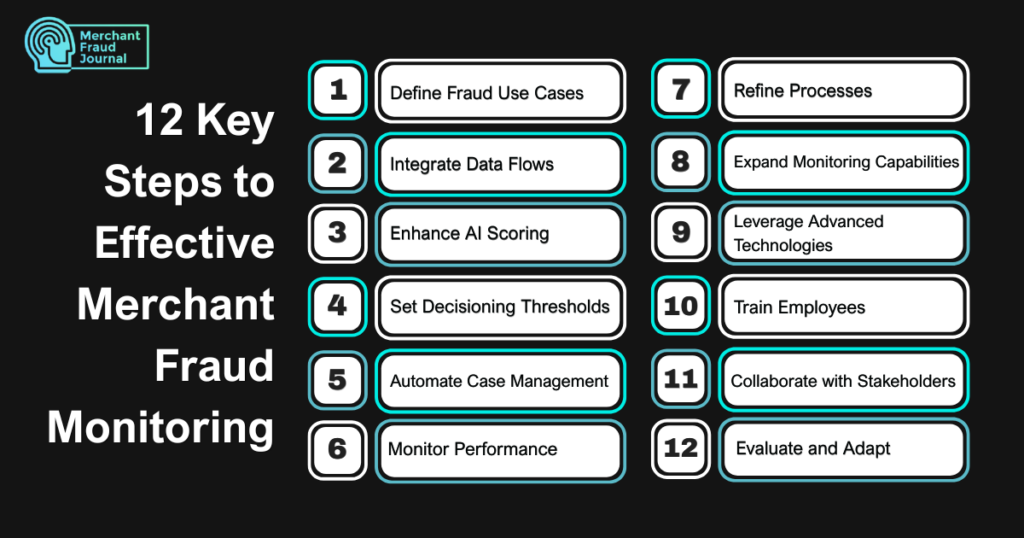
Step 1: Define Fraud Use Cases
Before implementing a merchant fraud monitoring solution, organizations must identify specific fraud use cases relevant to their operations. This involves understanding the types of eCommerce fraud that are most prevalent in their industry and tailoring monitoring strategies accordingly.
- Phishing: Fraudsters trick individuals into revealing sensitive information through deceptive emails or websites.
- Card-Not-Present Fraud: This occurs when stolen card information is used for online transactions without the physical card.
- Account Takeover: Fraudsters gain unauthorized access to customer accounts, often changing passwords and personal information.
These fraud types are not only prevalent but increasingly costly for merchants operating in both physical and digital environments. U.S. card-not-present fraud losses alone surged from $5.04 billion in 2019 to $10.16 billion in 2024, representing 74% of all card payment fraud. Merchants who take the time to define their specific fraud use cases from the outset are far better positioned to detect, respond to, and reduce those losses.
Step 2: Integrate Data Flows
Fragmented data can hinder effective decision-making and increase the risk of fraud slipping through the cracks. A successful merchant fraud monitoring strategy relies on the integration of various data sources
Create a unified database that consolidates transaction data from multiple sources, including payment processors, customer relationship management (CRM) systems, and fraud detection tools. Implement systems that allow for real-time data processing to quickly identify and respond to suspicious activities.
A well-integrated data environment does more than improve fraud detection, as it gives merchants a complete, accurate view of every transaction as it happens. When payment data, customer behavior signals, and fraud tool outputs feed into a single system, patterns that would otherwise go unnoticed become far easier to catch.
Step 3: Enhance AI Scoring
Artificial intelligence (AI) plays a pivotal role in modern fraud detection. Enhancing AI scoring models with additional rules tailored to business needs gives organizations a stronger ability to identify fraudulent transactions. Specifically, these improvements further lead to the following benefits.
- Pattern recognition: AI algorithms can analyze vast amounts of transaction data to identify patterns indicative of fraud.
- Reduced false positives: Continuously learning from new data, AI systems can minimize false positives, allowing legitimate transactions to proceed without unnecessary delays.
Merchants that regularly audit and update their AI models with business-specific rules are better equipped to stay ahead of fraudsters who constantly shift their tactics. Treating AI enhancement as an ongoing process rather than a one-time setup is what separates a fraud monitoring system that degrades over time from one that compounds in effectiveness.
Step 4: Set Decisioning Thresholds
Establishing decisioning thresholds is crucial for balancing fraud detection and customer experience. Organizations must determine how aggressively they want to flag transactions as potentially fraudulent.
Identify the factors that contribute to eCommerce fraud in your specific context, such as transaction volume or customer behavior. Regularly review and adjust thresholds based on historical data and emerging fraud trends to ensure optimal performance.
Step 5: Automate Case Management
Efficient case management is essential for investigating flagged transactions. Automating workflows can significantly enhance the effectiveness of fraud investigations. When looking for key automation features, consider these two features:
- Unified case management system: Implement a centralized system that allows investigators to access all relevant data and collaborate effectively.
- Automated alerts: Set up automated alerts for high-risk transactions, enabling quicker responses to potential fraud.
Without automation, fraud teams spend valuable time on manual processes that slow investigations and allow fraudulent transactions to go undetected longer. A well-configured case management system reduces that friction by centralizing data, and streamlining communication between investigators.
Step 6: Monitor Performance
Continuous monitoring of fraud detection systems is vital for assessing their effectiveness. Organizations should regularly evaluate their performance metrics to identify areas for improvement. Tracking the right data points gives merchants a clear, evidence-based picture of where their fraud monitoring strategy is working well and where gaps still exist.
For starters, measure the percentage of fraudulent transactions detected versus the total number of transactions. Then, analyze the time taken to resolve flagged transactions and the outcomes of investigations.
Small improvements in detection rates and investigation efficiency compound into significant cost savings across high transaction volumes. The percentage of eCommerce revenue lost to payment fraud fell globally from 3.6% in 2022 to 2.9% in 2023, a trend that reflects what consistent performance monitoring and incremental optimization can achieve at scale
Step 7: Refine Processes
As fraud tactics evolve, organizations must be prepared to refine their monitoring processes. This involves regularly updating fraud detection models and incorporating new data points.
Establish feedback mechanisms that allow investigators to provide insights on the effectiveness of fraud detection systems. Additionally, continuously enrich data sources with new information to enhance the accuracy of fraud detection models.
The value of these refinement efforts compounds as fraud threats grow more sophisticated across the industry. Fraudsters have increasingly exploited cyber-enabled fraud, with ransomware and technology-based scams becoming more sophisticated. Plus, AI-generated financial fraud and deepfake identities have made detection and attribution harder, forcing businesses to adopt real-time fraud monitoring.
Step 8: Expand Monitoring Capabilities
Once a robust merchant fraud monitoring system is in place, organizations can explore opportunities to expand their monitoring capabilities. This may involve integrating additional transaction types or payment flows.
Expansion at this stage is not simply about adding more tools. Instead, it is about ensuring that every channel through which a customer can transact is accounted for in your fraud detection architecture through the following steps:
- Cross-channel monitoring: Implement monitoring solutions that can track transactions across various channels, including online, mobile, and in-store.
- Emerging payment methods: Stay ahead of the curve by incorporating monitoring for new payment methods, such as cryptocurrencies or digital wallets.
The urgency of expanding monitoring capabilities is backed by clear data on where fraud is heading. eCommerce fraud is expected to rise from $44.3 billion in 2024 to $107 billion by 2029, a growth of 141%.
Step 9: Leverage Advanced Technologies
Incorporating advanced technologies can significantly enhance the effectiveness of merchant fraud monitoring. Organizations should explore the use of cloud computing, machine learning, and biometric authentication.
Cloud-based fraud monitoring systems offer scalability and flexibility, allowing organizations to adapt to changing fraud landscapes. Machine learning algorithms can continuously improve fraud detection capabilities by learning from historical data and adapting to new patterns.
Merchants who adopt these technologies are not just keeping pace with larger financial institutions. They are equipping their operations with the same caliber of adaptive, data-driven defenses that have become the industry standard for stopping fraud before it causes lasting damage.
Step 10: Train Employees
Ensuring that staff members are knowledgeable about fraud detection processes can enhance overall effectiveness. Without structured, role-specific training, even the most sophisticated fraud monitoring tools can fall short. This is because the people responsible for using them, interpreting alerts, and escalating concerns are the last line of defense against threats that automated systems may not catch.
Merchants should approach employee training as a continuous investment rather than a one-time onboarding task. Update materials as fraud tactics evolve and new tools are introduced. Educate employees about common fraud schemes and how to recognize suspicious activities. Additionally, provide training on using fraud monitoring tools and systems effectively.
Step 11: Collaborate with Stakeholders
Collaboration among various stakeholders is essential for a comprehensive approach to merchant fraud monitoring. This includes working with payment processors, regulatory bodies, and law enforcement agencies.
Fraud networks are increasingly organized and cross-industry, meaning the intelligence needed to detect and disrupt them rarely lives within one organization’s walls. Building strong stakeholder relationships through the following actions allows merchants to act on shared intelligence rather than reacting to threats in isolation.
- Information sharing: Establish partnerships that facilitate the sharing of information about emerging fraud trends and tactics.
- Joint training initiatives: Collaborate on training programs that enhance the collective knowledge of fraud prevention practices and strategies.
The value of stakeholder collaboration extends beyond awareness, as it directly improves detection accuracy and reduces losses across the network. A real-world example of this impact comes from a 2024 data-sharing agreement between Worldpay and Capital One, which found that merchants using Worldpay’s FraudSight solution could see false positive declines reduced by as much as 40% on average through direct transaction data sharing with Capital One’s fraud risk decisioning engine.
Step 12: Evaluate and Adapt
Finally, organizations must remain agile and willing to adapt their fraud monitoring strategies as new threats emerge. Regular evaluations of the fraud landscape will help businesses stay ahead of potential risks.
Merchants that treat their fraud strategy as a finished product rather than an evolving framework leave themselves exposed to threats that their existing rules and models were never designed to catch. To protect your business against eCommerce fraud, consider these adaptation strategies:
- Market research: Conduct regular research to stay informed about the latest fraud trends and technologies.
- Feedback mechanisms: Implement systems for gathering feedback from customers and employees to identify areas for improvement.
No fraud monitoring system, regardless of how well it was built, will remain effective without consistent review. The tactics fraudsters use today are rarely the same ones they will use six months from now.
A Smarter Approach to Merchant Fraud Monitoring
Merchant fraud monitoring is essential for protecting businesses in today’s digital economy. Following these steps gives organizations a clear path to developing a comprehensive strategy that not only mitigates risks but also enhances customer trust and operational efficiency. Fraud tactics will continue to evolve, making a proactive and adaptable approach the key to maintaining a secure and trustworthy environment for all stakeholders involved.
Frequently Asked Questions
Why is fraud monitoring important for merchants?
Fraud monitoring helps merchants avoid chargebacks, revenue loss, and reputational damage that result from undetected fraudulent transactions. Without a structured monitoring strategy, even a single fraud spike can strain operations and erode customer trust.
How does fraud monitoring help with chargeback management?
Strong fraud monitoring reduces the number of fraudulent transactions that reach completion, which directly lowers the volume of chargebacks a merchant receives. Fewer chargebacks protect the merchant's standing with payment processors and reduce the administrative burden of dispute management.
How does AI improve fraud detection for merchants?
AI scoring models analyze large volumes of transaction data in real time to identify patterns that may indicate fraudulent activity. Over time, these models learn from new data, reducing false positives and improving overall detection accuracy.

Charity Amancio
Charity Amancio specializes in SaaS solutions for global eCommerce businesses, including payments and risk management applications. She bridges the gap between technology and merchant needs, offering practical perspectives on the tools shaping eCommerce. Her insights appear regularly in B2B publications covering the digital commerce space.
