

Black Friday fraud prevention comes down to tuning your fraud rules, staffing, and dispute process before the traffic spike. This is because the attacks that hurt merchants most during the holiday rush (card testing, account takeover, bot-driven promo abuse, gift card fraud, and friendly fraud) all grow with order volume.
Black Friday 2026 falls on November 27, and Cyber Monday follows on November 30. That leaves merchants a few weeks to stress-test their controls, lock down accounts and promotions, and prepare chargeback evidence without blocking the legitimate shoppers who make the season profitable.
Why Black Friday Is a Peak Season for Fraud
Black Friday packs more transactions, first-time customers, and discount codes into a few days than any other stretch of the eCommerce calendar. Adobe’s Cyber Week 2025 data shows U.S. shoppers spent $11.8 billion online on Black Friday 2025, up 9.1% year over year, and $44.2 billion across the full Cyber Week. Fraudsters follow that volume because unusual orders are harder to spot when traffic, basket sizes, and shipping requests all look unusual.
The share of risky orders stays meaningful even as fraud tools improve. TransUnion’s analysis of the 2024 holiday weekend found that 4.2% of attempted U.S. eCommerce transactions between Thanksgiving and Cyber Monday were suspected to be fraudulent, and Thanksgiving Day posted the highest global rate of the period. The rate fell from the prior year, yet the number of attempts stayed high because overall transaction volume keeps growing.
Common Black Friday Scams and Fraud Types That Target Merchants
Black Friday scams aimed at shoppers get most of the headlines. Merchants face a separate set of attacks, and the table below summarizes the fraud types that typically rise during the holiday window.
| Fraud type | How it shows up during Black Friday | Main cost to merchants |
|---|---|---|
| Card testing fraud | Bots run thousands of small authorizations to validate stolen cards, hidden inside checkout traffic spikes | Authorization fees, processor scrutiny, and later chargebacks |
| Account takeover fraud | Stolen logins let fraudsters use saved cards, loyalty points, and gift card balances | Chargebacks, customer churn, and support costs |
| Promo abuse | Fake accounts and scripts stack or reuse discount codes and new-customer offers | Margin lost on already discounted inventory |
| Gift card fraud | Stolen cards buy digital gift cards that are resold or drained within minutes | Losses that are rarely recoverable once codes are redeemed |
| Friendly fraud | Real customers dispute legitimate holiday purchases weeks later | Chargebacks and fees in December and January |
| Holiday return fraud | Wardrobing, receipt fraud, and empty-box claims follow the season | Lost inventory and refunded revenue |
Most of these attacks share infrastructure. The same bot traffic that tests cards often attempts logins and abuses promo codes, so controls that detect automation pay off across several categories at once. These categories mirror the most common types of eCommerce fraud merchants see all year, compressed into a few high-pressure days.
The Black Friday Fraud Prevention Checklist
Work through this checklist in the weeks before Black Friday, and treat it as a holiday extension of your year-round eCommerce fraud prevention program. Each step targets one or more of the fraud types above while keeping friction low for legitimate shoppers.
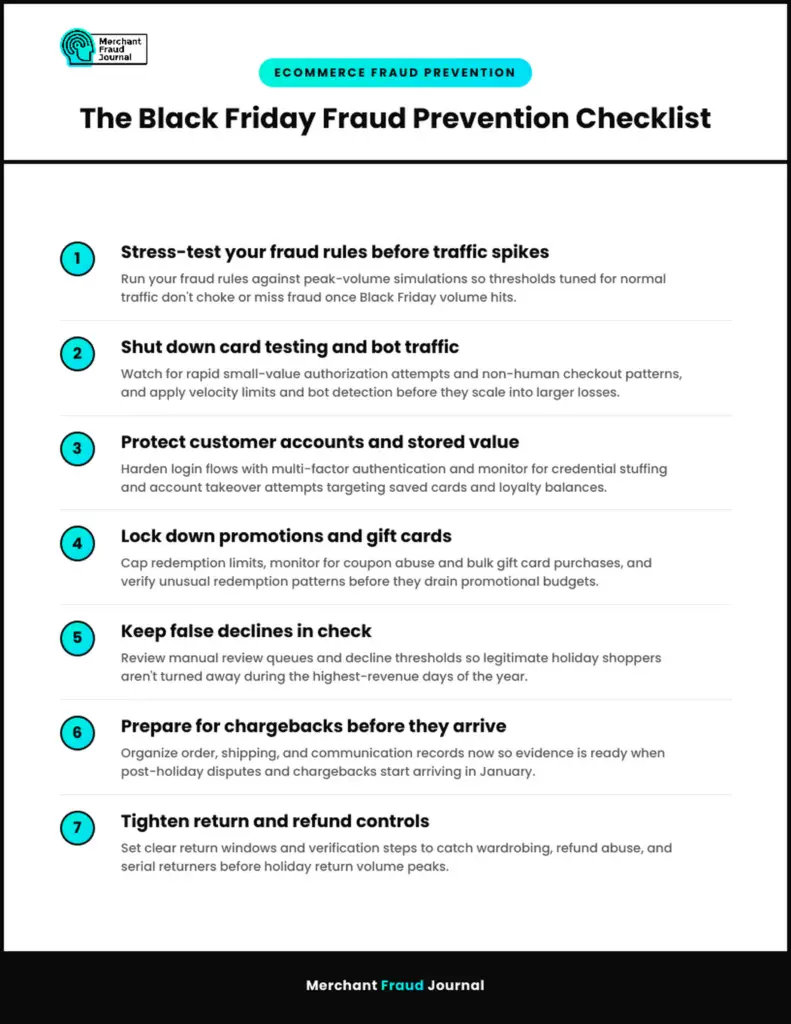
1. Stress-Test Your Fraud Rules Before Traffic Spikes
Review your rules against last year’s holiday data instead of a normal week. Velocity limits, order-value thresholds, and geolocation rules built for average traffic can either flood your review queue or decline good customers at peak. Run last season’s holiday orders through updated rules to see where false declines and missed fraud would land.
Warning signs to watch for
Flag orders and sessions that combine several of the following signals.
- Many failed authorizations from one IP address, device, or card BIN range within minutes
- New accounts placing high-value orders with expedited shipping to a different address
- Logins from new devices followed by changes to email, password, or shipping details
- The same discount code used across many new accounts with similar email patterns
- Orders for digital gift cards or high-resale electronics with mismatched billing details
One signal on its own rarely proves fraud. Combinations of signals do, which is why layered risk scoring outperforms single hard rules during peak season.
2. Shut Down Card Testing and Bot Traffic
Bots power card testing fraud, credential stuffing, and promo abuse. Kasada data cited in American Banker’s December 2025 holiday fraud report shows the average retailer faces 2.5 to 3 times more bot-driven login traffic during the holiday months. Add bot detection at login and checkout, rate-limit authorization attempts per session and per card, and trigger CAPTCHA or device checks only when behavior looks automated.
3. Protect Customer Accounts and Stored Value
Account takeover fraud spikes when fraudsters know customers are busy shopping and less likely to notice an unexpected email. Require step-up authentication before customers change contact details, ship a high-value order to a new address, or redeem gift card and loyalty balances. Send real-time alerts when account details change. Current account takeover fraud statistics show why these controls should stay in place after the holidays too.
4. Lock Down Promotions and Gift Cards
Limit high-value discount codes to one use per verified customer, tie new-customer offers to payment and device checks, and cap the number of gift cards per order. Add a short delivery hold on digital gift cards for orders that score as risky, since stolen codes are often drained within minutes of delivery.
5. Keep False Declines in Check
Overly strict rules carry a real cost during the holidays. A loyal customer who gets declined during a sale often buys from a competitor instead of trying again. Route borderline orders to manual review with clear response times, add reviewers for the long weekend, and track approval rates daily so you can loosen rules that block good orders. The peak-season fraud myths that push merchants toward blanket declines usually cost more in lost sales than they save in fraud.
6. Prepare for Chargebacks Before They Arrive
Holiday fraud shows up in disputes weeks later. Card networks commonly give cardholders up to 120 days to file, so many Black Friday chargebacks land in December and January. Save delivery confirmations, IP and device data, customer messages, and policy acceptance for every order, and keep return and refund terms visible at checkout. This evidence is what wins friendly fraud disputes, and planning now for the post-holiday chargeback surge keeps January from turning into a scramble.
7. Tighten Return and Refund Controls
Returns rise after the holidays, and so does abuse. Appriss Retail’s 2025 returns research found that about $100 billion of the $706 billion in merchandise returned in 2025 was lost to fraud and abuse. Set clear return windows for holiday purchases, require tracking on return shipments, and watch for repeat refund requests from the same customers or addresses. Newer tactics such as refund abuse and refundjacking belong in your review criteria as well.
Build a Black Friday Fraud Response Plan
Black Friday fraud prevention controls work best when everyone knows who acts on what. Assign an owner for fraud rule changes, set escalation paths for sudden attack spikes, and agree in advance on the thresholds that trigger stricter rules. Keep contacts for your payment processor and fraud vendor on hand for the long weekend, because card testing attacks often start overnight when staffing is lowest. Cyber Monday fraud deserves the same coverage as Black Friday, so keep the plan active through November 30 and run a short review in December to record what worked for next year.
Start Your Black Friday Fraud Prevention Plan This Week
Black Friday fraud prevention works when the preparation happens before the traffic arrives. Tune your rules against last year’s holiday data, stop bots at login and checkout, protect accounts and stored value, limit promo and gift card abuse, and collect the evidence you will need for January’s disputes. Merchants who finish this checklist before November 27 can approve more good orders with confidence, keep holiday fraud contained, and head into the new year with fewer chargebacks on the books.
Frequently Asked Questions
These answers cover what merchants most often ask about Black Friday fraud and holiday fraud.
Is there more fraud on Black Friday?
Fraud attempts rise during Black Friday weekend because order volume, new customers, and discount activity all spike at once. TransUnion found that 4.2% of attempted U.S. eCommerce transactions between Thanksgiving and Cyber Monday 2024 were suspected to be fraudulent.
What types of fraud increase during the holiday season?
Card testing, account takeover, promo abuse, gift card fraud, and friendly fraud all tend to climb during the holidays. Return fraud follows in December and January as shoppers send back holiday purchases.
How can merchants prevent card testing on Black Friday?
Use bot detection at checkout, rate-limit authorization attempts per session, card, and IP address, and add CAPTCHA or device checks when traffic looks automated. Watch for bursts of small or declined authorizations, which usually signal a card testing run.
How do I prepare my eCommerce store for holiday fraud?
Review fraud rules against last year's holiday data, protect customer accounts with step-up authentication, and set limits on promo codes and gift card purchases. Staff your manual review team for the peak weekend and start collecting chargeback evidence on every order.
Do chargebacks increase after Black Friday?
Yes, chargebacks typically rise in December and January because cardholders often have up to 120 days to dispute holiday purchases. Friendly fraud and delayed reports of stolen cards drive much of this increase.
Which has more scams, Black Friday or Cyber Monday?
Both days see heavy fraud activity, and the risk covers the full stretch from Thanksgiving to Cyber Monday. TransUnion's 2024 data found the highest global suspected fraud rate on Thanksgiving Day itself, so controls should be live before Black Friday begins.

Charity Amancio
Charity Amancio specializes in SaaS solutions for global eCommerce businesses, including payments and risk management applications. She bridges the gap between technology and merchant needs, offering practical perspectives on the tools shaping eCommerce. Her insights appear regularly in B2B publications covering the digital commerce space.