• Latest
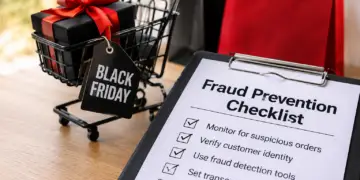
A clipboard with a “Fraud Prevention Checklist” listing checked items — monitor for suspicious orders, verify customer identity, use fraud detection tools, set transaction limits, and review high-risk orders — next to a miniature shopping cart holding a gift-wrapped box with a “Black Friday” price tag, and red and black shopping bags in the background.

Black Friday Fraud Prevention Checklist for eCommerce Merchants in 2026

November 6, 2026
A person's hand holding a wooden block featuring a person icon with a lock, next to a small blackboard displaying '$4 per account' in chalk, surrounded by other user-icon blocks.

Hacked Accounts Sell for $4 as Marketplace Fraud Scales, Mangopay Data Shows

November 27, 2026
A magnifying glass focused on a screen displaying a red warning triangle icon and the text "1.72 Million Infostealer Logs". To the right, logos for major eCommerce platforms—including Amazon, eBay, Shopify, and Walmart—are displayed above a red "Data at Risk" warning box.

FortiGuard Labs Finds 1.72 Million Infostealer Logs Tied to Major eCommerce Platforms

November 27, 2026
A 3D graphic featuring shopping bags, a gift tag on a fishing hook reading "LIMITED TIME OFFER!", a security shield with a padlock, and a black box displaying "19,063,077 NEARLY 3x".

Black Friday Phishing Nearly Triples as Kaspersky Blocks 19 Million Shopping Lures

November 27, 2026
A miniature shopping cart filled with gift boxes sits on a wooden surface in front of a festive Christmas tree. In the background, a hooded figure operates a futuristic digital interface displaying a glowing red warning icon alongside a shopping cart and credit card symbol.

RH-ISAC Expects Agentic Commerce Fraud to Reuse Familiar Tactics This Holiday Season

November 26, 2026
A stack of manila folders stamped with "ONLINE SCAMS" in red ink sits beside handcuffs on a wooden desk, in front of a U.S. Department of Justice seal and text reading "800+ Defendants in Largest-Ever Online Scams Crackdown".

DOJ Says Largest-Ever Online Scams Crackdown Has Targeted Over 800 Defendants

November 25, 2026
A miniature shopping cart containing a black price tag with red and white text reading "BLACK FRIDAY". A fishing hook hangs above the cart, hooking a white envelope representing a phishing email. In the dark background, a glowing red warning sign with an exclamation mark appears next to text that reads "DARKTRACE 13x more phishing in November".

Black Friday Scams Drove Phishing 13 Times Higher in November, Darktrace Finds

November 25, 2026
A phishing hook catches a fake login card in front of a Black Friday shopping sign and miniature shopping cart, symbolizing the surge in brand impersonation phishing attacks targeting online shoppers.

Kaspersky Finds Brand Impersonation Phishing Nearly Tripled Ahead of Black Friday

November 24, 2026
A retail fulfillment warehouse with shopping carts, parcels and red digital targeting indicators representing sophisticated bot attacks ahead of Black Friday. A Thales-branded report highlights that 55% of bots targeting retailers were classified as advanced, while bad bots accounted for 41% of observed retail web traffic.

Thales Warns Advanced Bad Bots Will Target Retailers Ahead of Black Friday

November 23, 2026
A visual representation of AI-driven financial crime, featuring a payment card surrounded by a digital neural network, a fraud warning symbol, and a protective shield. The Payments Association logo appears alongside three key findings: 56% identify AI fraud as the fastest-rising risk, 41% report insufficient AI governance guidance, and 63% emphasize real-time data sharing.

Payments Association Report Ranks AI Fraud as the Fastest-Rising Financial Crime Risk

November 23, 2026
The image features the key figure £6.1 BILLION, alongside a judge’s gavel, UK flag, and Crown Court references to convey the scale of alleged fraud in 2025.

KPMG Barometer Puts Alleged UK Crown Court Fraud at £6.1 Billion in 2025

November 23, 2026
A miniature robot with glowing red eyes sits in a shopping cart with shopping bags, next to a 'Black Friday' price tag.

Kasada Says Holiday Bot Attacks Peak Before Black Friday as Refund Fraud Signals Rise 3.5x

November 23, 2026
A cybersecurity breach illustration featuring Visa, Mastercard, and JPMorgan Chase logos above a red “DATA LEAK” warning, with digital code in the background and a blurred padlock in the foreground, symbolizing a ransomware attack and stolen vendor data.

Ransomware Group Leaks Visa, Mastercard and JPMorgan Data in Vendor Data Breach

November 20, 2026
  • Contribute
  • Contact Us
  • About
  • Join Us
  • Advertise
Friday, November 27, 2026
Merchant Fraud Journal
ADVERTISEMENT
  • Home
  • Articles
    • Chargebacks
    • Fraud Prevention
    • Influencer Insights
  • Resources
    • Recorded Webinars
    • Podcasts
    • Vendor Directory
    • eCommerce Fraud Reports
    • Training and Certifications
    • Jobs Board
    • Associations and Non-Profits
  • News
No Result
View All Result
Merchant Fraud Journal
No Result
View All Result

Black Friday Fraud Prevention Checklist for eCommerce Merchants in 2026

by Charity Amancio
November 6, 2026

Black Friday fraud prevention comes down to tuning your fraud rules, staffing, and dispute process before the traffic spike. This is because the attacks that hurt merchants most during the holiday rush (card testing, account takeover, bot-driven promo abuse, gift card fraud, and friendly fraud) all grow with order volume.

Black Friday 2026 falls on November 27, and Cyber Monday follows on November 30. That leaves merchants a few weeks to stress-test their controls, lock down accounts and promotions, and prepare chargeback evidence without blocking the legitimate shoppers who make the season profitable.

Why Black Friday Is a Peak Season for Fraud

Black Friday packs more transactions, first-time customers, and discount codes into a few days than any other stretch of the eCommerce calendar. Adobe’s Cyber Week 2025 data shows U.S. shoppers spent $11.8 billion online on Black Friday 2025, up 9.1% year over year, and $44.2 billion across the full Cyber Week. Fraudsters follow that volume because unusual orders are harder to spot when traffic, basket sizes, and shipping requests all look unusual.

The share of risky orders stays meaningful even as fraud tools improve. TransUnion’s analysis of the 2024 holiday weekend found that 4.2% of attempted U.S. eCommerce transactions between Thanksgiving and Cyber Monday were suspected to be fraudulent, and Thanksgiving Day posted the highest global rate of the period. The rate fell from the prior year, yet the number of attempts stayed high because overall transaction volume keeps growing.

Common Black Friday Scams and Fraud Types That Target Merchants

Black Friday scams aimed at shoppers get most of the headlines. Merchants face a separate set of attacks, and the table below summarizes the fraud types that typically rise during the holiday window.

Fraud type How it shows up during Black Friday Main cost to merchants
Card testing fraud Bots run thousands of small authorizations to validate stolen cards, hidden inside checkout traffic spikes Authorization fees, processor scrutiny, and later chargebacks
Account takeover fraud Stolen logins let fraudsters use saved cards, loyalty points, and gift card balances Chargebacks, customer churn, and support costs
Promo abuse Fake accounts and scripts stack or reuse discount codes and new-customer offers Margin lost on already discounted inventory
Gift card fraud Stolen cards buy digital gift cards that are resold or drained within minutes Losses that are rarely recoverable once codes are redeemed
Friendly fraud Real customers dispute legitimate holiday purchases weeks later Chargebacks and fees in December and January
Holiday return fraud Wardrobing, receipt fraud, and empty-box claims follow the season Lost inventory and refunded revenue

Most of these attacks share infrastructure. The same bot traffic that tests cards often attempts logins and abuses promo codes, so controls that detect automation pay off across several categories at once. These categories mirror the most common types of eCommerce fraud merchants see all year, compressed into a few high-pressure days.

The Black Friday Fraud Prevention Checklist

Work through this checklist in the weeks before Black Friday, and treat it as a holiday extension of your year-round eCommerce fraud prevention program. Each step targets one or more of the fraud types above while keeping friction low for legitimate shoppers.
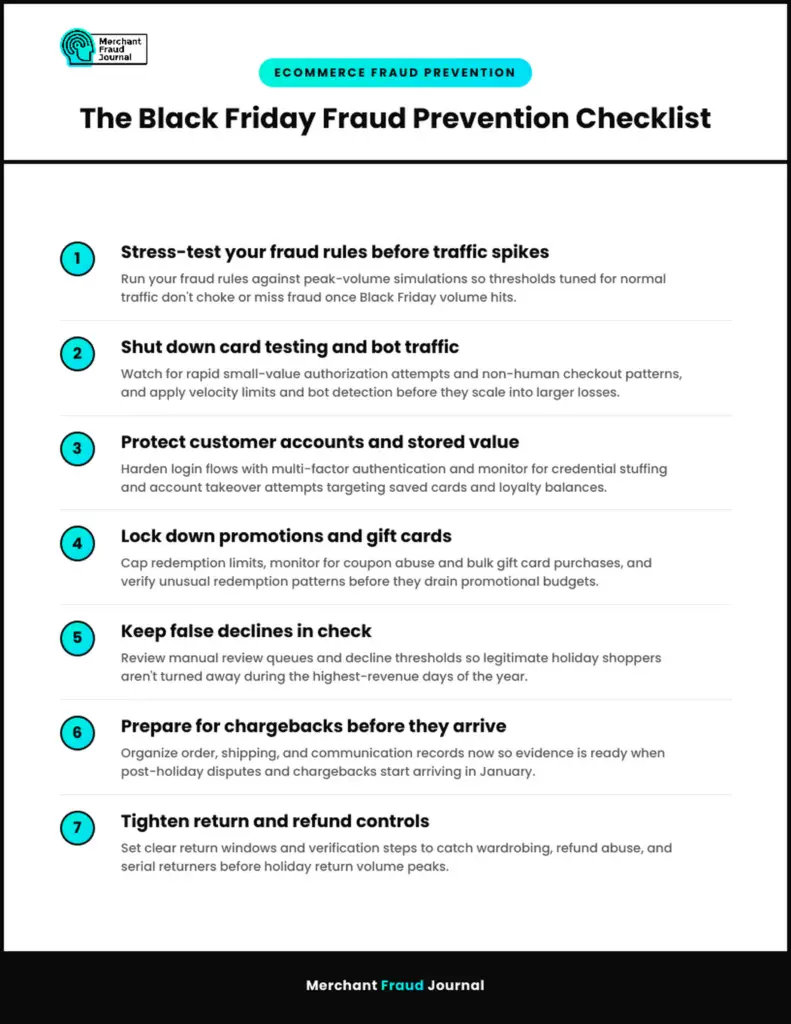
Merchant Fraud Journal infographic titled “The Black Friday Fraud Prevention Checklist,” tagged “Ecommerce Fraud Prevention,” with seven numbered tips: 1) Stress-test your fraud rules before traffic spikes — run your fraud rules against peak-volume simulations so thresholds tuned for normal traffic don’t choke or miss fraud once Black Friday volume hits; 2) Shut down card testing and bot traffic — watch for rapid small-value authorization attempts and non-human checkout patterns, and apply velocity limits and bot detection before they scale into larger losses; 3) Protect customer accounts and stored value — harden login flows with multi-factor authentication and monitor for credential stuffing and account takeover attempts targeting saved cards and loyalty balances; 4) Lock down promotions and gift cards — cap redemption limits, monitor for coupon abuse and bulk gift card purchases, and verify unusual redemption patterns before they drain promotional budgets; 5) Keep false declines in check — review manual review queues and decline thresholds so legitimate holiday shoppers aren’t turned away during the highest-revenue days of the year; 6) Prepare for chargebacks before they arrive — organize order, shipping, and communication records now so evidence is ready when post-holiday disputes and chargebacks start arriving in January; 7) Tighten return and refund controls — set clear return windows and verification steps to catch wardrobing, refund abuse, and serial returners before holiday return volume peaks.

1. Stress-Test Your Fraud Rules Before Traffic Spikes

Review your rules against last year’s holiday data instead of a normal week. Velocity limits, order-value thresholds, and geolocation rules built for average traffic can either flood your review queue or decline good customers at peak. Run last season’s holiday orders through updated rules to see where false declines and missed fraud would land.

Warning signs to watch for

Flag orders and sessions that combine several of the following signals.

  • Many failed authorizations from one IP address, device, or card BIN range within minutes
  • New accounts placing high-value orders with expedited shipping to a different address
  • Logins from new devices followed by changes to email, password, or shipping details
  • The same discount code used across many new accounts with similar email patterns
  • Orders for digital gift cards or high-resale electronics with mismatched billing details

One signal on its own rarely proves fraud. Combinations of signals do, which is why layered risk scoring outperforms single hard rules during peak season.

2. Shut Down Card Testing and Bot Traffic

Bots power card testing fraud, credential stuffing, and promo abuse. Kasada data cited in American Banker’s December 2025 holiday fraud report shows the average retailer faces 2.5 to 3 times more bot-driven login traffic during the holiday months. Add bot detection at login and checkout, rate-limit authorization attempts per session and per card, and trigger CAPTCHA or device checks only when behavior looks automated.

3. Protect Customer Accounts and Stored Value

Account takeover fraud spikes when fraudsters know customers are busy shopping and less likely to notice an unexpected email. Require step-up authentication before customers change contact details, ship a high-value order to a new address, or redeem gift card and loyalty balances. Send real-time alerts when account details change. Current account takeover fraud statistics show why these controls should stay in place after the holidays too.

4. Lock Down Promotions and Gift Cards

Limit high-value discount codes to one use per verified customer, tie new-customer offers to payment and device checks, and cap the number of gift cards per order. Add a short delivery hold on digital gift cards for orders that score as risky, since stolen codes are often drained within minutes of delivery.

5. Keep False Declines in Check

Overly strict rules carry a real cost during the holidays. A loyal customer who gets declined during a sale often buys from a competitor instead of trying again. Route borderline orders to manual review with clear response times, add reviewers for the long weekend, and track approval rates daily so you can loosen rules that block good orders. The peak-season fraud myths that push merchants toward blanket declines usually cost more in lost sales than they save in fraud.

6. Prepare for Chargebacks Before They Arrive

Holiday fraud shows up in disputes weeks later. Card networks commonly give cardholders up to 120 days to file, so many Black Friday chargebacks land in December and January. Save delivery confirmations, IP and device data, customer messages, and policy acceptance for every order, and keep return and refund terms visible at checkout. This evidence is what wins friendly fraud disputes, and planning now for the post-holiday chargeback surge keeps January from turning into a scramble.

7. Tighten Return and Refund Controls

Returns rise after the holidays, and so does abuse. Appriss Retail’s 2025 returns research found that about $100 billion of the $706 billion in merchandise returned in 2025 was lost to fraud and abuse. Set clear return windows for holiday purchases, require tracking on return shipments, and watch for repeat refund requests from the same customers or addresses. Newer tactics such as refund abuse and refundjacking belong in your review criteria as well.

Build a Black Friday Fraud Response Plan

Black Friday fraud prevention controls work best when everyone knows who acts on what. Assign an owner for fraud rule changes, set escalation paths for sudden attack spikes, and agree in advance on the thresholds that trigger stricter rules. Keep contacts for your payment processor and fraud vendor on hand for the long weekend, because card testing attacks often start overnight when staffing is lowest. Cyber Monday fraud deserves the same coverage as Black Friday, so keep the plan active through November 30 and run a short review in December to record what worked for next year.

Start Your Black Friday Fraud Prevention Plan This Week

Black Friday fraud prevention works when the preparation happens before the traffic arrives. Tune your rules against last year’s holiday data, stop bots at login and checkout, protect accounts and stored value, limit promo and gift card abuse, and collect the evidence you will need for January’s disputes. Merchants who finish this checklist before November 27 can approve more good orders with confidence, keep holiday fraud contained, and head into the new year with fewer chargebacks on the books.

Frequently Asked Questions

These answers cover what merchants most often ask about Black Friday fraud and holiday fraud.

Is there more fraud on Black Friday?

Fraud attempts rise during Black Friday weekend because order volume, new customers, and discount activity all spike at once. TransUnion found that 4.2% of attempted U.S. eCommerce transactions between Thanksgiving and Cyber Monday 2024 were suspected to be fraudulent.

What types of fraud increase during the holiday season?

Card testing, account takeover, promo abuse, gift card fraud, and friendly fraud all tend to climb during the holidays. Return fraud follows in December and January as shoppers send back holiday purchases.

How can merchants prevent card testing on Black Friday?

Use bot detection at checkout, rate-limit authorization attempts per session, card, and IP address, and add CAPTCHA or device checks when traffic looks automated. Watch for bursts of small or declined authorizations, which usually signal a card testing run.

How do I prepare my eCommerce store for holiday fraud?

Review fraud rules against last year's holiday data, protect customer accounts with step-up authentication, and set limits on promo codes and gift card purchases. Staff your manual review team for the peak weekend and start collecting chargeback evidence on every order.

Do chargebacks increase after Black Friday?

Yes, chargebacks typically rise in December and January because cardholders often have up to 120 days to dispute holiday purchases. Friendly fraud and delayed reports of stolen cards drive much of this increase.

Which has more scams, Black Friday or Cyber Monday?

Both days see heavy fraud activity, and the risk covers the full stretch from Thanksgiving to Cyber Monday. TransUnion's 2024 data found the highest global suspected fraud rate on Thanksgiving Day itself, so controls should be live before Black Friday begins.

Picture of Charity Amancio

Charity Amancio

Charity Amancio specializes in SaaS solutions for global eCommerce businesses, including payments and risk management applications. She bridges the gap between technology and merchant needs, offering practical perspectives on the tools shaping eCommerce. Her insights appear regularly in B2B publications covering the digital commerce space.

TweetShareSend
Previous Post

Revolve Says Attackers Stole Customer Payment Card Data Ahead of Holiday Shopping Season

Next Post

Raise Cuts Chargebacks 45% and Manual Fraud Reviews 98% With Sardine

Next Post
Four wooden blocks labeled “Chargebacks,” “Manual Fraud Reviews,” “45%,” and “98%” with downward arrows, connected by a blue curved arrow pointing toward the Sardine logo in the background — illustrating reductions in chargebacks and manual fraud reviews achieved with Sardine’s fraud prevention platform.

Raise Cuts Chargebacks 45% and Manual Fraud Reviews 98% With Sardine

Search:

No Result
View All Result

Our Latest Reports

Fraud Trends Report

Consumer Payments Survey Report

Fraud Prevention Tactics that Enable Exceptional Customer Experience

ATO Fraud In Retail Report

3 Ways a Unified Chargeback Management and Fraud Platform Increases Revenue

Digital Trust And Safety Report: Combating the Evolving Complexities of Payment Fraud

On-Demand Webinars

New Trends in The Payments Ecosystem

Balancing Customer Experience and Fraud Prevention: What’s the Secret?

Stopping Fraud Across the Customer Lifecycle

Addressing Payment Fraud and the Customer Experience in 2022


Quick Navigation

  • Home
  • News
  • Join Us
  • About Us
  • Contact Us
  • Advertise
  • Contribute
  • Privacy Policy

Privacy Policy

Our Privacy Policy
Our Terms of Use

Resources

  • Articles
  • eCommerce Fraud Reports
  • eCommerce Fraud Webinars
  • Associations and Non-Profits
  • Podcasts
  • Vendor Directory
  • Chargeflow – AI Chargeback Management

Featured Vendors

  • Signifyd
  • TransUnion
  • PayRetailers
  • Spotrisk
  • CB-ALERT
  • Chargeflow
  • Corepay
  • AtData
No Result
View All Result
  • About Merchant Fraud Journal
    • Interested in Contributing or Guest Posting to Merchant Fraud Journal?
    • Merchant Fraud Journal Editorial Guidelines
  • Advertise on Merchant Fraud Journal
  • Articles
    • Chargebacks
    • Fraud Prevention
    • Influencer Insights
  • Contact Us
  • Download Addressing Payment Fraud and Customer Experience Report
  • Download Chargebacks Consumer Survey Report 2022
  • Download Evolving Complexities of Payment Fraud Report
  • Download Fraud Prevention Tactics that Enable Exceptional Customer Experiences Report
  • Download Merchant Fraud Journal 2023 Fraud Trends Report
  • Download Merchant Fraud Journal 2024 Fraud Trends Report
  • Download Merchant Fraud Journal Generative AI Fraud Prevention Checklist for SMBs
  • Download Quantifying the Challenge of Friendly Fraud: Your Post-purchase Strategy for the Future
  • Download the 2020 Chargeback and Representment Report
  • Download the 2020 Merchant Fraud Journal Vendor Guide
  • Download the 2021 Fraud Trends Report
  • Download the 2022 Fraud Trends Report
  • Download the 2023 Consumer Payment Trends Report
  • Download the 3 Ways a Unified Chargeback Management and Fraud Platform Increases Revenue Report
  • Download the MFJ 2022 Customer Experience Report
  • Download the MFJ ATO in Retail Report
  • Home
  • Home Elementor
  • Job Dashboard
  • Join The Merchant Fraud Journal Community
  • Merchant Fraud Journal Advertising Agreement
  • Merchant Fraud Journal Advertising Agreement – Signifyd
  • MFJ Fraud Trends Report Giveaway
  • News
  • Post a Job
  • Privacy Policy
  • Resources
    • #9978 (no title)
    • 2020 Chargeback Representment Guide for Merchants
    • 2020 Vendor Guide
    • 2023 Consumer Payments Survey Report
    • 3 Ways a Unified Chargeback Management and Fraud Platform Increases Revenue
    • 8 Fraud Prevention Training and Certifications: A 2026 Guide
    • Addressing Payment Fraud and the Customer Experience in 2022
    • Associations and Non-Profits
    • ATO Fraud In Retail Report
    • Balancing Customer Experience and Fraud Prevention: What’s the Secret?
    • Chargebacks Consumer Survey Report 2022
    • Digital Trust & Safety: Combating the Evolving Complexities of Payment Fraud
    • eCommerce Fraud Reports
    • eCommerce Fraud Webinars
    • Fraud Prevention Tactics that Enable Exceptional Customer Experiences
    • How to Build a Recession Proof Chargeback Prevention Strategy
    • How to Reduce Customer Friction During Holiday Sales Season
    • How to Stop Fraud During the 2022 Holiday Season
    • Jobs Board
    • Merchant Fraud Journal 2023 Fraud Trends Report
    • Merchant Fraud Journal’s Fraud Trends 2020 Report
    • Merchant Fraud Journal’s Generative AI Fraud Prevention Report: A Checklist for SMB Companies
    • Merchant Fraud Journal’s Fraud Trends 2021 Report
    • Merchant Fraud Journal’s Fraud Trends 2022 Report
    • MFJ’s 2022 Customer Experience Report
    • Podcasts
    • Prevent High-Velocity Fraud Attacks During the 2021 Holiday Season
    • Quantifying the Challenge of Friendly Fraud: Your Post-purchase Strategy for the Future
    • Stopping Fraud Across the Customer Lifecycle
    • The surprisingly easy way to secure your payment data, reduce your risk, and win the war on ecommerce fraud
    • Vendor Directory
    • Webinar – Addressing Payment Fraud and the Customer Experience in 2022
    • Webinar – Mitigating Fraud and Risk on the ACH Network
    • Win January Chargeback Disputes
  • Subscribed
  • Terms and Conditions

© 2026 Merchant Fraud Journal

Not enough quota to unlock this post
Unlock left : 0
Are you sure want to cancel subscription?