


Dispute management is the end-to-end process of tracking, responding to, and resolving payment disputes and chargebacks to protect business revenue. It covers everything from the moment a cardholder questions a charge to the final decision on who keeps the money.
A single mishandled dispute costs far more than the transaction value as fees, lost product, and operational time add up fast. Below, we break down how the dispute process works, what separates merchants who recover revenue from those who don’t, and how to build a system that keeps your chargeback ratio out of the danger zone.
What Is Dispute Management?
Dispute management is the end-to-end process of tracking, responding to, and resolving payment disputes and chargebacks to protect business revenue. When a cardholder questions a transaction with their issuing bank, a formal process begins. How you handle it determines whether you recover those funds or lose them permanently.
It is considered as the operational backbone connecting fraud prevention, customer service, and payment operations. A dispute arrives, you gather evidence, you respond within a tight deadline, and the bank decides who keeps the money.
If you’re a merchant, you need to understand that this isn’t paperwork. It’s revenue protection. Every dispute you ignore or mishandle means lost product, forfeited transaction value, and fees ranging from $15 to $100 per case, regardless of whether the original charge was legitimate.
Why Disputes Happen in the First Place
Disputes fall into three categories, and knowing which type you’re facing shapes your entire response.
- True fraud: Someone uses stolen card credentials to buy from your store. The real cardholder spots the charge and calls their bank.
- Merchant error: Something went wrong on your end. It could be a duplicate charge, wrong amount, undelivered shipment, or damaged item.
- Friendly fraud: The customer received what they ordered but disputes the charge anyway. Sometimes intentional, sometimes genuine confusion about a billing descriptor or forgotten subscription.
Friendly fraud is particularly frustrating because the transaction itself was legitimate. The cardholder simply claims otherwise, and you’re left proving a negative.
How the Dispute Management Process Works
Once a cardholder contacts their bank to question a charge, a structured timeline kicks off. The specifics vary by card network, but the core sequence stays consistent across Visa, Mastercard, and others.
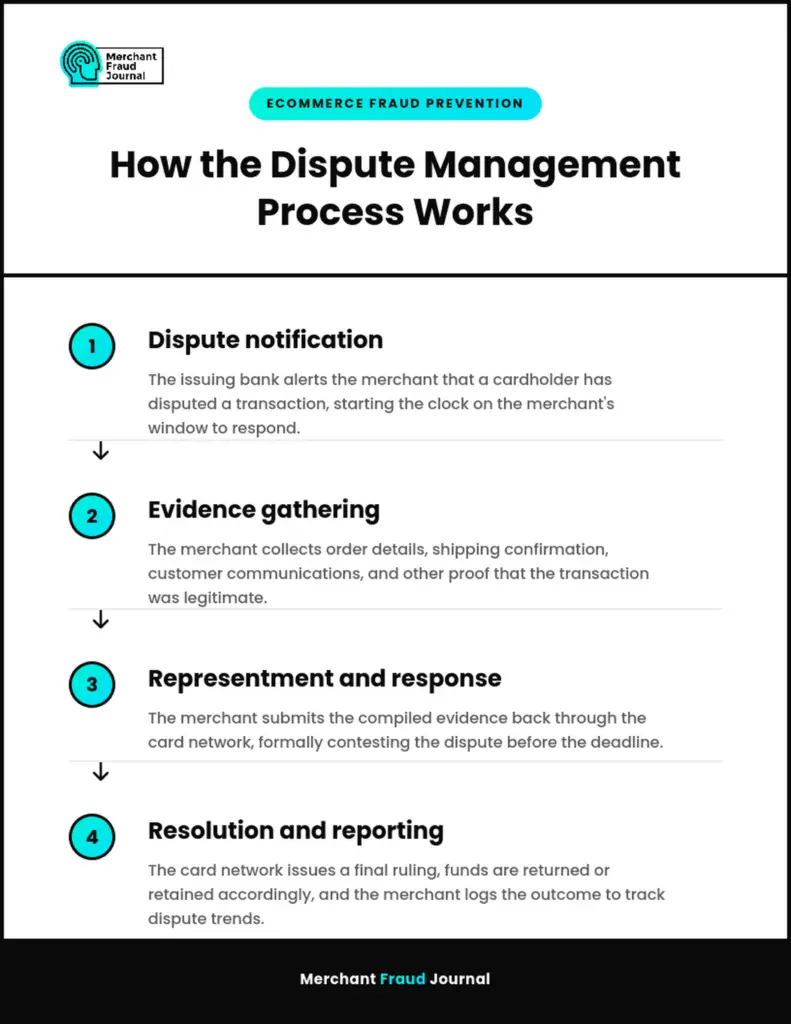
1. Dispute notification
The issuing bank reviews the cardholder’s claim. If it meets basic criteria, they initiate a dispute. Your acquiring bank or payment processor gets notified and passes the alert to you. This is your first signal that something has gone wrong, and the clock starts immediately. Depending on the card network and reason code, you typically have 7 to 30 days to respond.
2. Evidence gathering
This step determines whether you win or lose. You’ll compile documentation that directly addresses the cardholder’s specific claim, not just generic proof that a transaction happened.
What counts as relevant evidence depends on the reason code:
- Delivery confirmation with signature or tracking
- IP address and device fingerprint from the original transaction
- Customer communication history showing they received and used the product
- Terms of service or refund policy the customer agreed to at checkout
- Prior successful transactions from the same customer
A dispute claiming product not received requires different proof than one claiming product not as described. Match your evidence to the actual claim.
3. Representment and response
Representment is the formal process of challenging a dispute. You submit your evidence package to the issuing bank, making the case that the chargeback is invalid and the original transaction was legitimate.
Quality matters more than quantity here. A focused response that directly addresses the reason code wins more often than a document dump of everything you have on file.
4. Resolution and reporting
The issuing bank reviews your evidence and makes a decision. Win, and the funds return to your account. Lose, and the chargeback stands. You absorb the loss plus any associated fees.
Either outcome feeds back into your analytics. Patterns in reason codes, product categories, or customer segments reveal where your prevention efforts need attention.
| Card Network | Typical Response Window | Monitoring Threshold |
|---|---|---|
| Visa | 20–30 days (acquirer-set; Visa’s own guide does not specify a fixed number) | ~1.5% dispute ratio per most industry trackers as of 2026 |
| Mastercard | Up to 45 days per network rules; often under 30 days in practice | 1.5% dispute ratio (100+ disputes/month) — consistently reported across industry sources |
| American Express | 20 days | Varies by program |
| Discover | 30 days | Varies by program |
Card network sources:
- Visa — Dispute Management Guidelines for Visa Merchants (June 2024): https://usa.visa.com/dam/VCOM/global/support-legal/documents/merchants-dispute-management-guidelines.pdf
- Mastercard — Chargeback Guide, Merchant Edition (acquirer-facing, referenced for the 45-day network maximum): https://www.mastercard.com/content/dam/mccom/shared/business/support/rules-pdfs/chargeback-guide.pdf
- American Express — US Disputes Reference Guide: https://www.americanexpress.com/content/dam/amex/us/merchant/pdf/manage-disputes/US-Disputes-Reference-Guide.pdf
Industry/secondary sources:
- Merchant Risk Council — “Stricter VAMP Ratio Thresholds Are Now in Effect” (industry trade association; reports Visa’s 2026 threshold at 1.5%): https://merchantriskcouncil.org/learning/resource-center/member-news/blog/2026/stricter-vamp-ratio-thresholds-are-now-in-effect-heres-how-to-stay-compliant
- Chargeflow — Chargeback Thresholds 2026: Visa VAMP & Mastercard ECM Limits (reports both Visa and Mastercard at 1.5%): https://www.chargeflow.io/blog/chargeback-thresholds
- Chargeflow — Visa VAMP Explained: 2026 Ratio, Thresholds & Fees: https://www.chargeflow.io/blog/vamp-visa-acquirer-monitoring-program
- Acquired.com — VAMP FAQ (reports a 0.9% figure for 2026, conflicting with other sources): https://docs.acquired.com/docs/vamp-frequently-asked-questions
The Four Pillars of Effective Dispute Management
Waiting for disputes to arrive and then scrambling to respond leaves money on the table. Effective dispute management operates across four interconnected functions, each targeting a different stage of the problem.
1. Prevention
The cheapest dispute is the one that never happens. Prevention focuses on stopping the conditions that lead to disputes before they start.
Clear billing descriptors help customers recognize charges on their statements. Accurate product descriptions and photos reduce not as described claims. Responsive customer service gives frustrated buyers an alternative to calling their bank.
2. Deflection
Deflection intercepts disputes after a customer contacts their bank but before the chargeback formally posts. Real-time dispute alert tools like Verifi and Ethoca provide real-time alerts when a dispute is initiated, giving you a narrow window to issue a refund and avoid the chargeback entirely.
You’re trading the transaction value for protection of your dispute ratio. For low-margin orders where the chargeback fee alone exceeds your profit, that trade often makes sense.
3. Representment
When prevention and deflection fail, representment is your opportunity to recover revenue. The key is building an evidence package that directly addresses the cardholder’s claim.
Win rates vary widely depending on reason code, evidence quality, and industry. Merchants with automated evidence collection and reason-code-specific response templates typically see higher recovery rates than those handling disputes manually.
4. Analytics
Every dispute contains information. Tracking reason codes, product categories, customer segments, and outcomes reveals patterns that inform your prevention strategy.
A spike in product not received disputes might indicate a shipping carrier problem. Clusters of disputes from a specific traffic source could signal affiliate fraud. Rising friendly fraud on subscription products might mean your cancellation process is too difficult to find.
In-house vs. Outsourced Dispute Management
Merchants face a fundamental choice: build internal chargeback dispute management capabilities or partner with a specialized provider. Neither approach is universally correct—the right answer depends on your volume, complexity, and internal resources.
Building an internal dispute team
Managing disputes in-house gives you direct control over the process and keeps institutional knowledge inside your organization. You’ll want staff who understand card network rules, can compile evidence efficiently, and can meet tight response deadlines consistently.
This approach works well when you have sufficient volume to justify dedicated headcount, when your disputes involve nuanced situations that benefit from human judgment, or when you’re in a highly regulated industry where you want direct oversight of every response.
The challenge is expertise. Card network rules change frequently, and staying current requires ongoing investment in training and process updates.
Working with a dispute management provider
Outsourced providers bring specialized expertise, automation, and scale. They’ve handled thousands of disputes across many merchants and know which evidence combinations win for specific reason codes.
Performance-based pricing models align incentives—the provider earns when they recover revenue for you. This can be more cost-effective than fixed monthly fees, especially if your dispute volume fluctuates.
The trade-off is less direct control and potential dependency on a third party for a critical business function.
| Factor | In-House | Outsourced |
|---|---|---|
| Expertise depth | Requires ongoing training | Built-in specialization |
| Response speed | Depends on staffing | Typically automated |
| Cost structure | Fixed headcount | Often performance-based |
| Control | Direct oversight | Less visibility |
| Scalability | Requires hiring | Elastic capacity |
Dispute Management Software and Automation
Manual dispute management doesn’t scale. As transaction volume grows, the operational burden of tracking deadlines, gathering evidence, and submitting responses becomes unsustainable.
What automated dispute tools actually do
Automation platforms connect to your payment processor, eCommerce platform, and fulfillment systems to pull evidence automatically when a dispute arrives. They match the reason code to a response template, populate it with transaction-specific data, and submit within the required timeframe. These tools sit alongside broader fraud protection services that merchants layer together to cover prevention and recovery in one stack.
The best tools go further. Machine learning trained on historical disputes can predict which cases are worth fighting and which evidence combinations have the highest win probability for specific reason codes.
Key features to evaluate
When comparing chargeback dispute management software, focus on capabilities that directly impact outcomes:
- Integration depth: Does it connect to your specific payment processor, shopping cart, and shipping carriers without custom development?
- Evidence automation: Can it pull delivery confirmation, customer communications, and device data automatically?
- Reason code handling: Does it customize responses based on the specific claim, or use generic templates?
- Analytics and reporting: Can you track win rates, identify patterns, and measure ROI?
- Alert integration: Does it work with Verifi and Ethoca to enable deflection?
The Business Impact of Poor Dispute Management
Ignoring disputes or handling them inconsistently creates compounding problems that extend well beyond individual transaction losses. Primarily, it drags your business into unnecessary processes, fines, and loss in profit. Here’s how these effects of poor dispute management pan out.
Monitoring program penalties
Visa and Mastercard track your dispute ratio, the percentage of transactions that result in chargebacks. Exceed their thresholds and you enter monitoring programs like the Visa Acquirer Monitoring Program (VAMP) or Mastercard’s Excessive Chargeback Program, which bring escalating fines, higher processing fees, and potential account termination.
Losing your merchant account means losing the ability to accept card payments. For most eCommerce businesses, that outcome is existential.
Operational Drain
Every dispute requires attention. Without automation, staff spend hours gathering evidence, formatting responses, and tracking deadlines. All of which equate to time not spent on growth activities.
The true cost of a dispute extends far beyond the transaction value. When you factor in fees, labor, and lost merchandise, the total loss per dispute often reaches two to three times the original transaction amount.
Build a Dispute Management Process that Protects Revenue
Dispute management isn’t optional for any merchant accepting card payments. The question is whether you approach it reactively or build a systematic process that prevents disputes where possible, deflects them when prevention fails, and recovers revenue through effective representment.
Start by understanding your current dispute ratio and reason code distribution. That baseline tells you where to focus. Layer in prevention measures that address your most common dispute triggers. Implement alert services to enable deflection. And build or buy the capability to respond to every dispute with compelling, reason-code-specific evidence.
Frequently asked questions
How long does a chargeback dispute typically take to resolve?
Most disputes resolve within 60 to 90 days from initiation, though complex cases can extend longer. The timeline depends on the card network, whether you submit representment, and whether the case goes to arbitration.
How many disputes is too many before a merchant faces card network penalties?
Visa's threshold is 0.9% of transactions, while Mastercard's is 1.5%. Exceeding these ratios triggers monitoring programs with escalating fines and potential account termination.
What happens if a merchant disputes a chargeback and loses?
You lose the transaction value, keep the chargeback fee, and the loss counts against your dispute ratio. In some cases, you can escalate to arbitration, but that involves additional fees and is rarely cost-effective for typical transaction values.
Which chargeback reason codes are hardest for merchants to win?
Fraud-related reason codes (unauthorized transaction claims) are typically hardest because the burden of proof is high. "Product not received" disputes are winnable with solid delivery confirmation, while "not as described" claims fall somewhere in between.
Do chargeback dispute services charge a flat fee or performance-based pricing?
Both models exist. Performance-based pricing (you pay only when the provider wins) aligns incentives but may come with higher per-win fees. Flat monthly fees provide predictable costs but don't guarantee results.
Can high-risk merchants get dispute management support?
Yes, though options may be more limited and pricing higher. Industries like nutraceuticals, CBD, and adult content face elevated dispute rates, and some providers specialize in high-risk merchant fraud prevention while others avoid these verticals entirely.

Charity Amancio
Charity Amancio specializes in SaaS solutions for global eCommerce businesses, including payments and risk management applications. She bridges the gap between technology and merchant needs, offering practical perspectives on the tools shaping eCommerce. Her insights appear regularly in B2B publications covering the digital commerce space.
