
• Latest
8 Dropshipping Scams Targeting Sellers and Buyers in 2026

8 Dropshipping Scams Targeting Sellers and Buyers in 2026

July 2, 2026
How Credit Card Fraud Happens: 10 Common Methods Explained

How Credit Card Fraud Happens: 10 Common Methods Explained

June 25, 2026
Master the basics of Fraud-as-a-Service (FaaS). Discover how this underground economy works and get actionable strategies to defend your business.

A Guide to Fraud-as-a-Service: The New Frontier in Cybercrime

June 23, 2026
What Is a High-Risk Transaction?

What Is a High-Risk Transaction?

June 22, 2026
A woman sitting on a sofa while typing on her laptop and holding a credit card, illustrating the secure online login and verification processes discussed in "What Is Multi-Factor Authentication?".

What Is Multi-Factor Authentication?

June 16, 2026
A laptop on a desk showing a simulated phishing email notification about a locked credit card, used as a visual example of phishing threats and the need for effective merchant fraud monitoring systems.

12 Key Steps to Effective Merchant Fraud Monitoring

June 12, 2026
How to Report Credit Card Fraud as a Merchant

How to Report Credit Card Fraud as a Merchant

June 12, 2026
How to Apply for a High-Risk Merchant Account

How to Apply for a High-Risk Merchant Account

June 9, 2026
What Is a High-Risk Merchant Account?

High-Risk Merchant Fraud Prevention: Challenges, Solutions, and Best Practices

June 4, 2026
A man holding a credit card as he tries to commit fraud to a high-risk merchant account

What Is a High-Risk Merchant Account?

June 4, 2026
A masked scammer trying to commit online fraud by stealing credit card information but is blocked online by a store with comprehensive merchant fraud protection strategy in place

Merchant Fraud Protection Guide: What You Need to Know in 2026

May 28, 2026
An image of credit cards in a close-up shot of their edges; one is Visa and the other is Mastercard, symbolizing their immense value which strengthens the importance of preventing credit card fraud

How to Prevent Credit Card Fraud and Protect Your Revenue

May 27, 2026
A fake credit card tapped in a machine, depicting a merchant fraud in action

The Complete Business Guide for eCommerce Fraud in 2026

May 25, 2026 - Updated On May 27, 2026
  • Contribute
  • Contact Us
  • About
  • Join Us
  • Advertise
Thursday, July 2, 2026
Merchant Fraud Journal
ADVERTISEMENT
  • Home
  • Articles
    • Chargebacks
    • Fraud Prevention
    • Influencer Insights
  • Resources
    • Recorded Webinars
    • Podcasts
    • Vendor Directory
    • eCommerce Fraud Reports
    • Training and Certifications
    • Jobs Board
    • Associations and Non-Profits
  • News
No Result
View All Result
  • Home
  • Articles
    • Chargebacks
    • Fraud Prevention
    • Influencer Insights
  • Resources
    • Recorded Webinars
    • Podcasts
    • Vendor Directory
    • eCommerce Fraud Reports
    • Training and Certifications
    • Jobs Board
    • Associations and Non-Profits
  • News
No Result
View All Result
Merchant Fraud Journal
No Result
View All Result

8 Dropshipping Scams Targeting Sellers and Buyers in 2026

by Charity Amancio
July 2, 2026

Dropshipping is a legitimate retail model, but scammers have weaponized it to steal from both shoppers and aspiring entrepreneurs. The result is an industry where fake suppliers, ghost stores, and get-rich-quick gurus operate alongside honest merchants. This guide breaks down the eight most common dropshipping scams targeting buyers and sellers, and how to spot them before they drain your bottom line.

What Is a Dropshipping Scam?

A dropshipping scam is a scheme built on top of, or disguised as, the legitimate dropshipping business model. Sellers list products online without ever holding inventory and forward customer orders to a third-party supplier for fulfillment. This specific type of eCommerce fraud exploits the very same features that make dropshipping attractive to legitimate sellers: low barriers to entry and no physical inventory to inspect.

It’s worth being clear that dropshipping itself isn’t inherently fraudulent. About 27% of online stores use dropshipping as a legitimate way to handle orders. However, the model’s structure creates opportunities for fraud on both sides. 

On the seller-victim side, one of the most cited pain points is supplier reliability. Roughly 84% of dropshippers identify finding good suppliers as their biggest ongoing challenge. Plus, issues like long shipping times and product quality mismatches, both directly tied to supplier choice, are the most common causes of refunds and negative reviews.

8 Dropshipping Scams Targeting Sellers and Buyers

Scammers have gotten more sophisticated in recent years, adapting their tactics to exploit both sides of the retail transaction. Here are the most common schemes circulating right now, split between scams affecting shoppers and scams targeting store owners.
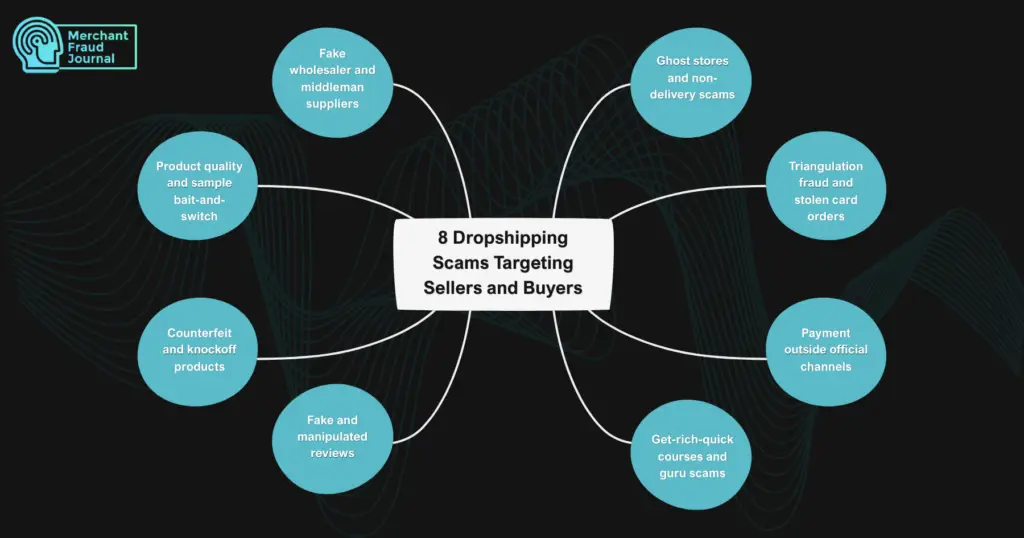
An infographic by Merchant Fraud Journal mapping out 8 dropshipping scams, including ghost stores, triangulation fraud, payment outside official channels, guru scams, fake reviews, counterfeit products, product quality bait-and-switch, and fake wholesalers.

1. Fake wholesaler and middleman suppliers

Some scammers pose as legitimate wholesalers but are actually middlemen marking up AliExpress prices by 30-50%. They charge monthly fees or upfront costs for exclusive supplier directories containing publicly available information. The red flag here is any supplier requiring payment just to access their catalog. Real wholesalers make money from product sales, not membership fees.

2. Product quality and sample bait-and-switch

A supplier sends you a quality sample to earn your trust, then ships cheap knockoffs to your actual customers. You won’t know there’s a problem until refund requests and chargebacks start rolling in. This scam is particularly damaging because it creates a paper trail showing you received and approved the product quality. That makes disputes harder to win later.

3. Counterfeit and knockoff products

Suppliers sometimes ship fake branded goods without the seller’s knowledge. You might think you’re selling legitimate products, but your customers receive counterfeits. Counterfeit sales expose you to intellectual property lawsuits and potential criminal liability. Card networks also treat counterfeit disputes harshly, often siding with the cardholder automatically.

4. Fake and manipulated reviews

Scam stores and suppliers use bot-generated reviews to create false trust. You’ll notice patterns like all five-star ratings, similar language across reviews, and multiple reviews posted within the same timeframe. Legitimate businesses accumulate reviews gradually with natural variation in ratings and language. A store with 200 perfect reviews posted over two weeks is almost certainly fake.

5. Get-rich-quick courses and guru scams

Self-proclaimed dropshipping millionaires sell overpriced courses promising overnight wealth. The done-for-you store variant is equally problematic, as scammers sell generic, cloned websites to hundreds of buyers, guaranteeing market saturation and zero real sales. One way to spot a get-rich-quick scheme is through exaggerated claims. If someone promises overnight success or huge profits without showing verifiable proof, walk away.

6. Payment outside official channels

Scammers request wire transfers, cryptocurrency, or PayPal friends-and-family payments to avoid buyer protection mechanisms. Once you send money through unofficial channels, recovery is nearly impossible. Legitimate suppliers accept credit cards and standard PayPal business transactions because they have nothing to hide. 

Any request to pay outside secure platforms is a major warning sign. The same caution applies to loyalty fraud, where scammers ask you to redeem or transfer rewards points through unofficial third-party sites instead of the retailer’s own system.

7. Triangulation fraud and stolen card orders

In triangulation fraud, a scammer takes an order using stolen card details, places that order with your legitimate store, and ships the product to their victim. You fulfill the order, thinking it’s a normal sale. When the real cardholder discovers the fraud, they file a chargeback against you. You lose the product, the revenue, and pay the chargeback fee—even though you did nothing wrong. This scheme turns legitimate merchants into unwitting participants in fraud.

8. Ghost stores and non-delivery scams

Fraudsters create temporary storefronts, collect payments, and never ship anything. Within weeks, the site and social profiles disappear completely. Ghost store scams spike during high-demand periods like Black Friday and holiday shopping seasons when buyers are less cautious about unfamiliar stores.

AI Dropshipping Scams

Fraudsters use artificial intelligence (AI) to build entire storefronts, personas, and marketing campaigns that look completely legitimate at first glance. This scheme has scaled faster than almost any other scam on this list. 

Roughly 100 new fraudulent accounts using AI-generated influencers are created every day, many of them built to sell dropshipped goods. 

In one documented pattern, hundreds of synthetic personas created entirely through AI video generation have impersonated small-business owners across TikTok, Instagram, and Facebook. They appear to handcraft products that are actually cheap items sourced from mass retailers and resold at a markup. The videos often include an emotional narrative to build trust and drive engagement, and the accounts run on automated responses to engage with viewers and push sales. 

Telltale signs of this fraud-as-a-service model include mismatched voiceovers, physically implausible movements, and near-identical videos reused across dozens of accounts with only the AI persona swapped out. Before buying from a seller you found through a viral video, look up the product on the retailer’s own site and check whether the account has a real, verifiable business history behind it.

Staying One Step Ahead of Dropshipping Scams

The best defense against dropshipping scams is consistent vigilance. Verify supplier credentials, stick to secure payment platforms, watch for red flags in reviews and sales pitches, and treat any request to move outside official channels as a warning sign. It doesn’t matter if you’re buying a product or running the store; a little skepticism upfront can save you from a costly mistake down the line.

Frequently Asked Questions

Is dropshipping considered scamming?

No, dropshipping is a legitimate fulfillment model used by major retailers worldwide. Scams exist within the dropshipping space, not because of the model itself.

Are AliExpress and Alibaba dropshipping platforms scams?

No, both are legitimate marketplaces. However, individual sellers on AliExpress and Alibaba vary widely in reliability, so vetting suppliers with sample orders and reviews remains essential.

How can you identify a fake dropshipping supplier?

Look for upfront fees to access catalogs, missing contact information, wholesale prices that match retail, and requests for payment outside secure platforms.

Picture of Charity Amancio

Charity Amancio

Charity Amancio specializes in SaaS solutions for global eCommerce businesses, including payments and risk management applications. She bridges the gap between technology and merchant needs, offering practical perspectives on the tools shaping eCommerce. Her insights appear regularly in B2B publications covering the digital commerce space.

TweetShareSend
Previous Post

How Credit Card Fraud Happens: 10 Common Methods Explained

Download our latest report:

Our Latest Reports

2024 Fraud Trends Report

2023 Consumer Payments Survey Report

2023 Fraud Trends Report

2022 Chargeback Consumer Survey Report

Fraud Prevention Tactics that Enable Exceptional Customer Experience

Addressing Payment Fraud and The Customer Experience in 2022

2022 Fraud Trends Report

ATO Fraud In Retail Report

2022 Customer Experience Report

3 Ways a Unified Chargeback Management and Fraud Platform Increases Revenue

Digital Trust And Safety Report: Combating the Evolving Complexities of Payment Fraud

On-Demand Webinars

New Trends in The Payments Ecosystem

Balancing Customer Experience and Fraud Prevention: What’s the Secret?

Stopping Fraud Across the Customer Lifecycle

Addressing Payment Fraud and the Customer Experience in 2022


Get the 2024 Fraud Trends Report

Search Our Site

No Result
View All Result

Our Sponsors

Quick Navigation

  • Home
  • News
  • Join Us
  • About Us
  • Contact Us
  • Advertise
  • Contribute
  • Privacy Policy

The Payments Media Network

Merchant Fraud Journal
Payments Review

Privacy Policy

Our Privacy Policy
Our Terms of Use

Resources

  • Articles
  • eCommerce Fraud Reports
  • eCommerce Fraud Webinars
  • Training and Certifications
  • Jobs Board
  • Associations and Non-Profits
  • Podcasts
  • Vendor Directory

Download the 2023 Fraud Trends Report

No Result
View All Result
  • About Merchant Fraud Journal
    • Interested in Contributing or Guest Posting to Merchant Fraud Journal?
    • Merchant Fraud Journal Editorial Guidelines
  • Advertise on Merchant Fraud Journal
  • Articles
    • Chargebacks
    • Fraud Prevention
    • Influencer Insights
  • Contact Us
  • Download Addressing Payment Fraud and Customer Experience Report
  • Download Chargebacks Consumer Survey Report 2022
  • Download Evolving Complexities of Payment Fraud Report
  • Download Fraud Prevention Tactics that Enable Exceptional Customer Experiences Report
  • Download Merchant Fraud Journal 2023 Fraud Trends Report
  • Download Merchant Fraud Journal 2024 Fraud Trends Report
  • Download Merchant Fraud Journal Generative AI Fraud Prevention Checklist for SMBs
  • Download Quantifying the Challenge of Friendly Fraud: Your Post-purchase Strategy for the Future
  • Download the 2020 Chargeback and Representment Report
  • Download the 2020 Merchant Fraud Journal Vendor Guide
  • Download the 2021 Fraud Trends Report
  • Download the 2022 Fraud Trends Report
  • Download the 2023 Consumer Payment Trends Report
  • Download the 3 Ways a Unified Chargeback Management and Fraud Platform Increases Revenue Report
  • Download the MFJ 2022 Customer Experience Report
  • Download the MFJ ATO in Retail Report
  • Home
  • Home Elementor
  • Job Dashboard
  • Join The Merchant Fraud Journal Community
  • Merchant Fraud Journal Advertising Agreement
  • Merchant Fraud Journal Advertising Agreement – Signifyd
  • MFJ Fraud Trends Report Giveaway
  • News
  • Post a Job
  • Privacy Policy
  • Resources
    • #9978 (no title)
    • 2020 Chargeback Representment Guide for Merchants
    • 2020 Vendor Guide
    • 2023 Consumer Payments Survey Report
    • 3 Ways a Unified Chargeback Management and Fraud Platform Increases Revenue
    • Addressing Payment Fraud and the Customer Experience in 2022
    • Associations and Non-Profits
    • ATO Fraud In Retail Report
    • Balancing Customer Experience and Fraud Prevention: What’s the Secret?
    • Chargebacks Consumer Survey Report 2022
    • Digital Trust & Safety: Combating the Evolving Complexities of Payment Fraud
    • eCommerce Fraud Reports
    • eCommerce Fraud Webinars
    • Fraud Prevention Tactics that Enable Exceptional Customer Experiences
    • Fraud Prevention Training and Certifications
    • How to Build a Recession Proof Chargeback Prevention Strategy
    • How to Reduce Customer Friction During Holiday Sales Season
    • How to Stop Fraud During the 2022 Holiday Season
    • Jobs Board
    • Merchant Fraud Journal 2023 Fraud Trends Report
    • Merchant Fraud Journal’s Fraud Trends 2020 Report
    • Merchant Fraud Journal’s Generative AI Fraud Prevention Report: A Checklist for SMB Companies
    • Merchant Fraud Journal’s Fraud Trends 2021 Report
    • Merchant Fraud Journal’s Fraud Trends 2022 Report
    • MFJ’s 2022 Customer Experience Report
    • Podcasts
    • Prevent High-Velocity Fraud Attacks During the 2021 Holiday Season
    • Quantifying the Challenge of Friendly Fraud: Your Post-purchase Strategy for the Future
    • Stopping Fraud Across the Customer Lifecycle
    • The surprisingly easy way to secure your payment data, reduce your risk, and win the war on ecommerce fraud
    • Vendor Directory
    • Webinar – Addressing Payment Fraud and the Customer Experience in 2022
    • Webinar – Mitigating Fraud and Risk on the ACH Network
    • Win January Chargeback Disputes
  • Subscribed
  • Terms and Conditions

© 2021 Payments Media Solutions Canada Inc.

Not enough quota to unlock this post
Unlock left : 0
Are you sure want to cancel subscription?