

Running an online store on Shopify can be a rewarding venture. However, it also exposes sellers to various scams that can jeopardize their business. As the popularity of eCommerce continues to rise, so does the sophistication of scammers looking to exploit unsuspecting entrepreneurs. This article will delve into the most common Shopify scams, how they operate, and practical strategies to safeguard your business against these threats.
The Landscape of Shopify Scams
The world of eCommerce is rife with opportunities, but it also presents a fertile ground for fraudulent activities. Scammers often target Shopify sellers by impersonating customers, suppliers, or even Shopify representatives. Understanding the landscape of these scams is crucial for any seller looking to protect their business.
Online shopping fraud isn’t a fringe problem — it’s one of the most commonly reported categories of consumer fraud in the United States, according to the Federal Trade Commission’s Consumer Sentinel Data Book. The FBI’s Internet Crime Complaint Center (IC3) also reported phishing as the single most-reported form of cybercrime in its most recent annual report, underscoring just how central email-based deception has become to online retail fraud. Shopify sellers are not immune to this trend, and the platform’s popularity makes it a natural target for scammers looking for volume.
Types of Shopify Scams
Shopify scams take many different shapes, and they don’t all come from the same direction. Some target sellers directly through fake orders or stolen credentials, while others exploit the trust customers place in your store or the tools you rely on to run it. Knowing what each scam looks like in practice is the first step toward catching one before it costs you money, product, or access to your own account. Below are the most common types sellers run into.
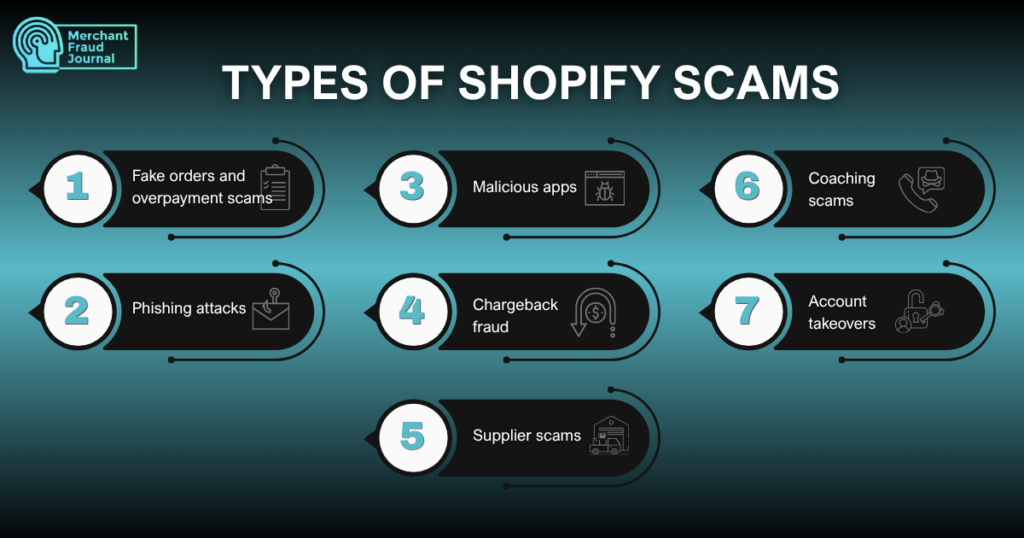
1. Fake orders and overpayment scams
Scammers may place large orders or send payments that exceed the total amount due. They often follow up with a request for a refund of the excess amount, which can lead to significant financial losses when the original payment is found to be fraudulent.
2. Phishing attacks
Phishing scams involve emails that mimic official Shopify communications, tricking sellers into revealing sensitive information. These Shopify email scams often create a sense of urgency, prompting sellers to act quickly without verifying the source. Merchant Fraud Journal’s breakdown of common phishing tactics notes that attackers typically move within minutes of stealing credentials, which is why quick recognition matters more than reacting after the fact.
3. Malicious apps
The Shopify App Store is a valuable resource for sellers, but it can also harbor malicious applications. Scammers create fake apps that appear legitimate, only to steal data or compromise store security once installed. Merchant Fraud Journal’s roundup of Shopify fraud protection apps is a useful starting point for sellers trying to separate legitimate fraud-prevention tools from the noise.
4. Chargeback fraud
In this scenario, a customer places an order, receives the product, and then disputes the charge with their bank, claiming the transaction was unauthorized. This can result in the seller losing both the product and the payment. This pattern, often called friendly fraud, is one of the fastest-growing categories of chargeback abuse, since it doesn’t require a stolen card at all — just a customer willing to dispute a legitimate purchase. Chargeflow’s guide on chargeback and fraud prevention outlines several practical tactics merchants can use to catch disputes before they escalate into full chargebacks.
5. Supplier scams
For dropshippers, dealing with unreliable suppliers can be a significant risk. Fraudulent suppliers may offer attractive deals but disappear after payment, leaving sellers with no products to fulfill orders. Merchant Fraud Journal’s guide to drop shipping fraud prevention recommends sticking to established, Shopify-recommended sourcing platforms rather than sourcing from unverified directories.
6. Coaching scams
Some individuals market themselves as “Shopify coaches,” promising quick success for a fee. However, many of these offers are scams that provide little value in return for the investment.
Red flags often include guaranteed income claims, pressure to enroll before a countdown timer expires, and testimonials that cannot be independently verified. Merchants who fall for these schemes frequently end up paying thousands of dollars for generic advice that is freely available through legitimate business resources.
7. Account takeovers
Scammers may attempt to gain access to seller accounts using stolen credentials or weak passwords. Once inside, they can change payment details and lock the seller out of their own account. Merchant Fraud Journal’s explainer on account takeover fraud points out that pairing strong, unique passwords with two-factor authentication closes off most of the easy entry points scammers rely on.
Recognizing the Warning Signs of Shopify Scams
Being aware of the warning signs associated with Shopify scams can help sellers take proactive measures to protect their businesses. Most scams share a handful of tell-tale patterns, and learning to spot them takes far less effort than recovering from a successful attack. Here are some red flags to watch for:
- Unusual payment requests: Be cautious of customers who request refunds before payments have cleared or who want to communicate outside of Shopify.
- Suspicious emails: Always verify the sender’s email address. Legitimate communications from Shopify will come from an official domain.
- Pressure tactics: Scammers often create a sense of urgency, pushing sellers to act quickly without proper verification.
- Unverified apps: Only install applications from trusted developers and read reviews before adding them to your store.
None of these signals is proof of a scam on its own, but seeing two or three together in the same interaction is a strong reason to slow down, verify the details independently, and avoid making any changes to your store or payment settings until you’re confident the request is legitimate.
Practical Strategies for Protection Against Shopify Scams
To safeguard your Shopify store from scams, implementing a combination of proactive measures and best practices is essential. Here are some effective strategies:
1. Use Shopify's built-in tools
Leverage Shopify’s fraud analysis tools to assess the risk of each transaction. This feature can help identify potentially fraudulent orders before they are fulfilled. Shopify assigns a risk level of low, medium, or high to each order based on factors like billbilling and shipping address mismatches, unusual order patterns, and proxy or VPN usage. Merchants should treat high-risk flags as a prompt for manual review rather than automatic fulfillment, since blocking a legitimate customer is far less costly than absorbing a chargeback.
2. Enable two-factor authentication
Adding an extra layer of security to your account can significantly reduce the risk of unauthorized access. Two-factor authentication requires a second form of verification, making it harder for scammers to gain entry. Learn how two-factor authentication works to understand the value of avoiding SMS-based codes tied to your personal phone number, since these can be vulnerable to SIM-swapping attacks.
Multi-factor authenticator apps or hardware security keys offer stronger protection and should be prioritized over text message verification wherever Shopify allows the option. Staff members with access to the admin dashboard should also be required to enable two-factor authentication, since a single compromised employee account can expose the entire store.
3. Verify suppliers and partners
Conduct thorough research on suppliers and partners before engaging in business. Look for reviews and testimonials from other sellers to ensure their legitimacy. Requesting business licenses, tax identification numbers, or references from other merchants can help confirm a supplier operates a genuine business. Starting with a small trial order before committing to a larger contract allows merchants to evaluate product quality and reliability with limited financial exposure.
4. Educate yourself and your team
Regularly update your knowledge about the latest scams and tactics used by fraudsters. Training your team to recognize these threats can help create a more secure environment. Fraud tactics evolve quickly, so subscribing to industry publications or joining merchant forums can help store owners stay current on emerging schemes. Running periodic refresher sessions with staff, rather than a single onboarding session, keeps awareness sharp as new scam variations appear.
5. Monitor your accounts regularly
Keep a close eye on your financial accounts and Shopify dashboard for any unusual activity. Promptly address any discrepancies to minimize potential losses. Setting up automated alerts for large transactions or login attempts from unrecognized devices allows merchants to respond within minutes rather than discovering an issue days later. Reviewing order and payout histories on a weekly basis, rather than only when something looks wrong, makes small irregularities easier to catch before they become larger problems.
Responding to a Shopify Scam
If you find yourself a victim of a Shopify scam, it’s crucial to act quickly and decisively. The steps you take in the first few hours can determine whether losses are limited to a single transaction or spread across your entire store.
Delaying action gives scammers more time to exploit compromised accounts or push through additional fraudulent charges before you can intervene. Here’s what to do:
1. Cease Communication with the Scammer
Stop all interactions with the individual or entity involved in the scam. This can help prevent further losses.
2. Gather Evidence
Collect all relevant information, including emails, transaction records, and screenshots. This documentation will be essential for reporting the scam, and it will also strengthen your case if you later need to contest a related chargeback.
3. Report to Shopify
Contact Shopify Support to report the incident. They can assist in flagging suspicious accounts and may provide guidance on how to proceed.
4. Notify Your Payment Provider
If you processed payments through a third-party service, inform them of the situation. They may be able to help you dispute unauthorized transactions.
5. Change Your Passwords
Immediately update your passwords for Shopify and any other accounts that may have been compromised. Consider using a password manager to create and store strong, unique passwords.
Merchants should also consider filing a report with the Federal Trade Commission or their local consumer protection agency, since a documented case can support future disputes and helps regulators track broader scam patterns.
It is worth reviewing connected apps and third-party integrations on your Shopify admin as well, since some scams gain access through a compromised app rather than the main account itself. Finally, notifying your team and any affected customers when appropriate helps contain reputational damage and ensures everyone is alert to follow-up attempts by the same scammer.
The Role of Cybersecurity Tools
In addition to the measures mentioned above, utilizing cybersecurity tools can provide an extra layer of protection for your Shopify store. Here are some tools to consider. Many of these solutions require minimal technical expertise to set up and can be layered on top of Shopify’s native protections for a more comprehensive defense. Investing in a handful of reliable tools upfront is typically far less expensive than recovering from a successful attack.
- Antivirus Software: Invest in reputable antivirus software to protect your devices from malware and phishing attempts.
- Email Filtering Services: Use email filtering tools to block suspicious messages before they reach your inbox.
- VPN Services: A Virtual Private Network (VPN) can help secure your internet connection, especially when accessing your store on public Wi-Fi.
Merchants get the best results by layering them together rather than relying on a single solution. Antivirus software catches threats that make it onto a device, email filtering stops many threats before they arrive, and a VPN protects data in transit, so each tool covers a different point in the potential attack chain. Reviewing and updating these tools periodically also matters, since outdated antivirus definitions or unpatched software can leave gaps that newer scam tactics are designed to exploit.
Building a Culture of Security
Creating a culture of security within your business is essential for long-term protection against scams. This matters just as much for solo entrepreneurs as it does for teams — the habits you build now become the default behavior your business relies on as it grows. A security-conscious culture also reduces reliance on any single tool or policy, since employees who understand the “why” behind a practice are more likely to catch threats that fall outside a checklist. Building this mindset early is far easier than trying to retrofit it once bad habits have already taken hold.
- Regular Training Sessions: Hold training sessions to keep your team informed about the latest scams and security practices.
- Open Communication: Encourage team members to report any suspicious activity or concerns without fear of repercussions.
- Reward Vigilance: Recognize and reward employees who demonstrate exceptional awareness of security practices.
These practices shift security from a top-down mandate into a shared responsibility that every team member has a stake in. A team that feels safe flagging a potentially Shopify email scam, even if it turns out to be nothing, will surface real threats faster than one that stays silent out of fear of looking foolish. Over time, this kind of open, rewarded vigilance becomes a genuine competitive advantage, since fraud attempts caught early rarely turn into costly losses.
The Bottom Line
Navigating the world of eCommerce can be challenging, especially with the looming threat of scams targeting Shopify sellers. Understanding the various types of scams, recognizing warning signs, and implementing effective protective measures can significantly reduce your risk of falling victim to fraud. Remember, staying informed and proactive is your best defense against the ever-evolving landscape of online scams.
Fostering a culture of security and using the tools available to you will help protect your business and let you focus on what truly matters: growing your Shopify store and serving your customers.
Frequently Asked Questions
Does Shopify protect against scams?
Yes, Shopify offers native fraud tools including Fraud Analysis (risk scoring on every order), the free Fraud Filter app for custom rules, and Shopify Protect, which reimburses eligible fraud chargebacks on qualifying orders. However, relying on these tools alone still leaves merchants vulnerable, since a chargeback still damages their dispute ratio even when Shopify Protect reimburses the funds.
Does Shopify refund scams?
Shopify Protect reimburses merchants for chargeback losses on certain eligible orders, but only covers fraudulent or unrecognized transactions made through Shop Pay with Shopify Payments. It does not cover "not received," "not as described," or "subscription canceled" disputes, which merchants must fight themselves, and merchants are otherwise liable for chargebacks since Shopify states it isn't responsible for them on the platform.
How do merchants report Shopify scams?
Merchants can report fraudulent orders directly through their Shopify admin dashboard by flagging suspicious transactions, and can dispute chargebacks by submitting evidence such as tracking numbers, delivery confirmation, or store policies when Shopify requests it. For scams involving Shopify itself, such as phishing emails or fake coaching schemes, merchants can report the incident to Shopify Support and, where financial fraud is involved, file a report with their payment processor or local authorities.

Charity Amancio
Charity Amancio specializes in SaaS solutions for global eCommerce businesses, including payments and risk management applications. She bridges the gap between technology and merchant needs, offering practical perspectives on the tools shaping eCommerce. Her insights appear regularly in B2B publications covering the digital commerce space.
