


Every fraudulent order that slips through costs you more than the transaction value. You lose the product, pay shipping, absorb chargeback fees, and risk your merchant account standing with card networks.
eCommerce fraud detection uses real-time behavioral analytics, artificial intelligence (AI), and device fingerprinting to identify bad actors before they drain your revenue. This guide covers the fraud types hitting merchants hardest, the warning signs to watch for, and the detection strategies that actually work.
What Is eCommerce Fraud Detection?
eCommerce fraud detection uses real-time behavioral analytics, AI, and device fingerprinting to analyze user sessions and verify transaction authenticity. The process stops fraudulent purchases, reduces chargebacks, and prevents account takeovers without disrupting legitimate customers.
While your customer clicks “buy now,” the system analyzes hundreds of data points in milliseconds. Think of it as a security layer running invisibly behind every transaction.
- Behavioral analytics: Tracks how users navigate, click, and interact with your site to spot patterns that don’t match normal shopping behavior
- AI and machine learning (ML): Analyzes patterns across millions of transactions to flag anomalies before they become chargebacks
- Device fingerprinting: Identifies returning devices across sessions to recognize known bad actors, even when they create new accounts
As fraud tactics grow more sophisticated, particularly with AI-generated identities and deepfake-driven account takeovers (ATO), static rules and manual checks simply can’t keep pace. Combining behavioral analytics, machine learning, and device fingerprinting gives merchants a layered defense that adapts in real time, catching threats early while keeping checkout friction low for genuine customers.
How eCommerce Fraud Detection Works
Global ecommerce fraud losses are projected to hit $107 billion by 2029, while chargeback volume is expected to climb 41% by 2026. Modern fraud detection follows a consistent process, though sophistication varies dramatically between solutions. The following are the steps to detect eCommerce fraud:
- Data collection: The system gathers transaction data, device signals, IP address, behavioral patterns, and historical account activity
- Real-time analysis: AI and ML models analyze the data against known fraud patterns and anomaly thresholds
- Risk scoring: Each transaction receives a risk score indicating fraud likelihood
- Decision and action: Based on score and merchant rules, the system approves, declines, or flags for review
This entire process happens in milliseconds without adding checkout friction. Network-based systems improve accuracy by learning from fraud patterns across thousands of merchants. When a fraudster hits one store, every store in the network benefits from that intelligence.
Warning Signs of a Fraudulent Order
Catching fraud early means knowing what to look for. 64% of merchants report a meaningful increase in first-party misuse in 2026, including 25% who say it increased by 25% or more, and the average cost to resolve a single dispute has climbed accordingly. This is why knowing the signs of a fraudulent transaction becomes critical. Although red flags don’t guarantee fraud, they warrant closer inspection.
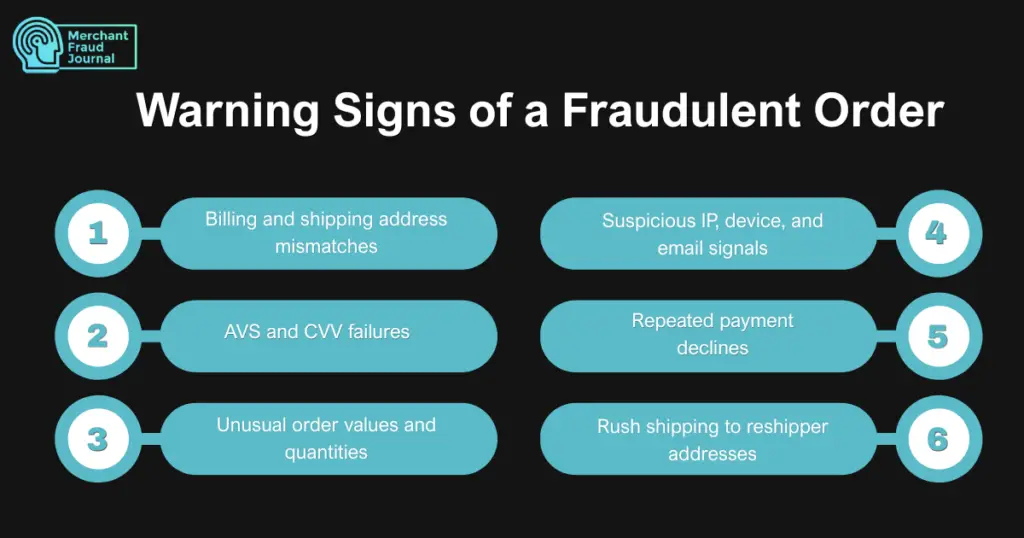
1. Billing and shipping address mismatches
Orders where billing and shipping addresses don’t match deserve extra scrutiny. Pay particular attention when shipping goes to freight forwarders, PO boxes, or reshipper addresses. Reshippers are services that forward packages internationally, often used to obscure the final destination.
2. AVS and CVV failures
AVS (Address Verification System) checks whether the billing address matches card issuer records. CVV is the three-digit security code on the card back. Failures or mismatches on either signal potential stolen card use.
3. Unusual order values and quantities
Unusually high-value orders or bulk purchases of high-resale items like electronics and gift cards are classic fraud indicators. Interestingly, unusually low-value orders can also signal trouble since fraudsters often test stolen cards with small purchases first.
4. Suspicious IP, device, and email signals
Watch for IP addresses far from the billing location, known VPN or proxy usage, and disposable email domains. Device fingerprinting can identify devices previously linked to fraud across your store and others.
5. Repeated payment declines
Multiple declined card attempts or rapid purchases from the same IP in a short window indicate card testing or brute-force attacks. This pattern is called a velocity anomaly. Setting thresholds that automatically flag or temporarily block an IP or card after a certain number of attempts within a short timeframe can stop these attacks before they escalate.
6. Rush shipping to reshipper addresses
Fraudsters often request expedited shipping to receive goods before the cardholder notices and disputes. When combined with reshipper or freight forwarder destinations, this pattern is highly suspicious. Flagging orders that pair rush delivery with these destination types for manual review can catch fraud before the goods ever leave the warehouse.
The most effective approach combines automated screening tools like AVS, CVV checks, and device fingerprinting with human review for borderline cases, so legitimate customers aren’t turned away unnecessarily. Merchants who regularly update their detection rules and monitor emerging patterns will stay ahead of losses instead of reacting to them after the fact.
Pre-Transaction Vs. Post-Purchase Fraud Detection
Most fraud tools focus exclusively on pre-transaction detection. That’s only half the picture. AI-driven dispute management delivering up to 80% higher win rates on chargebacks and saving merchants roughly $315 per dispute compared to manual handling, detection should have a 370-degree coverage.
| Aspect | Pre-transaction detection | Post-purchase detection |
|---|---|---|
| When it runs | At checkout, before payment authorization | After order placed, before fulfillment |
| Primary goal | Block fraudulent payments | Cancel or verify risky orders before shipping |
| Best for | Stolen card fraud, bot attacks | Friendly fraud, refund abuse, policy exploitation |
| Customer friction | Can increase checkout abandonment if too aggressive | Zero checkout friction |
Friendly fraud and policy abuse often slip through pre-transaction tools because the transaction itself looks legitimate. Post-purchase detection catches fraud by analyzing order patterns and customer behavior after checkout, giving you a chance to verify or cancel before shipping.
Proven eCommerce Fraud Detection Strategies
From payment verification at checkout to network intelligence and post-purchase review, each strategy below closes a different gap that fraudsters look to exploit. Used together, they reduce losses without adding unnecessary friction for legitimate customers.

1. Enforce AVS, CVV, and 3D Secure authentication
Implement baseline payment verification as your first defense layer. 3D Secure (also called SCA, or Strong Customer Authentication) adds a verification step like a one-time code before completing payment. Beyond the security benefit, it shifts liability for fraud chargebacks to the card issuer.
2. Deploy AI and machine learning risk scoring
ML-powered fraud scoring analyzes hundreds of data points per transaction in real time. The best models improve continuously by learning from confirmed fraud and legitimate orders across your store and the broader network.
3. Use device fingerprinting and behavioral analytics
Track devices across sessions to recognize returning good customers and flag known fraudulent devices. Behavioral signals like navigation speed, typing patterns, and mouse movements help detect bots and anomalies that transaction data alone would miss.
4. Tap into a global merchant fraud network
Network intelligence that shares fraud signals across thousands of merchants identifies repeat offenders who have defrauded other stores before they hit yours. This approach is particularly valuable for catching friendly fraud abusers.
5. Monitor chargeback ratios and card network thresholds
Track your dispute ratio continuously. The ratio equals chargebacks divided by total transactions. Set proactive alerts when ratios approach card network thresholds to avoid monitoring programs before they become a crisis.
6. Automate post-purchase verification and order review
Automated order holds for high-risk transactions give you time to verify before shipping. Branded verification flows that prompt customers to confirm orders create chargeback-proof evidence while catching fraudsters who abandon them when challenged.
7. Layer chargeback alerts with fraud detection
Chargeback alerts are real-time notifications from card networks (Verifi, Ethoca) when a cardholder initiates a dispute. Alerts let you refund before the dispute becomes a chargeback, preserving your ratio even when fraud slips through.
Payment verification stops opportunistic fraud at checkout, machine learning and device intelligence catch patterns humans would miss, and network data plus chargeback alerts protect you from the disputes that inevitably slip through the first layers. Building all seven into a single workflow, rather than treating them as separate tools, is what turns fraud detection from a reactive cost center into a proactive part of running a healthy store.
How to choose an eCommerce fraud detection solution
Choosing the right eCommerce fraud detection solution can feel overwhelming given how many vendors promise similar results. The right choice depends on more than marketing claims. It comes down to accuracy, coverage, integration ease, pricing structure, and security standards. Here’s what to evaluate before committing to a platform.
1. Detection accuracy and false positive rate
Prioritize solutions with high detection rates and low false positives. A false positive flags a legitimate order as fraud, causing lost revenue and customer frustration. Overly aggressive tools hurt conversion more than fraud itself. Ask vendors for their real-world precision and recall benchmarks rather than relying on marketing claims alone.
2. Coverage of friendly fraud and refund abuse
Find out whether the solution detects friendly fraud or only third-party stolen card fraud. Most legacy tools miss friendly fraud entirely because the cardholder is legitimate. A solution that flags patterns like repeat disputes or excessive returns can help you catch abuse that traditional fraud scoring overlooks.
3. Native integrations with your payment and commerce stack
Look for one-click integrations with your payment processor, eCommerce platform, and CRM. Multi-store and multi-processor support matters for scaling businesses. Poor integrations often create data gaps that force your team into manual workarounds, slowing down order review.
4. Pricing model and ROI guarantees
Compare success-based pricing (pay only for results) versus flat monthly fees. Vendors offering ROI guarantees or chargeback liability coverage demonstrate confidence in their performance. Factor in hidden costs like setup fees, minimum commitments, or charges for chargeback representment before comparing totals.
5. Compliance and data security standards
Require SOC 2 Type II certification and GDPR compliance. Confirm data encryption standards: AES-256 at rest and TLS in transit are the baseline. Also check how the vendor handles data retention and deletion, since mishandled customer data can create compliance risk of its own.
The best fraud detection solution is the one that fits your specific risk profile, sales channels, and growth plans rather than the one with the longest feature list. Take advantage of free trials or pilot periods to test detection accuracy against your own order data before signing a long-term contract. A tool that balances strong fraud coverage with a smooth customer experience will protect your revenue without sacrificing the sales you worked hard to earn.
Detect eCommerce Fraud and Protect Your Revenue
Effective eCommerce fraud detection closes that gap by catching risky orders at multiple points, before payment authorization and after purchase, so fewer bad transactions ever reach fulfillment. The businesses that treat fraud detection as an ongoing practice rather than a one-time setup are the ones that protect their margins without sacrificing the smooth checkout experience their legitimate customers expect.
Frequently Asked Questions
What is the difference between fraud detection and fraud prevention?
Fraud detection identifies potentially fraudulent transactions through data analysis and risk scoring. Fraud prevention takes action to block or stop transactions from completing or causing financial loss. Detection tells you something is wrong. Prevention does something about it.
How accurate is AI-based eCommerce fraud detection?
Accuracy depends on the quality of training data and the size of the merchant network feeding the models. The best AI fraud detection systems achieve high detection rates with false positive rates below one percent.
Does fraud detection hurt checkout conversion rates?
Poorly tuned fraud detection can increase false declines and hurt conversion. Modern AI-based systems minimize friction by making risk decisions invisibly and only adding verification steps for genuinely risky orders.

Charity Amancio
Charity Amancio specializes in SaaS solutions for global eCommerce businesses, including payments and risk management applications. She bridges the gap between technology and merchant needs, offering practical perspectives on the tools shaping eCommerce. Her insights appear regularly in B2B publications covering the digital commerce space.
