


By: Charity Amancio | First published on: | Updated on:
Merchant fraud protection is the combined set of tools, rules, and processes a business uses to stop fraudulent orders before they ship, keep chargebacks under card network limits, and win back revenue when disputes still happen. In 2026 that means layering basic checks such as CVV and address verification with risk scoring, authentication for risky orders, daily chargeback monitoring, and a disciplined dispute process, because Visa now flags merchants once their fraud and dispute ratio passes 1.5%.
The sections below explain what each layer does, what fraud costs when a layer is missing, and how to choose a solution that covers the full cycle.
What Is Merchant Fraud Protection?
Merchant fraud protection covers every stage of an order, from the first checkout attempt to the final chargeback decision. It brings together screening tools that stop bad orders, monitoring that watches dispute ratios, and dispute workflows that recover revenue when fraud gets through. For an online seller, the goal of eCommerce fraud protection is to approve as many good customers as possible while keeping fraud losses and chargebacks low enough to protect the merchant account.
The term overlaps with payment fraud protection, which processors and gateways offer at the transaction level. A merchant needs both views, since the processor sees the payment and only the merchant sees the full customer history, delivery data, and refund record.
The Fraud Types Merchant Fraud Protection Must Cover
Most merchant fraud falls into three groups, and each needs a different control. Third-party fraud uses stolen card or account details. First-party fraud, often called friendly fraud, happens when a real customer disputes a legitimate purchase. Policy abuse, such as refund fraud and reshipping schemes, sits between the two. A full breakdown of the types of eCommerce fraud shows how often these categories overlap in a single order.
How Merchant Fraud Hurts Your Business
Fraud costs far more than the value of the stolen goods. The LexisNexis Risk Solutions 2026 True Cost of Fraud study found that US retail and eCommerce firms lose about $5.13 in total costs for every $1 of direct fraud loss, compared with $4.61 in the 2025 edition. Those costs include lost merchandise, shipping, chargeback fees, staff time, and customers who leave after a false decline. The same study ties online and mobile channels to as much as 83% of fraud costs for eCommerce merchants.
The problem is also growing. Juniper Research forecasts that global eCommerce fraud will rise from $44.3 billion in 2024 to $107 billion in 2029, a 141% increase driven largely by AI-enabled attacks and friendly fraud. Merchant fraud that goes unchecked also pushes up dispute ratios, which can place a store in a card network monitoring program and, in the worst case, cost it the ability to accept cards.
Fraud Detection vs. Fraud Prevention vs. Fraud Protection
The three terms are often used interchangeably, yet each describes a different job. The table below shows where each one fits in the order cycle.
| Term | What it does | When it happens | Example |
|---|---|---|---|
| Fraud detection | Spots suspicious activity and flags it for action | During or after the transaction | A risk score flags an order shipping to a freight forwarder |
| Fraud prevention | Blocks fraud before money or goods change hands | Before or at checkout | 3D Secure authentication on a high-risk order |
| Fraud protection | Combines prevention, detection, monitoring, and recovery | Across the full order and dispute cycle | Screening orders, tracking dispute ratios, and fighting chargebacks with evidence |
eCommerce fraud detection on its own only tells you something went wrong. Merchant fraud protection connects that signal to a decision, a monitoring alert, and a dispute response, which is why the rest of this guide treats the three as one system.
Basic Merchant Fraud Protection Measures
Every online store should have these controls in place before adding anything more advanced. They form the base of credit card fraud protection for merchants, cost little, and are supported by nearly every payment processor.
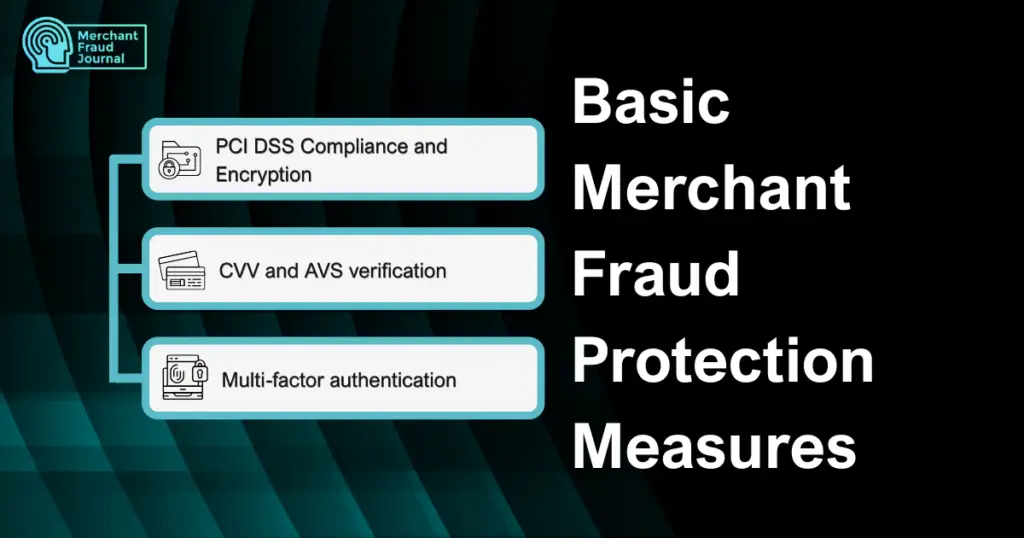
1. PCI DSS Compliance and Encryption
The Payment Card Industry Data Security Standard sets the rules for storing, processing, and transmitting card data. A processor that tokenizes card numbers keeps raw card data off your servers and limits the damage of a breach.
2. CVV and Address Verification Checks
A card verification value check confirms the shopper has the card’s security code, and the address verification service compares the billing address with the one on file at the issuer. Neither check is conclusive alone, yet a mismatch on both is a strong reason to review an order before it ships.
3. Multi-Factor Authentication for Accounts
Customer and staff accounts are common targets for account takeover. Requiring a second factor at login, at password reset, and before changes to payout or shipping details closes one of the easiest routes to stored payment methods.
Advanced Merchant Fraud Prevention Strategies
Once the basics are in place, these layers catch fraud that passes simple checks and reduce false declines at the same time. Most stores add them as order volume grows or as a single fraud type starts to drive chargebacks.
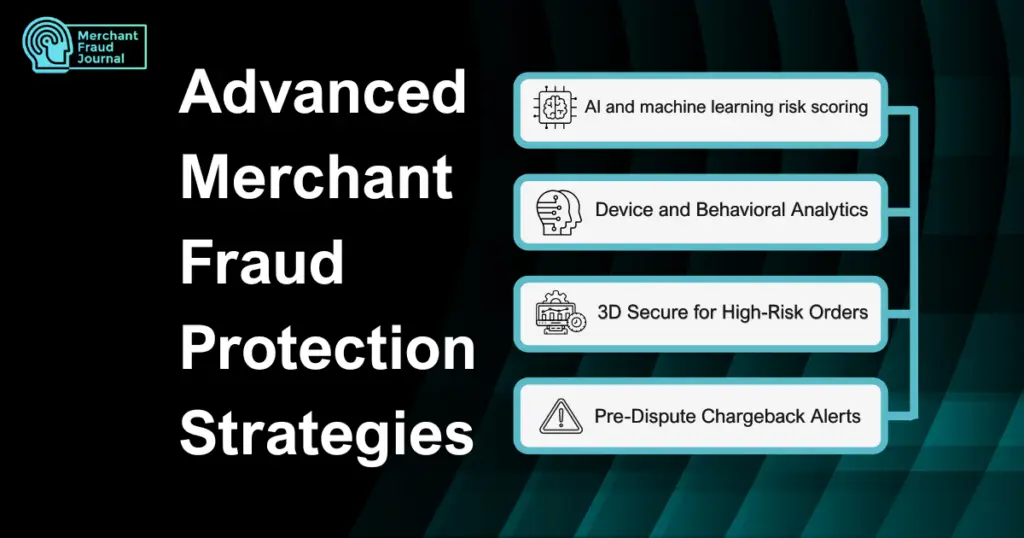
1. AI and Machine Learning Risk Scoring
Risk scoring models weigh many signals per order, such as order value, purchase velocity, email age, and the distance between billing and shipping addresses. The model returns a score that decides whether to approve, review, or decline the order, and models trained on data from many merchants adapt faster than static rules when fraud patterns change.
2. Device and Behavioral Analytics
Device fingerprinting identifies the browser and hardware behind an order, so a fraudster cycling through stolen cards on one device stands out quickly. Behavioral signals such as typing rhythm and navigation patterns help separate real shoppers from bots and scripted card testing.
3. 3D Secure for High-Risk Orders
3D Secure authentication asks the card issuer to verify the shopper, usually without extra steps for low-risk purchases. When an authenticated transaction is later disputed as fraud, liability generally shifts to the issuer, which makes 3D Secure a useful step-up for orders your risk score marks as uncertain.
4. Pre-Dispute Chargeback Alerts
Alert services such as Verifi from Visa and Ethoca from Mastercard notify merchants when a cardholder contacts their bank about a charge. The merchant then has a short window to refund the order before it becomes a formal chargeback with its own fees, which makes alerts one of the most direct forms of chargeback protection.
Card Network Thresholds Every Merchant Should Track
Card networks compare your fraud and disputes against your total transactions, and crossing their limits brings fines, extra fees, and possible loss of card acceptance. These are the thresholds that matter most for online merchants in 2026.
| Program | What it measures | Merchant threshold | Effective |
|---|---|---|---|
| Visa Acquirer Monitoring Program (VAMP) | Fraud reports plus disputes, divided by settled card-not-present transactions | Excessive at a VAMP ratio of 1.5% or higher | April 1, 2026 (lowered from 2.2%) |
| Mastercard Excessive Chargeback Merchant (ECM) | Chargebacks in a month, divided by the prior month's Mastercard transactions | At least 1.5% and 100 to 299 chargebacks in the same month | Current program rules |
| Mastercard High Excessive Chargeback Merchant (HECM) | Same calculation as ECM | At least 3% and 300 or more chargebacks in the same month | Current program rules |
The Visa Acquirer Monitoring Program counts fraud reports and disputes together, so a store can breach it with a modest chargeback count if issuers report a lot of fraud. The Merchant Risk Council summary of the VAMP changes confirms that only card-not-present transactions count toward the ratio, and Visa’s own VAMP program overview explains that the program replaced several older fraud and dispute programs. Mastercard’s Excessive Chargeback Program requires both the ratio and the chargeback count in the same month before a merchant is placed in it.
Best Practices to Reduce Fraud and Chargebacks
These five habits keep merchant fraud prevention effective after the tools are switched on. Each one closes a common gap that lets fraudulent orders and avoidable disputes slip through, even when your defenses look solid on paper.
- Track chargeback and VAMP ratios daily, with alerts set well below each network threshold
- Layer pre-purchase screening with post-purchase checks before high-risk orders ship
- Refund flagged orders before the cardholder files a dispute when the evidence is weak
- Keep order, delivery, and customer communication records ready for every dispute
- Review fraud rules, refund policies, and staff training at least every quarter
Steady merchant fraud monitoring ties these habits together. A clear chargeback rebuttal letter backed by those records then turns good documentation into recovered revenue.
How to Choose Fraud Protection Software
The right fraud protection software depends on order volume, risk profile, and how much of the work your team can handle in-house. These questions separate full-cycle tools from point solutions.
| Criterion | What to ask the vendor |
|---|---|
| Integration | Does it connect natively to your eCommerce platform, processor, and order management system? |
| Decision automation | Can it approve, review, and decline orders automatically with rules you control? |
| Network data | Does the model learn from fraud patterns seen across many merchants? |
| Dispute coverage | Does it handle chargeback alerts, evidence, and representment, or only order screening? |
| Pricing model | Is it priced per transaction, as a share of recovered revenue, or with a chargeback guarantee? |
| Compliance | Does the vendor hold current PCI DSS and SOC 2 certifications? |
Scoring every vendor against the same questions keeps the decision focused on coverage and total cost. A comparison of leading eCommerce fraud prevention companies shows how widely these answers vary in practice, especially on dispute coverage and pricing.
Build Your Merchant Fraud Protection Stack Now
Start with CVV and address checks, encryption, and account security, then add risk scoring, device data, and 3D Secure where your fraud rate justifies them. Track your Visa and Mastercard ratios every day so a spike never reaches a monitoring program unnoticed, and keep dispute evidence organized so the fraud that does get through can be recovered. Merchants that run detection, prevention, and recovery as one system protect both their margins and their merchant accounts.
Frequently Asked Questions
These answers cover the questions merchants ask most often about fraud protection.
What is merchant fraud protection?
Merchant fraud protection is the set of tools and processes a business uses to block fraudulent orders, keep chargebacks under card network limits, and recover revenue from disputes. It combines prevention at checkout, ongoing monitoring, and dispute management.
How do merchants prevent credit card fraud?
Merchants prevent credit card fraud with CVV and address checks, risk scoring on every order, and 3D Secure on orders that look risky. Daily dispute ratio monitoring and manual review of high-value orders close most of the remaining gaps.
How do you prevent eCommerce fraud?
Layer basic card checks with machine learning risk scoring and device analytics, then add authentication for high-risk orders. Clear refund policies and complete order records make friendly fraud disputes easier to win.
What is chargeback protection?
Chargeback protection is any service that reduces chargebacks or covers their cost, such as pre-dispute alerts, automated representment, or a guarantee that reimburses fraud chargebacks on approved orders. Coverage and pricing vary widely between providers, so compare what each one pays out.
What is the difference between fraud detection and fraud prevention?
Fraud detection identifies suspicious activity during or after a transaction, while fraud prevention stops fraud before the order is approved. Most merchants need both, because detection data is what keeps prevention rules accurate.
How much does fraud cost merchants?
LexisNexis Risk Solutions found in 2026 that US retail and eCommerce firms lose about $5.13 in total costs for every $1 of direct fraud loss. That figure includes fees, labor, lost goods, and customers lost to false declines.

Charity Amancio
Charity Amancio specializes in SaaS solutions for global eCommerce businesses, including payments and risk management applications. She bridges the gap between technology and merchant needs, offering practical perspectives on the tools shaping eCommerce. Her insights appear regularly in B2B publications covering the digital commerce space.
