


Address verification service (AVS) is an eCommerce fraud prevention measure that verifies the person placing an order with a credit card can correctly identify the billing address on file with the card’s issuing bank. An address verification service check works on the assumption that a card’s authorized holder will be able to identify the card’s billing address.
By extension, identifying orders with AVS mismatches allows merchants to better identify potentially stolen credit credit cards, reducing the likelihood they will get hit with a chargeback. Given its value in preventing eCommerce merchant fraud, we delve into the intricacies of AVS, its functionality, and its significance in the eCommerce landscape.
What Is Address Verification Service (AVS)?
The Address verification service (AVS) is a fraud prevention mechanism that helps businesses confirm the legitimacy of a transaction. An AVS check provides merchants with a layer of security against fraudulent activities by cross-referencing the billing address entered by the customer with the address maintained by the card issuer. This service is particularly vital for online retailers and businesses that process card-not-present transactions, where the risk of fraud is significantly higher.
How an AVS Check Works
When a customer initiates a transaction, they are required to input their billing address. This information is then sent to the payment processor, which forwards it to the issuing bank to complete the address verification service check. Successfully filling out the AVS billing address fields requires the purchaser to provide standard mailing address information including:
- House or apartment number
- Street name
- City
- Zip Code
- State
The AVS system operates behind the scenes, and creates as little friction as possible for merchants. Merchants receive a decision in an instant. A staggering 76% of organizations reported experiencing attempted or actual payments fraud. Within this high-risk landscape, merchants receive an AVS decision in an instant.
Here are the specific steps on how AVS works:
- During the checkout process, a merchant requests the shopper provide the billing address associated with the credit card they want to use for payment
- The merchant passes this address along to the credit card company (Visa, Mastercard, etc.) when seeking authorization for a credit card transaction
- The credit card company forwards the data along to the bank that issued the card
- The bank checks the address provided by the shopper against the address on file in their records
- The bank responds to the credit card company with an AVS Response Code. This code indicates how well the provided address matches the one on file
- The credit card company passes this information along to the merchant
The bank checks the provided address against its records and returns an AVS response code to the merchant. This code indicates whether the addresses match and to what extent, allowing the merchant to make informed decisions regarding the transaction.
AVS Codes and Their Meanings
The response from the AVS check is conveyed through a series of codes, each representing a different outcome of the verification process. Understanding these codes is essential for merchants to interpret the results accurately and take appropriate action.
| AVS Code | Description |
|---|---|
| Y | Full match: Street address and 5-digit ZIP code match. |
| X | Full match: Street address and 9-digit ZIP code match. |
| W | Partial match: 9-digit ZIP code matches, street address does not. |
| Z | Partial match: 5-digit ZIP code matches, street address does not. |
| A | Partial match: Street address matches, ZIP code does not. |
| N | No match: No match on street address or ZIP code. |
| R | Retry: System unavailable or timed out. |
| U | Unavailable: Address information is unavailable. |
These codes help merchants determine the next steps in processing the transaction, whether it involves approval, further investigation, or cancellation. Familiarity with each code allows merchants to establish automated rules within their payment systems, reducing manual review time and enabling faster, more consistent decision-making.
How to Implement AVS in Your Payment Processing System
To leverage the benefits of AVS, merchants must integrate it into their payment processing systems. This typically involves configuring the payment gateway to run an address verification service check during the authorization process. Here are the steps to implement AVS effectively.
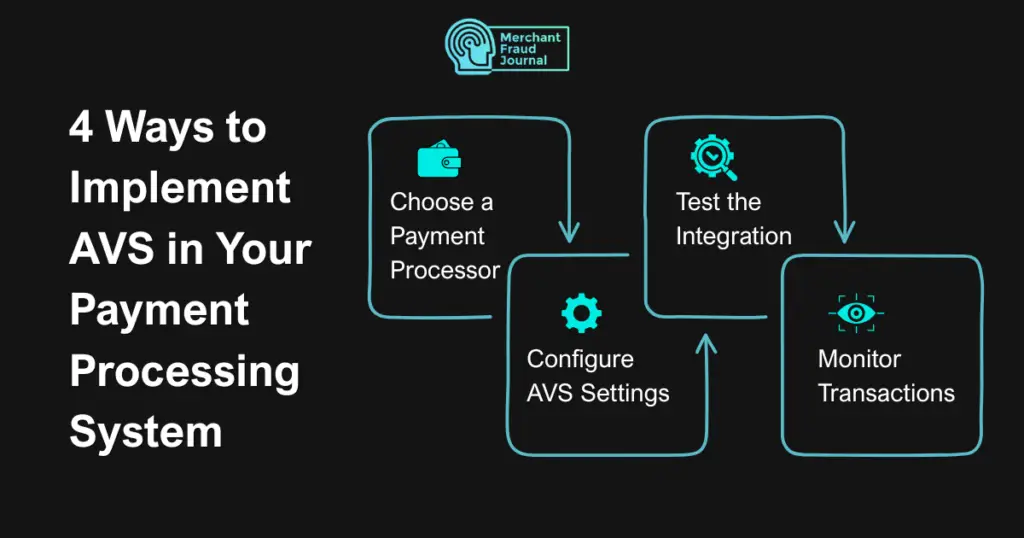
- Choose a Payment Processor: Select a payment processor that supports AVS checks. Most major processors offer this feature as part of their fraud prevention tools.
- Configure AVS Settings: Within the payment gateway, enable AVS checks and specify the desired settings for handling AVS responses.
- Test the Integration: Before going live, conduct thorough testing to ensure that AVS checks are functioning correctly and that the response codes are being interpreted accurately.
- Monitor Transactions: After implementation, continuously monitor transactions and review AVS results to identify any patterns or issues that may arise.
When properly configured and actively monitored, AVS serves as a reliable first line of defense against fraudulent transactions, reducing chargebacks and building customer trust. Taking the time to test thoroughly and review results consistently will ensure your payment system remains secure, efficient, and well-equipped to handle the evolving landscape of eCommerce fraud.
What Are AVS Mismatches?
AVS mismatch occurs when the billing address provided by the customer does not match the address on file with the card issuer. While strict verification rules help prevent credit card fraud, relying heavily on inflexible parameters can damage a merchant’s bottom line. For instance, requiring a strict AVS match on all orders contributes to an 8% to 12% higher checkout decline rate on mobile devices, forcing legitimate shoppers away due to simple formatting errors or minor address discrepancies.
AVS mismatches can happen for various reasons, including:
- Incorrect Address Entry: Customers may accidentally input the wrong address during checkout.
- Outdated Information: Cardholders may have moved and not updated their billing address with the issuing bank.
- Discrepancies Between Billing and Shipping Addresses: If a customer uses a different shipping address, it may lead to an AVS mismatch.
While AVS mismatches are not always indicative of fraudulent activity, they should not be ignored. Merchants must weigh the risk of proceeding with a flagged transaction against the potential of turning away a legitimate customer. Establishing clear policies for handling mismatches, whether that means requesting additional verification or declining the transaction outright, is essential for maintaining both security and a positive customer experience.
Implications of AVS Mismatches
When an address verification service check returns a mismatch, merchants must decide how to proceed with the transaction. Depending on their risk tolerance and business policies, they may choose to:
- Decline the transaction: If the mismatch raises concerns about fraud, the merchant may opt to cancel the order.
- Review the order: Merchants can investigate further by contacting the customer for clarification or additional verification.
- Proceed with caution: In some cases, merchants may choose to fulfill the order despite the mismatch, but this should be done with caution.
AVS mismatches are not automatic indicators of various eCommerce fraud types, but they are meaningful signals that warrant careful consideration. A thoughtful approach balances the need to protect against fraudulent transactions with the goal of delivering a smooth experience for legitimate customers.
Impact of AVS in Chargebacks
One of the significant benefits of using AVS is its potential to reduce chargebacks. When a merchant can demonstrate that they performed an AVS check and received a full match, they have a stronger defense against chargeback disputes.
In cases where an AVS check returns a partial or no-match result, merchants should apply additional scrutiny before approving the transaction. However, it is essential to understand that a full AVS match does not guarantee immunity from chargebacks.
Merchant Liability
In cases where a chargeback occurs despite a full AVS match, the merchant may still be held liable. Cardholder rights dictate that banks must investigate claims of unauthorized transactions, regardless of the AVS results. Therefore, merchants should not rely solely on AVS as a means to avoid chargebacks but should incorporate it into a broader fraud protection and prevention strategy.
6 Best Practices for Using AVS
With global eCommerce fraud losses projected to surge from $56 billion in 2025 to $131 billion by 2030, safeguarding transaction data has never been more urgent for online retailers. To maximize the effectiveness of AVS in fraud prevention, merchants should consider the following best practices:
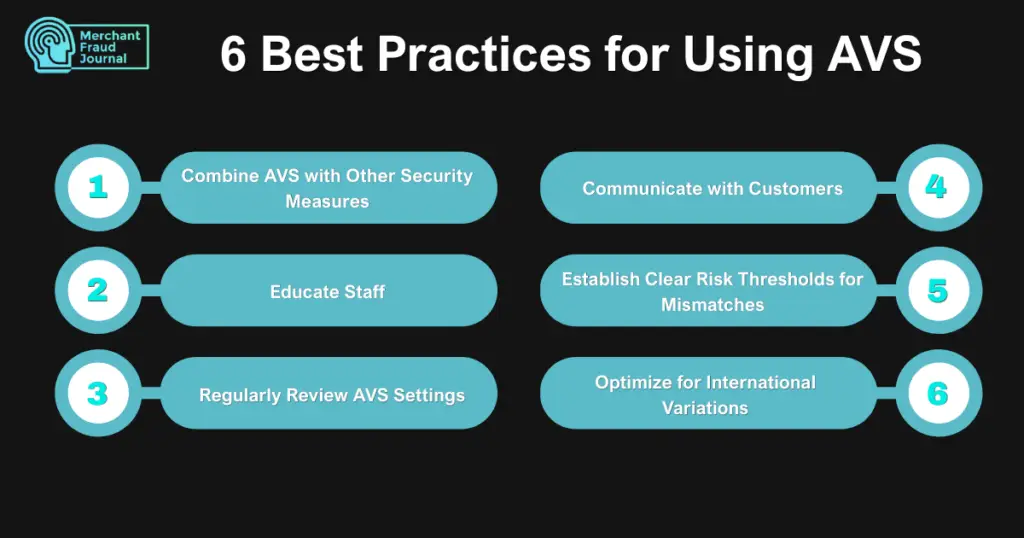
- Combine AVS with other security measures: Use AVS in conjunction with other fraud prevention practices and detection tools, such as Card Verification Value (CVV) verification and transaction monitoring, to create a comprehensive security strategy.
- Educate staff: Ensure that employees involved in order processing understand how AVS works and how to interpret the results effectively.
- Regularly review AVS settings: Periodically assess the AVS settings within the payment gateway to ensure they align with the latest fraud prevention strategies and industry standards.
- Communicate with customers: If a transaction is declined due to an AVS mismatch, communicate with the customer to clarify the issue and provide guidance on how to resolve it.
- Establish clear risk thresholds for mismatches: Define specific rules for how to handle partial AVS matches, such as when the ZIP code matches but the street address does not.
- Optimize for international variations: Recognize that AVS support and formatting vary significantly across different countries and card issuers. Configure your payment gateway to handle international formats correctly and implement alternative verification methods for regions where AVS is not widely supported.
Finding the right balance between strict fraud prevention and a seamless customer checkout experience requires ongoing refinement, but the payoff is substantial. Nevertheless, a proactive approach to address verification not only safeguards revenue against chargebacks but also builds long-term customer trust in your platform’s security.
Address Verification Service Check for Secure Online Transactions
The AVS is a vital tool for businesses seeking to enhance their fraud prevention efforts in online transactions. AVS helps merchants mitigate the risk of fraudulent purchases and chargebacks by verifying the billing address provided by customers. As the digital landscape continues to evolve, leveraging AVS effectively will remain a cornerstone of secure online transactions.
Frequently Asked Questions
Why is an AVS check essential for eCommerce merchants?
Online merchants cannot physically inspect a customer's credit card, making them highly vulnerable to card-not-present (CNP) fraud. Implementing AVS checks adds a crucial layer of security that helps verify cardholder identity before an order is processed.
Can an AVS mismatch automatically decline a transaction?
Merchants can configure their payment gateways to automatically decline orders that return specific mismatch codes. However, an AVS mismatch does not inherently block a transaction on the issuer's end unless the merchant's system is set up to reject it.
What is the difference between an AVS check and a CVV check?
An AVS check validates the location data associated with the account holder to verify identity. In contrast, a Card Verification Value (CVV) check verifies that the physical card is in the possession of the buyer by checking the printed three- or four-digit security code.
Does AVS prevent all types of credit card fraud?
While highly effective at stopping basic identity theft and unauthorized card use, AVS cannot prevent advanced fraud techniques like account takeover or friendly fraud. Security strategies should combine AVS with other verification methods, such as CVV checks and behavioral analytics, for comprehensive protection.
Does AVS work internationally for all credit card transactions?
AVS is primarily supported by major card networks like Visa, Mastercard, Discover, and American Express in the United States, Canada, and the United Kingdom. Transactions originating from other countries may return a code indicating that the service is unavailable or unsupported by the local issuing bank.
Can legitimate customers experience an AVS mismatch?
Yes, honest shoppers frequently trigger AVS mismatches due to minor typographical errors, recent moves where the bank record hasn't been updated, or differing corporate billing formats. Strict automatic decline rules can unintentionally turn away these valid buyers and hurt conversion rates.

Charity Amancio
Charity Amancio specializes in SaaS solutions for global eCommerce businesses, including payments and risk management applications. She bridges the gap between technology and merchant needs, offering practical perspectives on the tools shaping eCommerce. Her insights appear regularly in B2B publications covering the digital commerce space.