


Post-purchase fraud prevention stops bad actors from exploiting returns, refunds, and delivery claims after an order goes through. It’s the layer of defense that kicks in once checkout fraud tools have done their job, and it’s where friendly fraud, return abuse, and false delivery claims quietly drain merchant margins.
Most merchants invest heavily in blocking stolen cards at checkout, then wonder why chargebacks keep climbing. The gap is everything that happens after fulfillment: the customer who disputes a charge they authorized, the empty box claim on a high-value order, the serial returner gaming your policy. This guide breaks down the three types of post-purchase fraud, explains why isolated tactics don’t scale, and walks through how to build a fraud prevention system that catches abuse before it compounds.
What Is Post-Purchase Fraud?
Post-purchase fraud stops bad actors from exploiting returns, refunds, and delivery claims after an order goes through. Unlike checkout fraud, where someone uses a stolen card to place an order, post-purchase fraud targets the window between fulfillment and the dispute deadline. A customer, or someone pretending to be one, files a chargeback, requests a refund for an item they actually received, or claims a package never arrived.
The tricky part: by the time post-purchase fraud happens, you’ve already shipped the product. So prevention looks different here. It’s less about blocking transactions at checkout and more about building systems that spot abuse patterns, collect evidence automatically, and catch problems before a dispute ever lands on your desk.
Three fraud types fall under this umbrella: friendly fraud, return fraud, and refund fraud. While the tactics vary, they share a common thread: the merchant has already fulfilled the order, which means the damage is done unless you’ve prepared for it. For many merchants, post-purchase losses fly under the radar until chargeback ratios spike or return costs start eating into margins. A single friendly fraud dispute might feel like a cost of doing business, but at scale, this kind of abuse quietly erodes profitability and can push you into card network monitoring programs.
The Three Types of Post-Purchase Fraud
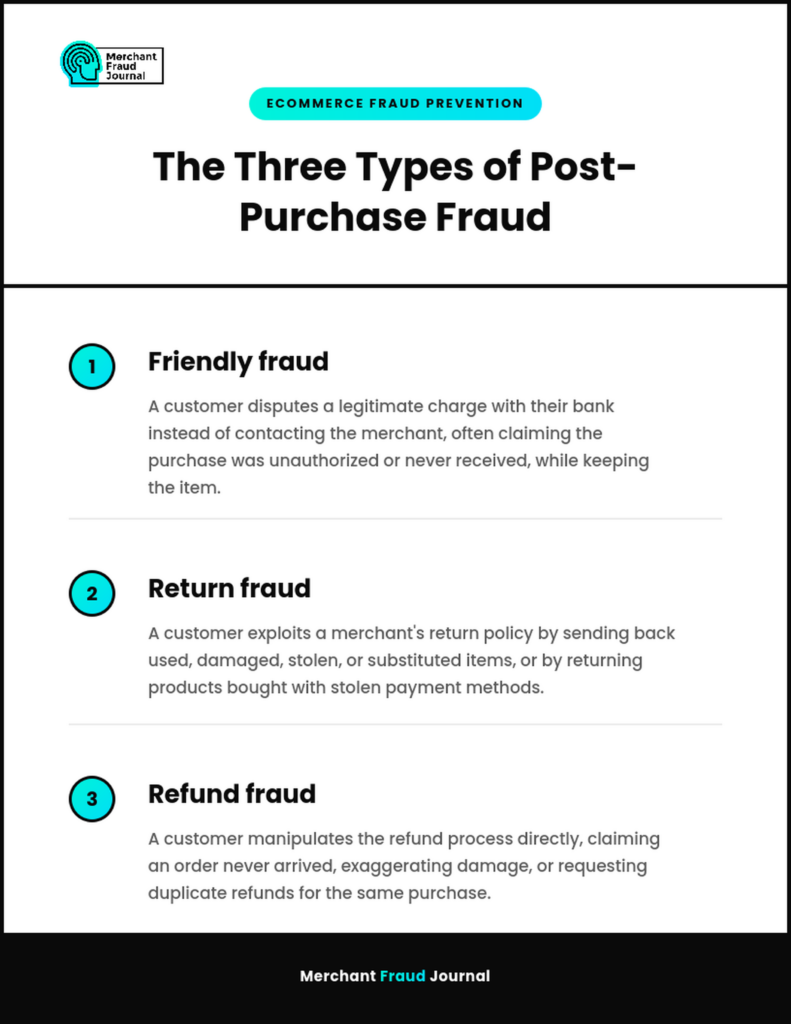
Understanding the differences between friendly fraud, return fraud, and refund fraud helps you deploy the right fraud defenses at the right stage of the order lifecycle.
Friendly fraud
Friendly fraud happens when a legitimate customer disputes a charge with their bank instead of requesting a refund directly from you. Sometimes it’s intentional: the customer wants to keep the product and get their money back too. Other times, it’s accidental: the cardholder doesn’t recognize the billing descriptor or forgot about a subscription renewal.
Either way, you lose the sale, pay a chargeback fee (typically $15 to $100), and take a hit to your dispute ratio. Friendly fraud is notoriously difficult to prevent because the original transaction was fully authorized. The customer isn’t a criminal in the traditional sense; they’re just gaming the system. Consumers do have formal rights to dispute charges under federal law, which is part of why this category is so hard to police.
Return fraud
Return fraud involves manipulating your return policy to get a refund without actually returning the product, or returning something different entirely. Common tactics include wardrobing (wearing an item once and returning it), returning stolen merchandise for store credit, or shipping back an empty box.
Return fraud exploits generous return windows and lax inspection processes. According to the National Retail Federation’s 2025 Retail Returns Landscape report, roughly 9% of all retail returns are fraudulent, and merchants with lenient policies tend to see higher rates of abuse, especially during peak shopping seasons when return volumes make thorough inspection impractical. Building a solid return fraud prevention policy is one of the highest-leverage moves a merchant can make.
Refund fraud
Refund fraud targets the refund process itself through false claims. A customer might claim an item never arrived (even though carrier tracking shows delivery), report that the product was damaged or defective, or request a refund while keeping the merchandise.
Some refund fraud is opportunistic: a customer sees an opening and takes it. Some are organized. Professional refund fraud rings sell refund services that coach buyers on exactly what to say to get their money back. High-value items are frequent targets, and inconsistent verification processes make the problem worse.
Why Point Tactics Fall Short
Billing descriptors, clear return policies, and delivery confirmation all help, but they don’t add up to a system. A merchant who relies solely on individual tactics is playing defense one dispute at a time, which doesn’t scale.
The problem is that post-purchase fraud adapts. Fraudsters share scripts online, test which merchants have weak verification, and move on when defenses tighten. A clear billing descriptor might reduce accidental friendly fraud, but it won’t stop a customer who intentionally disputes a charge. A strict return policy might deter casual wardrobing, but it won’t catch a fraud ring submitting false delivery claims across dozens of accounts.
What’s missing is a connected approach: signals that flow from order to fulfillment to dispute, automated evidence collection that doesn’t depend on manual work, and escalation rules that flag abuse before it compounds. That’s the gap a post-purchase fraud prevention system fills.
How to Build a Post-Purchase Fraud Prevention System
Effective post-purchase fraud prevention treats the entire order lifecycle as a single risk surface rather than isolated checkpoints.
1. Monitor signals across the order lifecycle
Every stage (order placement, fulfillment, delivery, and the dispute window) generates data that can indicate fraud risk. You’re looking for patterns that repeat across transactions:
- Order-level signals: Velocity of purchases, mismatched billing and shipping addresses, use of virtual cards or prepaid payment methods
- Fulfillment-level signals: Expedited shipping requests on high-risk orders, address changes after checkout, multiple orders to the same address from different accounts
- Delivery-level signals: Signature confirmation status, carrier scan data, delivery photos, GPS coordinates at drop-off
- Dispute-level signals: Reason codes, timing of disputes relative to delivery date, repeat dispute behavior from the same customer or device
Individually, any of these signals might be innocent. Together, they paint a picture. A customer who changes their shipping address after checkout, requests expedited delivery, and then files a not received claim two days after delivery confirmation? That’s a pattern worth flagging with a device fingerprinting or velocity rule.
2. Automate evidence capture
When a chargeback hits, you typically have 7 to 30 days to respond, depending on the card network. Manually gathering evidence for each dispute doesn’t scale, especially during high-volume periods.
Instead, configure your systems to automatically log:
- IP address and device fingerprint at checkout
- Delivery confirmation with timestamp and carrier tracking
- Customer communications including order confirmations, shipping updates, and support tickets
- Proof of prior successful transactions from the same customer
This evidence becomes the foundation of your chargeback representment case. The stronger your documentation, the higher your win rate. Merchants who automate evidence collection consistently outperform those who scramble to gather proof after a dispute is filed.
3. Set escalation thresholds and manual review triggers
Not every order warrants the same level of scrutiny. Define rules that escalate high-risk transactions for manual fraud review before fulfillment:
- Orders above a certain dollar threshold
- Customers with prior disputes or refund requests
- Shipping addresses flagged in fraud databases
- Unusual purchase velocity from a single account or device
Manual review adds friction, so reserve it for cases where the risk justifies the delay. The goal is to catch abuse early without slowing down legitimate orders. Most merchants find that 5% to 10% of orders warrant closer inspection, while the rest can flow through automated checks.
4. Use chargeback prevention tools and alert services
Several services help merchants intercept disputes before they become formal chargebacks. Understanding what each tool does, and when to use it, can significantly reduce your chargeback ratio.
| Tool | What it does | Best for |
|---|---|---|
| Verifi Order Insight | Shares order details with issuers so cardholders can recognize charges before disputing | Reducing accidental friendly fraud from billing descriptor confusion |
| Verifi CE 3.0 (Rapid Dispute Resolution) | Automatically refunds disputes that match your rules before they become chargebacks | High-volume merchants prioritizing ratio protection over individual dispute wins |
| Ethoca Alerts | Notifies you when a dispute is filed so you can refund proactively | Merchants who prefer manual control over automatic refunds |
| Visa RDR | Automatically resolves disputes based on pre-set rules | Merchants in or approaching VAMP threshold territory |
These tools work best in combination. Alerts give you visibility into disputes as they happen. Automated resolution protects your ratio when you can’t respond fast enough manually. Neither replaces good evidence collection—they’re complementary layers.
Measuring Success With Post-Purchase Fraud KPIs
You can’t improve what you don’t measure. Four metrics tell you whether your post-purchase fraud prevention system is working:
- Chargeback ratio: Total chargebacks divided by total transactions. Visa’s VAMP Excessive threshold is 1.5%; Mastercard’s ECM threshold is 1.5%. Track this in real time, not monthly; by the time you see a problem in monthly reports, you may already be in violation.
- Dispute win rate: The percentage of chargebacks you successfully represent and win. A low win rate often signals weak evidence collection or poor case presentation.
- Average resolution time: How long it takes to respond to a dispute. Faster responses correlate with higher win rates, and some card networks penalize slow responses.
- Fraud-to-sales ratio: Total fraud losses (chargebacks, refund abuse, return fraud) as a percentage of revenue. This gives you a holistic view beyond just chargebacks.
If your chargeback ratio is climbing but your win rate is flat, the problem is likely upstream: either you’re not catching fraud before fulfillment, or your evidence isn’t compelling enough. If your win rate is high but your ratio is still elevated, you might benefit from more aggressive use of alerts and pre-dispute resolution tools.
Building a System That Outlasts the Next Fraud Tactic
Post-purchase fraud will keep evolving as fraudsters test new angles on returns, refunds, and disputes, which is exactly why a connected, signal-driven system beats a pile of one-off fixes. Merchants who monitor the full order lifecycle, automate their evidence collection, and layer in the right chargeback tools consistently protect more margin than those relying on policy tweaks alone. Start with the metrics: track your chargeback ratio and win rate closely, and let the gaps they reveal guide where you invest next.
Frequently Asked Questions
What is the difference between friendly fraud and true fraud?
True fraud involves a stolen card or compromised account; the legitimate cardholder never authorized the purchase. Friendly fraud involves a real customer who authorized the transaction but later disputes it, either intentionally or by mistake.
How is post-purchase fraud different from fraud caught at checkout?
Checkout fraud targets the payment authorization itself, often using stolen credentials. Post-purchase fraud exploits the fulfillment, delivery, or dispute process after a legitimate transaction has already been approved and shipped.
Can small merchants benefit from chargeback alert services?
Yes, though the ROI depends on volume and average order value. For merchants with thin margins or high-value products, even a handful of prevented chargebacks can justify the cost of an alert service.
Is friendly fraud illegal?
Intentional friendly fraud (disputing a charge while keeping the product) is a form of fraud and can be prosecuted. However, enforcement is rare, and most merchants focus on prevention and representment rather than pursuing legal action.
How do cross-merchant networks help prevent post-purchase fraud?
Networks share signals about known bad actors, suspicious devices, and abuse patterns across thousands of merchants. When a fraudster targets one merchant in the network, that intelligence helps protect every other merchant before the same tactics are used again.

Charity Amancio
Charity Amancio specializes in SaaS solutions for global eCommerce businesses, including payments and risk management applications. She bridges the gap between technology and merchant needs, offering practical perspectives on the tools shaping eCommerce. Her insights appear regularly in B2B publications covering the digital commerce space.
