


Payment fraud occurs when someone uses false, stolen, or manipulated payment information to complete an unauthorized transaction, and it’s costing online merchants billions annually. For every dollar lost to fraud, businesses typically lose an additional $3 to $4 in chargebacks, fees, and operational costs.
The challenge is that payment fraud isn’t one problem. It’s a dozen different problems wearing the same label. The sections below break down the major fraud types targeting eCommerce merchants, how modern detection systems actually work, and the prevention strategies that reduce losses without blocking legitimate customers.
What Is Payment Fraud?
Payment fraud is any scheme built to trick a payment system into approving a transaction the rightful account holder never intended to make. Common tactics include stolen credit card numbers, compromised account logins, and social engineering tricks that convince victims to authorize payments they never intended to make.
Payment fraud hits harder than most people realize, especially for online merchants. The damage extends well beyond the transaction itself: chargebacks, processor fees, lost inventory, and hours spent investigating disputes can multiply a single fraudulent order’s cost by three or four times.
The distinction between fraud types matters because a stolen credit card transaction looks nothing like a customer falsely claiming they never received their package. Both fall under the umbrella of payment fraud, but each one calls for a completely different defensive approach.
Merchants who treat every dispute as the same problem end up applying the wrong fix in the wrong place. Stolen-card fraud calls for stronger authentication at checkout, while a customer dispute calls for better evidence and communication after the sale. Sorting incidents by type first is what makes the detection and prevention strategies below actually work.
Types of Payment Fraud
Payment fraud takes several distinct forms, each with its own tactics, warning signs, and required defenses. The types below account for most of the fraud eCommerce merchants encounter today.
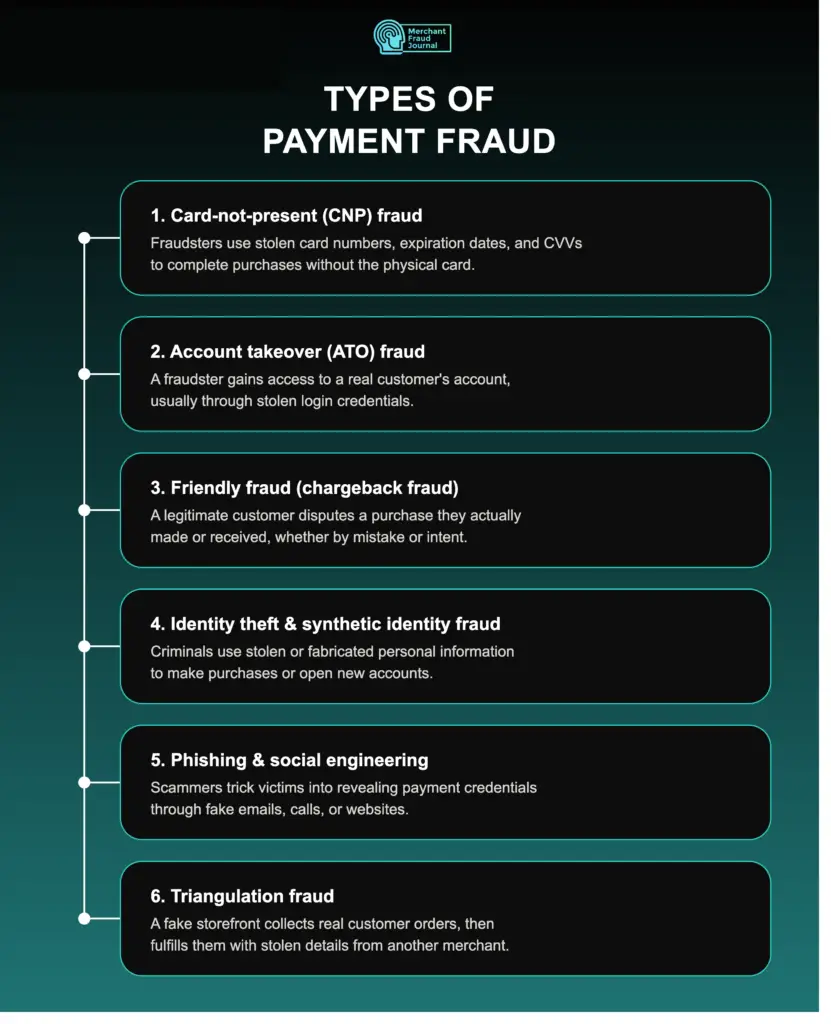
1. Card-not-present fraud
Card-not-present (CNP) fraud occurs when criminals use stolen card details to make purchases online, over the phone, or through any channel where the physical card isn’t required. For eCommerce merchants, CNP fraud dominates because the barrier to entry is low. Fraudsters only need the card number, expiration date, and CVV.
CNP fraud has grown right alongside the shift to digital commerce. Without the ability to verify a physical card or check a signature, merchants rely almost entirely on digital signals to figure out whether a transaction is legitimate.
2. Account takeover fraud
Account takeover (ATO) happens when a fraudster gains access to a real customer’s account. Fraudsters typically get in through stolen credentials obtained via phishing, data breaches, or credential stuffing attacks, where bots test username and password combinations across multiple sites.
Once inside, fraudsters can make purchases, change shipping addresses, or drain stored payment methods. Account takeover fraud is particularly tricky to catch because the transaction often looks legitimate, coming from a real account with genuine purchase history. The fraud usually only becomes obvious once the actual customer notices something is wrong.
3. Friendly fraud and chargeback fraud
Friendly fraud, sometimes called first-party fraud or chargeback abuse, occurs when a legitimate customer makes a purchase and then disputes the charge with their bank. They might claim the item never arrived, wasn’t as described, or that they never authorized the transaction, even when none of that is true.
Friendly fraud frustrates merchants more than almost any other type because the “fraudster” is often a real customer. Some cases are genuine misunderstandings, like a family member using the card or a customer forgetting about a purchase. Others are deliberate abuse of the chargeback system.
4. Identity theft and synthetic identity fraud
Identity theft involves using another person’s real information to make fraudulent purchases. Synthetic identity fraud takes that a step further, combining real and fabricated information to create entirely new identities that don’t belong to any actual person.
Synthetic identities are harder to catch because they don’t trigger the same alerts as stolen identities. The “person” has no fraud history because they’ve never existed before, and fraudsters often build credit over months before cashing out.
5. Phishing and social engineering
Phishing attacks trick victims into revealing sensitive information through fake emails, websites, or messages that impersonate legitimate businesses. Social engineering broadens this to include any manipulation tactic, including phone calls, text messages, and in-person interactions, designed to extract credentials or authorize fraudulent payments.
These attacks target both consumers and business employees. A compromised employee email account can lead to invoice fraud, while a phished customer hands over credentials that enable account takeover.
6. Triangulation fraud
Triangulation fraud involves three parties: the fraudster, an unsuspecting customer, and a legitimate merchant. The fraudster sets up a fake storefront offering products at attractive prices, then uses stolen payment credentials to purchase the item from a real merchant once a customer places an order, shipping it directly to that customer.
The customer receives their product and has no idea fraud occurred. Meanwhile, the legitimate merchant eventually faces a chargeback once the true cardholder disputes the charge.
Each fraud type above requires a different combination of detection signals and response procedures. CNP fraud and account takeover call for stronger authentication and monitoring at the point of transaction, while friendly fraud and triangulation fraud call for better documentation and post-sale review. Knowing which type is hitting a business first is what makes it possible to choose the right defense.
How Payment Fraud Detection Works
Modern fraud detection combines several layers of technology to catch what a single method would miss on its own. Merchants typically rely on a mix of rules, machine learning, behavioral signals, and real-time monitoring to separate legitimate customers from fraudsters.
Rule-based detection systems
Rule-based systems use predefined criteria to flag suspicious transactions. Common rules include:
- Velocity checks: how many orders come from one IP address in an hour
- Geographic mismatches: billing address in one country, shipping to another
- Order value thresholds: unusually large purchases from new accounts
Rules are straightforward to implement and easy to explain. They’re also rigid, though: fraudsters quickly learn to stay just under the thresholds, and legitimate customers sometimes trigger false positives.
Machine learning and AI-based detection
Machine learning models analyze hundreds of transaction signals simultaneously to calculate risk scores. Unlike static rules, these models learn from historical data and adapt as fraud patterns evolve.
The best ML systems improve continuously with each transaction they evaluate. They can identify subtle patterns, like combinations of device type, browsing behavior, and purchase history, that no human analyst would catch.
Behavioral analytics and device fingerprinting
Behavioral analytics track how users interact with a site: typing speed, mouse movements, scroll patterns, and navigation paths. Device fingerprinting identifies the specific hardware, operating system, and browser configuration making a purchase.
Together, these signals can detect when someone isn’t who they claim to be. A returning customer suddenly using a completely different device with unfamiliar browsing patterns warrants additional scrutiny.
Real-time transaction monitoring
Real-time monitoring evaluates risk before a merchant fulfills an order, creating the opportunity to cancel, hold, or verify suspicious purchases. Batch review, checking transactions hours or days later, is simply too slow for modern fraud prevention.
The window between order placement and fulfillment is a merchant’s best opportunity to stop fraud. Once the package ships, the options narrow considerably.
Common red flags and warning signs
Certain patterns consistently indicate elevated fraud risk. Spotting these red flags early gives merchants a chance to review an order before it ships:
- Mismatched addresses: billing and shipping addresses in different countries or regions
- Rush shipping on high-value orders: fraudsters want items delivered before the fraud is detected
- Multiple failed payment attempts: testing stolen cards until one works
- New accounts with large orders: no purchase history to establish trust
- Unusual purchase times: orders placed at odd hours for the customer’s stated location
No single detection method catches every type of fraud on its own. Layering rules, machine learning, behavioral analytics, and real-time monitoring gives merchants far more coverage than any one tool alone provides. The goal is catching fraud early enough to act, without slowing down the legitimate customers placing the vast majority of orders.
Payment Fraud Prevention Strategies
Detecting fraud is only half the job. Merchants also need prevention measures in place at checkout and beyond to stop fraudulent transactions before they cause damage.
Multi-factor authentication and 3D Secure
Multi-factor authentication (MFA) adds verification steps beyond passwords, typically a code sent to a phone or email, or biometric confirmation like a fingerprint. 3D Secure (3DS) shifts liability for fraudulent transactions to the card issuer once the cardholder successfully authenticates.
Implementing 3DS can reduce chargebacks significantly, though it adds friction to checkout. The key is applying it selectively to higher-risk transactions rather than every purchase.
Address verification and CVV checks
Address Verification Service (AVS) compares the billing address provided at checkout against the address on file with the card issuer. CVV verification confirms the customer has physical access to the card, or at least knows the security code.
Neither check is foolproof. Fraudsters often have complete card details, including billing addresses, but these baseline credit card checks, for instance, still add friction and filter out the least sophisticated attacks.
Fraud scoring and risk rules
Fraud scoring assigns a numerical risk value to each transaction based on multiple signals. Merchants can then set thresholds for how each score gets handled:
- Auto-approve: low-risk orders proceed without delay
- Auto-decline: obvious fraud gets blocked immediately
- Manual review: medium-risk transactions go to a human for evaluation
The goal is balancing fraud prevention against false declines. Blocking too aggressively costs legitimate sales, while blocking too loosely costs fraud losses.
Employee and customer education
Technology alone can’t prevent fraud. Employees who handle payments, customer service, or account changes are often targeted by social engineering attacks, so training staff to verify unusual requests through secondary channels helps prevent business email compromise and invoice fraud.
Customer education matters too. Clear communication about how a business will contact customers, and how it won’t, helps them recognize phishing attempts.
Working with payment service providers and fraud prevention vendors
Most merchants don’t need to build fraud prevention from scratch. Payment processors, gateways, and specialized fraud prevention vendors offer tools ranging from basic screening to sophisticated ML-powered platforms.
When evaluating vendors, consider integration depth, automation capabilities, and whether their pricing aligns with merchant incentives. Performance-based models, where the vendor shares risk, can be more attractive than flat fees.
| Prevention Layer | What It Does | Best For |
|---|---|---|
| AVS/CVV checks | Verifies card details match issuer records | Basic screening, low-cost implementation |
| 3D Secure | Shifts liability to issuer after authentication | High-value transactions, liability protection |
| ML fraud scoring | Calculates risk from hundreds of signals | Scaling fraud prevention without manual review |
| Chargeback alerts | Notifies merchants before disputes become chargebacks | Protecting chargeback ratios |
| Manual review | Human evaluation of flagged orders | Complex cases, high-value orders |
Each prevention layer closes a gap the others don’t cover. Authentication tools like 3DS and AVS stop fraud at checkout, fraud scoring routes uncertain cases to the right process, and vendor partnerships add scale that most in-house teams can’t match alone. Combined, these measures cut losses substantially without turning away the legitimate customers a business depends on.
Building a Payment Fraud Prevention Strategy
A strong fraud prevention strategy layers multiple tools and processes rather than relying on any single solution. The practical approach below combines pre-transaction screening, real-time monitoring, and post-transaction dispute management.
Start with the data. Understanding current fraud rate, chargeback ratio, and false decline rate is the baseline every improvement gets measured against.
Layer the defenses next. Automated screening handles obvious cases, manual review is reserved for edge cases, and chargeback alerts protect the processor relationship. Visa’s VAMP program and Mastercard’s ECM program impose penalties once a merchant’s dispute ratio exceeds their set limits, so tracking that ratio in real time, not just monthly, matters.
Review and adapt after that, on a regular cadence. Fraud tactics evolve constantly, and what worked last quarter may not work next quarter. Regular review of declined transactions, successful fraud, and false positives helps merchants tune their approach over time.
Proactive refunds sometimes cost less than chargebacks. When alerts flag a dispute in progress, issuing a refund can protect a merchant’s ratio and avoid the dispute fee entirely.
Building this kind of strategy takes time, and no merchant gets every layer right on the first attempt. Starting with accurate data and a couple of well-chosen tools still beats waiting for a perfect plan. Small, consistent improvements to detection and prevention compound into meaningfully lower losses over the course of a year.
Beating Payment Fraud Before It Impacts Your Profit
Payment fraud isn’t going away, but it is manageable. Merchants who fare best treat fraud prevention as an ongoing operational discipline rather than a one-time technology purchase.
Understanding the different fraud types, from CNP fraud to friendly fraud to account takeover, helps a business deploy the right defenses for each threat. Combining detection tools like ML scoring and behavioral analytics with prevention measures like 3DS and employee training creates a layered defense that’s harder for fraudsters to penetrate.
Eliminating fraud entirely isn’t realistic. Instead, the goal is reducing fraud to a manageable cost while minimizing the false declines that turn away legitimate customers.
Frequently Asked Questions
Is payment fraud a felony?
Payment fraud is typically prosecuted as a felony in most jurisdictions, particularly when it involves significant dollar amounts or crosses state or national borders. Penalties can include substantial fines and imprisonment depending on the severity and scale of the fraud.
What industries are most targeted by payment fraud?
Retail, travel, digital goods, and financial services consistently rank among the most targeted industries. High-value items, easily resellable merchandise, and digital products that can be delivered instantly are particularly attractive to fraudsters.
How does payment fraud affect small businesses differently than large enterprises?
Small businesses often lack dedicated fraud teams and sophisticated detection tools, making them easier targets. A single large chargeback can also have a proportionally greater impact on cash flow and processor relationships for smaller merchants.
What is the difference between payment fraud and identity theft?
Identity theft involves stealing someone's personal information, while payment fraud specifically refers to using that information or other deceptive means to complete unauthorized transactions. Identity theft often enables payment fraud, but the two are distinct concepts.
Can payment fraud be fully eliminated?
No fraud prevention system eliminates fraud entirely. The goal is reducing it to acceptable levels while minimizing false declines, since even the most sophisticated systems face a tradeoff between blocking fraud and approving legitimate transactions.
What is the first step after discovering a fraudulent transaction?
Document everything immediately, including transaction details, customer communications, and any available device or behavioral data. From there, follow the payment processor's dispute response procedures, and consult the FTC's fraud data to understand how the incident fits broader trends.

Charity Amancio
Charity Amancio specializes in SaaS solutions for global eCommerce businesses, including payments and risk management applications. She bridges the gap between technology and merchant needs, offering practical perspectives on the tools shaping eCommerce. Her insights appear regularly in B2B publications covering the digital commerce space.